For years, parents in Lamu’s Boni Forest villages have had to make a painful choice of whether to keep their children close and watch their education stop at primary level or send them hundreds of kilometres away to continue learning.
Neither option has been easy for many families because sending a child out of the area has meant finding more than Sh6,000 to cover the cost of transport, sometimes through long boat rides to Lamu Island and the mainland, or specialised security convoys offered by the Kenya Defence Forces (KDF).
The situation was worsened by insecurity caused by terror groups in previous years. Today, parents and other stakeholders say security in the vast Boni Forest and other areas of Lamu has improved, so local boarding Junior Secondary and Senior Secondary schools should be established for the children to study closer to home.
“As a mother, I fully support the establishment of Junior and Senior Secondary boarding institutions in our villages as that will bring both emotional relief and accord us the freedom from constant fear,” Ms Tima Shidho, a parent, says.
Between 2014 and 2020, villages including Milimani, Mangai, Mararani, Basuba, Kiangwe and Bodhei were considered terror hotspots. Al-Shabaab militants operating from neighbouring Somalia staged attacks and ambushes, creating an environment in which hardly a day or week passed without a security incident.
The insecurity eventually forced all schools in Boni Forest to close. Teachers fled for their safety and did not return, leaving children with little option but to remain at home.
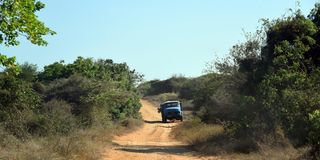
Boni Forest.
Photo credit: Kevin Odit | Nation Media Group
Then, in 2021, the national government reopened the five schools in the forest as the multi-agency Operation Amani Boni (OAB) continued across the region and towards the Kenya-Somalia border.
Launched in September 2015, the operation was intended to flush out Al-Shabaab militants believed to be hiding in the dense forest. Eleven years on, authorities say it has made significant strides, with many of the attacks and threats that once terrorised the area having been curtailed.
On Monday, during the official handover of eight Junior Secondary School classrooms and a perimeter wall to the Boni community at Kiangwe village, parents questioned why their children still cannot study closer home with the improved security.
Presently, schools in the forest operate only from Early Childhood Development and Education (ECDE) to Grade 6 because of a shortage of teachers and the facilities required for higher levels of learning. Once children reach the upper grades, they have to leave the forest for institutions in safer areas, including Kiunga in Lamu East and Mokowe Arid Zone School in Lamu West.
Mr Yusuf Nuri, a parent and retired administrator in Boni Forest, believes that the establishment of such institutions closer could transform the community's education prospects while helping address early pregnancies and school dropouts.
According to him, having the schools within the area would also help remove the minority community from the margins and give its children a fairer chance at securing their future. Mr Nuri says many parents cannot afford the more than Sh6,000 needed to transport their children to the schools far away from home.
“Now that we have these new, fully furnished Junior Secondary classrooms with a perimeter wall here in Kiangwe, I don’t see why we shouldn’t have a full-boarding institution so that children from across Boni Forest can be accommodated here to learn,” he says.
Security officers on patrol inside Boni Forest in late March 2018.
Photo credit: File| Nation Media Group
Ms Tima Shidho, a Kiangwe resident, said a local boarding Junior and Senior Secondary School would bring peace of mind. This is because families in Boni have for years carried economic, security and emotional burdens associated with the lack of secondary schools within their communities.
“As parents, we will no longer have to worry about the daily physical dangers of wild animals and security threats in the forest corridor, traversing while ferrying our children to secure places in Mokowe or Kiunga,” she said.
On her part, Ms Fatuma Ware, a resident of Basuba, sees the proposed schools as a way of keeping families together. She says children should not have to be separated from their parents simply because there are no institutions nearby where they can continue their education.
“Let the plan be fast-tracked. It will enable us to escape that heartbreaking choice of sending our young, vulnerable children to far-flung boarding centres like Mokowe Arid Zone or Kiunga,” Ms Ware added.
According to her, having the children closer would provide reassurance that they are growing up and learning in a safe and structured environment within their own community, rather than being isolated from their families by distance.
The push has received backing from Lamu East MP Ruweida Obbo, who says a full boarding school in Boni Forest would give parents a renewed sense of inclusion and allow their children to compete academically with learners elsewhere in the country.
She noted that the first step has already been taken with the construction of the Kiangwe JSS classrooms. The project was funded by the Lamu East National Government Constituency Development Fund (NG-CDF) in coordination with donors, including the Kenya Defence Forces (KDF) and Deris Wanaag, a project aimed at promoting peace and stability and strengthening social and economic dynamics in the Kenya-Somalia border areas.
Boni-Dondori forest in Lamu.
Photo credit: Evans Habil | Nation Media Group
“It’s clear that most parents here are unable to fund their children’s travel, either to Kiunga or the Mokowe Arid Zone schools. Having the institutions in Boni Forest will relieve the parents of such a burden,” she says.
Lamu County Director for Peacebuilding Shee Kupi described the Kiangwe school as an investment in the future and peace of the Boni Forest community, where residents have for years faced displacement and significant barriers to consistent and dignified education.
The facility, he says, could become a turning point for children who have been held back by circumstances beyond their control, giving them an opportunity to learn, grow and dream.
Lamu County Commissioner Stephen Sangolo confirmed that the security situation in Boni Forest has improved considerably, with only a few Al-Shabaab threats reported in recent years. He, however, added that the area is “not out of the woods yet”, with isolated threats continuing to occur in some places.
Mr Sangolo said the government is working with the Ministry of Education to conduct an assessment that will determine whether conditions are suitable for establishing the boarding learning institutions proposed. Among the issues to be considered is whether the schools will have sufficient numbers of learners to remain viable, noting that the area generally has few learners.
He, however, supported the push, noting that it will help the state to easily mop up school dropouts within Boni Forest and facilitate the 100 per cent transition.