About 3.5 kilometres from Machakos Town, off Kangundo Road, stands a market that was once billed as a game-changer for traders in the region.
Today, Mavivye Wholesale Market is a ghost of that promise — overgrown with thickets, silent and largely abandoned.
Built on a two-acre parcel using millions of shillings in public and donor funding, including support from the World Bank, the market was meant to decongest Machakos Town and decentralise economic activity. Instead, it has become a symbol of stalled development.
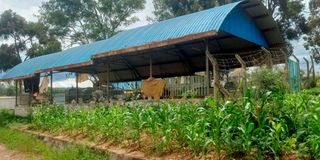
Sections of the market are now covered in weeds, while some residents have turned the idle land into small-scale farms, planting crops where traders were once expected to do business.
Abandoned sheds at Mavivye Wholesale Market, which was funded with support from World Bank. Residents have converted the idle land into small-scale farms, planting crops where traders once conducted brisk business.
Photo credit: Benson Matheka| Nation Media Group
Its empty sheds, overgrown pathways and quiet surroundings tell the story of a project undone not by lack of resources, but by decisions that failed to prioritise long-term impact.
“It is painful to see such a facility go to waste. This place used to be very busy. Today it is quiet and people have turned to farming just to survive,” says David Mutombi, a resident who lives near the market.
“When it was operational, biashara ilikuwa juu (business was booming). Now everything is down,” he says.
A project that briefly revived a town
Commissioned in 2016, the market quickly transformed Mavivye from what local leaders once described as a “dead town” into a vibrant commercial hub.
Traders moved in, transporters found steady work and businesses such as hotels and shops emerged to serve the growing population.
According to debates in the Machakos County Assembly, the impact was immediate.
“I remember when I used to pass through Mavivye and the roads were rough and it was a dead town,” said nominated MCA Justus Katumo during a 2021 debate. “When I visited there last year, that town was booming and there was a lot of business and a lot of life.”
In 2021, wholesale traders were relocated back to Machakos Town in a move that sparked outrage among residents and leaders.
Critics argued the decision was made without adequate public participation and was influenced by political considerations.
A petition presented to the county assembly reflected the anger among residents, who said the relocation had devastated livelihoods.
“The petitioners draw the attention of the County Assembly on the matter of removal of the wholesale market from Mavivye Market, which has negatively impacted Machakos Central Ward,” read part of the petition.
Residents called for the return of the wholesale market, the creation of a livestock section and construction of a slaughterhouse to support expanded trade.
“We even suggested a livestock market because it is lucrative, just to save the multi-million project from total collapse,” said Mulomba Mumina, chairperson of the market committee.
Inside the assembly, MCAs openly criticised the relocation.
Former Machakos Central Ward MCA Peter Mutiso said he helped conceptualise the market and described the transfer as a political miscalculation.
“When the traders were transferred to that area, development was coming up,” he said. “However, during the campaign period of the Machakos senatorial by-election, that is when our governor transferred those people back to the CBD. It was done politically.”
His successor, Nicholas Nzioka, known as Wangondi, later urged traders to remain in the central market until full public participation could be conducted.
“We did not come here for politics. We came here to listen to you and we have heard you. I can assure you an amicable solution would be reached,” he said.
Efforts by the county government to revive Mavivye have repeatedly been rejected by traders who prefer operating in the central business district.
In a notice dated August 27, 2024, county director of markets Charles Mutua ordered traders to return to Mavivye, but the directive was resisted.
Abandoned sheds at Mavivye Wholesale Market, which was funded with support from World Bank. Residents have converted the idle land into small-scale farms, planting crops where traders once conducted brisk business.
Photo credit: Benson Matheka| Nation Media Group
Transport operators, including boda boda riders and handcart pushers who ferried goods between Mavivye and Machakos Town, lost income. Businesses that had grown around the market also shut down.
“Those working between Mavivye market and the retailers, and the mkokoteni operators who used to move produce, lost jobs,” said Wamunyu Ward MCA Thomas Mutinda during assembly debates.
“When it was closed, they stopped earning.”
At the same time, Machakos Town began to experience renewed congestion.
“When you see the current situation in Machakos Town, there is traffic because both retail and wholesale markets are there,” Mutinda said. “To decongest this town, it is important that the market is returned to Mavivye.”
Kathiani MCA Dominic Ndambuki said the market had been intended to spread development beyond the town centre.
“The major aim was to decentralise the economy and ensure other upcoming towns also get a share of the resources,” he said.
Even as Mavivye remains idle, county policy continues to emphasise structured markets as the backbone of urban trade.
A statement tabled in the Machakos County Assembly on June 25, 2024, reaffirmed restrictions on hawking in the CBD under the Machakos County Public Markets and Stalls Act, 2016.
The report stated that traders were required to operate within designated market spaces, including Mavivye.
“Traders and hawkers were informed that all trading activities within the CBD are prohibited and the only designated areas for traders in Machakos Town include Mitumba Market, Wholesale Market, Retail Market and Mavivye Market,” the report stated.
Yet despite being an officially designated trading zone, Mavivye remains largely unused, raising questions about implementation.
New projects deepen frustration
On November 14, 2025, President William Ruto praised progress at Mutituni Modern Market in Machakos, a Sh52 million facility expected to accommodate 200 traders.
“This is part of 15 such markets we are building in Machakos County, fulfilling our commitment to provide mama mboga and other small-scale traders with a dignified and secure working environment,” he said.
For residents of Mavivye, the comparison has only deepened frustration.
Attempts to revive Mavivye have continued, though progress has been slow.
On September 4, 2024, Deputy Governor Francis Mwangangi met wholesalers and the market committee to discuss operationalising the facility.
“We have managed to reach a win-win situation that benefits all parties,” he said after the meeting. “We will gazette the market days as we plan for the official opening.”
“What I would suggest is that we set two market days, so that we can accommodate both markets,” he said.
Despite those proposals, the reality on the ground remains unchanged.
Urban planning expert Michael Muambi says the Mavivye case reflects a wider challenge facing devolved governments — the need for policy consistency and alignment between political decisions and development goals.
Markets, he says, are more than trading centres. They are engines of local economies, creating jobs, attracting investment and shaping urban growth.
“Without sustained commitment, even well-funded projects can fail,” he says.