The Senate has faulted a decision by the National Treasury to freeze 50 per cent of funds to be disbursed to Meru County, warning that the move risks crippling service delivery and unfairly punishing residents over a debt dispute entangled in political commitments, legal obligations and years of failed settlement efforts.
The Senate’s Standing Committee on Finance and Budget, chaired by Mandera senator Ali Roba pushed back against the stoppage initiated in April by Treasury Cabinet Secretary John Mbadi, questioning both the timing and justification of the decision and demanding clear evidence that the county had deliberately failed to meet its obligations.
During the inquiry, senators argued that Meru County should not bear the full burden of the Sh642 million debt, particularly in light of a public commitment by President William Ruto to have the national government take over the liability, a pledge that county officials say informed their decision to halt further payments.
Kakamega senator Boni Khalwale told the committee that it would be unjust to penalize the county for relying on a presidential assurance, even as he acknowledged the absence of a formal directive.
“It would be wrong for the Senate to punish the people of Meru and deny them money for a failure which is not theirs,” he said. “The President said he would pay. The county had no reason to doubt that, but in law, that promise is not binding unless it is formally communicated.”
Nominated Senator Tabitha Mutinda questioned the role of the Controller of Budget and the National Treasury, accusing both offices of overlooking key facts, including partial payments already made by the county and ongoing negotiations involving multiple state agencies.
She also raised concerns about selective enforcement, asking why Meru had been singled out despite widespread pending bills across all counties.
“Is it because this one involves a foreign investor that Meru has been targeted,” she posed, pressing officials to explain disparities in enforcement.
At the centre of the dispute is a protracted legal battle involving Leopard Rock Mico Limited, a French-owned investment that operated a lodge on 40 acres within Meru National Park under a lease dating back to 1997, later revised in 2008 to increase rent and revenue obligations.
The conflict escalated in July 2018 when the county government terminated the lease, triggering arbitration proceedings that culminated in a December 2019 award of more than Sh337 million in favour of the investor, with interest accruing at 14 percent annually.
The award was later adopted as a High Court judgment, and with accumulated interest, the debt has since risen to about Sh642.9 million.
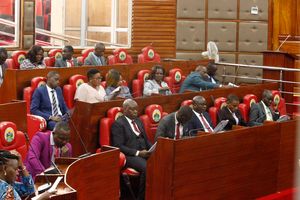
Members of Meru County Assembly follow proceedings during a past session.
Photo credit: File | Nation Media Group
Documents submitted to the Senate show that the county made partial payments amounting to Sh200 million between September 2023 and March 2025, and had incorporated the liability into its debt management framework as a contingent obligation to be settled over several financial years.
It was against this backdrop that President William Ruto, during a public address in Meru in July 2025, intervened and pledged that the national government would assume responsibility for the debt.
“The French President called me and told me that the investor comes from his country and that his property was destroyed,” he said at the time. “He went to court and he was awarded. The governor came to my office and asked me if I would step in. I want to tell you that the national government will now take over the debt. We will negotiate with the investor and we will pay him so that the people of Meru do not carry that burden.”
County officials, led by Meru Governor Isaac Mutuma told the Senate that the directive created a reasonable expectation that the liability had shifted to the national government, prompting the county assembly and executive to suspend further budgetary allocation toward the debt.
“We had made a commitment to pay back the amount but only stopped after the President intervened and said the national government will pay the debt,” he told senators.
Subsequent engagements involving the Ministry of Trade, the Attorney General’s office, and other agencies led to negotiations with the investor in July 2025, during which the national government reportedly offered Sh200 million as a settlement, taking into account the amounts already paid by the county, but the proposal was rejected by the claimant, who countered with a higher demand of Sh320 million.
Despite these efforts, the Deputy Controller of Budget Stephen Masha concluded that the county’s failure to fully settle the court-adopted award over a period exceeding six years constituted a persistent breach of the Public Finance Management Act, thereby justifying the Treasury’s decision to halt transfers.
“Our decision to agree with the Treasury was informed by the fact that, looking at the provisions of the law. From those objectives, we were gauging whether the cabinet secretary responsible for national treasury adhered by provisions of the law,” Mr Masha said.
Committee chair Ali Roba, however, questioned whether due process had been adequately followed, pointing to what he described as a disconnect between the county’s demonstrated efforts to settle the debt and the conclusion that it had failed to comply.
The Controller of Budget defended the decision, stating that the stoppage was anchored in law and limited in scope, noting that such measures are time-bound and designed to compel corrective action, even as she acknowledged that all counties carry pending bills and that disclosures largely depend on self-reporting.