Delegates at the fifth Piny Luo Festival want the Luo Council of Elders to establish a new traditional rite of passage into adulthood, following the abolition of the long-abandoned practice of removing six lower teeth.
They argue that the Luo community is now without a clearly defined ceremony to mark the transition from childhood to adulthood, and should no longer rely on borrowed practices, such as circumcision, to fulfil this vital cultural role.
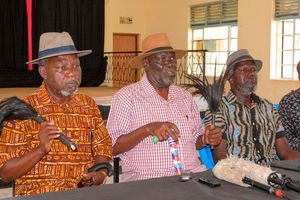
Homa Bay Senator Moses Kajwang raised pointed questions about cultural identity, particularly the absence of a recognised traditional ceremony signifying adulthood among the Luo. He called on the Luo Council of Elders to develop a new customary rite of passage, noting that the former practice of extracting six lower teeth is no longer viable.
Homa Bay Senator Moses Kajwang' (centre) at the 5th edition of the Piny Luo Festival, held at Rongo University in Migori County on December 15, 2025.
Photo credit: Alex Odhiambo | Nation
Senator Kajwang observed that the Luo lack a distinct adulthood ceremony and should not depend on traditions borrowed from other communities, including circumcision.
Drawing from his experience in Maasai land, he said initiation rites there are used to impact cultural values, responsibilities and a sense of belonging to the young.
“When I went to Maasai land, I saw them practising their tradition, circumcising boys to usher them into adulthood. They were taught what it means to be Maasai and what their traditions stand for. But when you come to Luo land, nothing is being done for our children as tradition requires,” he said.
He challenged the community to reflect more deeply on what it truly means to be Luo, questioning whether identity is defined by language, names, or a deeper understanding of culture and heritage.
“What does being Luo mean? Is it speaking the language fluently, or being named Otieno or Onyango, or is it understanding the culture and heritage?” he asked.
The senator appealed to elders to help establish a rite of passage that would ensure future generations are Luo not only by name, but by culture. The festival, he added, remains an important forum for safeguarding Luo heritage while confronting the modern challenges facing the community.
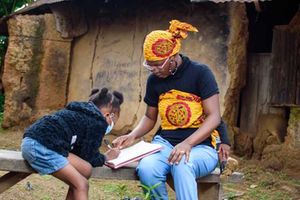
John Okumu, an elder from Kamagambo in Rongo Sub-county, recalled that traditionally, youths were grouped together after initiation and taught their responsibilities and duties.
“The girls were taught by their grandmothers, while the boys were guided by their grandfathers,” he said.
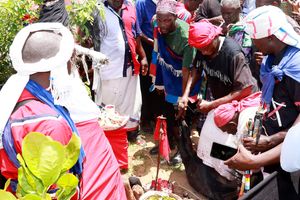
Traditional Luo dancers showcased their skills and talent at the 5th edition of the Piny Luo Festival, held at Rongo University in Migori County on December 15, 2025.
Photo credit: Alex Odhiambo | Nation
He described how, during the initiation ceremony, a sharp, pointed end of a hoe was forced between the teeth, and once the middle tooth was removed, the remaining incisors loosened. Six front teeth on the lower jaw were extracted to test the courage and endurance of both men and women.
The practice, he explained, marked the transition from childhood to adulthood for both genders. However, the removal of the six lower teeth has since been abandoned, with many families opting to circumcise male children, while girls pass through adolescence without a formal initiation ceremony.
According to Mr Okumu, the Luo adopted circumcision from neighbouring communities such as the Agikuyu and the Maasai, but the practice excludes girls, leaving a significant gap in traditional rites of passage.
The late former Prime Minister Raila Odinga reignited debate when he called on the Luo to embrace male circumcision, a practice traditionally rejected by the community. Speaking at the fourth Piny Luo Festival in Siaya early last year, Mr Odinga cited scientific evidence linking circumcision to reduced HIV transmission, referencing Uganda’s success in adopting the measure as part of its HIV/AIDS prevention strategy.
His remarks drew sharp criticism from some cultural elders, who dismissed the proposal as taboo and warned it could invite misfortune. Mr Odinga, however, maintained that breaking away from certain traditions is sometimes necessary to safeguard the health and future of the community.
The fifth edition of the Piny Luo Festival, an annual gathering of Luo speakers from around the world, will conclude today, with President William Ruto expected to grace the occasion at Rongo University in Migori County.
Since its resumption in 2021, the festival has rotated across counties within Luo land. The inaugural edition was held in Kisumu County, followed by the second and third editions in Homa Bay County. Siaya County hosted the fourth edition before this year’s event moved to Migori.
Piny Luo, loosely translated as “The Land of Luos,” brings together diverse cultural practices and traditions of the Luo community. According to Homa Bay Governor Gladys Wanga, the festival offers a crucial opportunity for reflection on culture, heritage and a shared commitment to prosperous livelihoods.
During the opening ceremony, Orange Democratic Movement party leader Oburu Oginga challenged parents to prioritise teaching their children their mother tongue before introducing foreign languages. He noted that in earlier years, mother-tongue instruction was emphasised in lower primary schools, whereas today many parents promote foreign languages in the name of civilisation.
He argued that cultural pride must begin with the basics, observing that there is little honour in speaking a foreign language fluently while being unable to speak one’s mother tongue.
“During our time, we were taught our mother tongue in the lower classes. Today, parents rush to teach their children foreign languages and call it civilisation. If we truly want to embrace our culture, we must start with the basics,” he said.
This year’s gathering has attracted participants from across Africa, including Ochieng Gideon, a Luo elder from the Pajok Community in South Sudan, who attended his first Piny Luo Festival.
“My great-grandfather left me in Pajok during the Luo migration. This is my first time seeing my brothers and sisters in Kenya. I am very happy,” said Mr Ochieng, who urged organisers to consider Pajok for the next edition.
“My wish is for the Luo of Kenya to come to Pajok in South Sudan. We are very welcoming and we have vast land,” he added.
Ker Msangia Ongati of Tanzania echoed calls for unity, urging attendees to uphold the spirit of togetherness.
Ker Odungi Randa, leader of the Luo Council of Elders, and Siaya Governor James Orengo, at the 5th edition of the Piny Luo Festival, held at Rongo University in Migori County on December 15, 2025.
Photo credit: Alex Odhiambo | Nation
The Luo Council of Elders, led by Ker Odungi Randa, also called for greater brotherhood within the community.
“In 2026, I will call a special sitting with key leaders from the community so that we can deliberate on issues affecting our people and chart the way forward,” Ker Randa said.
He added, “I will guide the Luo community until my last day on earth, and then someone will take over from me. I am still strong enough to guide the community.”