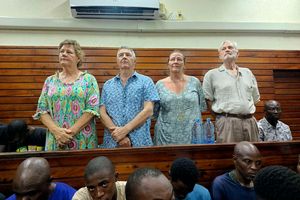
Richard John Veevers (right) and his brother Philip Veevers (left) listen attentively during the inquest into the death of their father Harry Roy Veevers at the Mombasa Law Courts on May 4, 2017.

A mortuary bill exceeding Sh2.6 million has prevented the widow and daughters of British tycoon Harry Roy Veevers, who died in Mombasa on Valentine’s Eve more than a decade ago under mysterious circumstances, from collecting his remains for reburial.
Documents seen by Nation indicate that the deceased’s daughters, Hellen Veevers and Alexandra Veevers, and his widow Azra Parvin Din, were issued with an invoice requiring them to settle millions of shillings in accrued mortuary charges before collecting the remains.
The body has been preserved at the Coast General Teaching and Referral Hospital mortuary in Mombasa since January 31, 2014. According to the invoice dated February 24, 2026 and issued to Alexandra, the charges are based on a daily storage fee of Sh600.
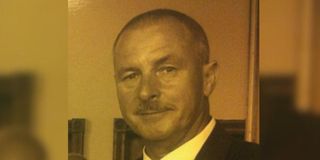
Harry Roy Veevers, 64, from Rochdale, UK died at his home in Kenya in 2013.
The bill was calculated over 4,380 days that the body has remained in the morgue, pushing the total to more than Sh2.6 million. Morgue records also indicate that the deceased was 73 years old at the time of his death.
The three have now approached the Office of the Director of Public Prosecutions requesting for intervention to have the body released without the family paying the mortuary charges.
In a letter to the ODPP, the three, through their advocate, lamented that the delay in collecting the body for burial was materially occasioned by the prosecution agency after it recommended and instituted inquest proceedings to determine the cause of death, a process that took more than a decade to conclude.
Alexandra and Hellen’s half brothers, Richard John Veevers and Philip David Veevers, had lodged a complaint with the police when their father died mysteriously and was buried in a Muslim cemetery. This prompted the exhumation of the body for pathological examination.
Subsequently, the ODPP recommended and instituted inquest proceedings to determine the cause of death, which took 12 years to conclude on August 12, 2025.
According to the three women, the delays were occasioned by judicial administrative factors, including the transfer of presiding magistrates and delays in the preparation of transcripts.
Throughout that period, they say, the deceased’s remains were preserved at the Coast General Teaching and Referral Hospital mortuary at the instance of the Directorate of Criminal Investigations and the ODPP.
“As a result of this state mandated preservation, the hospital has accrued a bill exceeding Sh2.6 million, as evidenced by the attached invoice,” they said in the letter.
Ms Alexandra Veevers gives her testimony at Mombasa Law Courts on May 3, 2017 during an inquest into the death of her father Harry Roy Veevers.
Since the prolonged preservation was not a mistake attributable to them, the family has urged the ODPP to engage with the management of the hospital to allow them to collect the body without paying the accrued charges. The facility is managed by the Mombasa County Government.
“Given that the exhumation and prolonged preservation were conducted solely for the purpose of state investigations and the subsequent inquest, which has now reached its finality, we hereby formally request your intervention to liaise with the hospital management to facilitate a full waiver of the accrued mortuary fees and authorise the immediate release of the remains to us for final rites and reburial,” they said in the letter.
However, releasing the body to Alexandra, Hellen and their mother could open a new legal battle with their half-brothers, who have also shown interest in having the remains released to them and flown to the United Kingdom for another judicial inquest at the Coroners’ Court.
Richard has stated that he has been in contact with coroners in the UK and that they have agreed to hold another inquest once Roy’s body is repatriated.
The court, in concluding the inquest, did not clarify which side of the family, between Richard and Philip on one hand and Alexandra, Hellen and their mother on the other, should collect the body for burial. It only indicated the "body to be released to the family for burial after payment of required mortuary charges".
The court noted that determining Roy’s final resting place, whether as a Christian or a Muslim, was challenging due to the absence of formal legislative provisions in Kenya to guide burial disputes.

British national Richard John Veevers walks past the remains of his father Harry Roy Veevers who was exhumed following court order obtained by the family in this picture taken on January 31, 2014.
It observed that the difficulty in determining the final resting place arose from the fact that Roy was a Briton who did not subscribe to or bind himself to any known custom, and there was no concrete evidence presented to exclude any close family member from the deceased’s legal proximity.
The complication was further compounded by the fact that no will was presented in court to show that Roy had expressed any specific wishes about how or where he should be buried. There was also no evidence of a strained relationship with any of his close family members that would justify excluding them from claiming his body.
This lack of a clear directive from the court on who should collect the body or where Roy should be buried may lead to another legal battle, since both sides of the family have expressed interest in collecting the remains for final burial.
The inquest into Roy’s death, which began in 2014, was concluded without establishing who or what killed him as he was preparing to celebrate Valentine’s Day. The court noted that the badly decomposed state of Roy’s body, coupled with conflicting findings from pathologists, the government chemist and other specialists, left the cause of death unresolved.
Follow our WhatsApp channel for breaking news updates and more stories like this.