For decades, Mohamed Salim Ahmed has gone where few others dared to venture.
He has descended into the dark waters of shipwrecks, searched for bodies in the depths of the Indian Ocean and Lake Victoria, and risked his life to rescue survivors from some of East Africa’s worst maritime disasters.
Yet, at 52, the veteran diver from Majengo, Mombasa County, wonders why a lifetime of service has not earned him any deserved recognition.
Mr Salim vividly recalls the dark, churning waters of the 1994 MV Mtongwe ferry disaster, where he courageously joined a team of divers in retrieving bodies and saving lives. The memories then shift to 1996, taking him far from the Kenyan coast to the tragic waters of Lake Victoria in Tanzania.
The father of four remembers the cold and silent depths of Lake Victoria during the MV Bukoba tragedy. He had answered the call when it mattered most, pulling souls from the brink and bringing closure to grieving families.
Today, however, the silence in his living room feels heavier than the waters he once navigated.
Mohamed Salim Ahmed
Photo credit: Pool
“I am left without any special state recognition like the Presidential awards I’ve been seeing issued to various people in the country from time to time. No medal, a certificate or a single token of formal acknowledgement for all these years I’ve put my own life on the line for the nation,” says Mr Salim.
His first major diving and rescue mission was the Mtongwe Ferry accident in Mombasa. On April 29, 1994, along the Kilindini Channel, MV Mtongwe, bound for Mombasa Island, capsized just 40 metres from the mainland pontoon, killing 272 of the 400 people on board.
“A team of 14 professional divers, including myself from Divecon International Limited, were sent to undertake joint rescue and recovery operations together with the Kenya Navy and Kenya Ferry Services (KFS) shortly after the ferry boat capsized. We did the operation, diving 28 metres deep and retrieving bodies for almost a week, day and night,” said Mr Salim.
Later that same year, while still attached to Divecon, Mr Salim was among a team hired to take part in another rescue operation after a US AC-130H Spectre gunship crashed into the Indian Ocean in the Mayungu area of Malindi.
Flames had reportedly burst from the rear of the ill-fated aircraft before it nose-dived into the ocean.
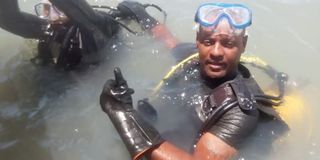
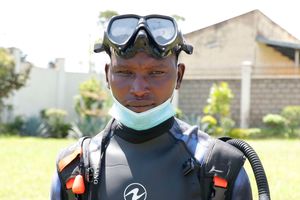
Diver Mohamed Salim Ahmed.
Photo credit: Pool
“The plane was carrying a crew of about 14. When it crashed, our company was also hired to carry out a joint rescue operation, together with the Kenya Navy. I was among the team. We undertook a nine-day operation and managed to save lives and salvage crucial items,” said Mr Salim.
The Mayungu operation further boosted his profile and eventually led to his recruitment into the Kenya Navy as a special diver.
While serving in the Kenya Navy, Mr Salim took part in yet another major rescue operation following the tragic sinking of the MV Bukoba ferry in Lake Victoria, near Mwanza, Tanzania, in May 1996.
The scale of the disaster, which claimed more than 1,000 lives, overwhelmed the Tanzanian government, forcing it to seek regional assistance. The Kenyan government and local authorities subsequently deployed divers from Mombasa to assist with the recovery efforts.
“I was among the team of experienced professional divers from Mombasa. As the Kenya Navy, we met another crew of the South African Navy and army in Mwanza. Together, we undertook the joint month-long operation to extract victims trapped inside the sunken MV Bukoba vessel,” said Mr Salim.
After the MV Bukoba operation, he left the Kenya Navy and became more involved in freelance diving.
Having already built a reputation through his involvement in delicate maritime rescue operations in Kenya and across the region, he would often receive calls from people seeking help whenever capsizing or drowning incidents occurred.
Mohamed Salim Ahmed
Photo credit: Pool
One such incident occurred on May 14, 2003, when a seven-tonne sand-carrying lorry lost control, crashed through the guard rail of Nyali Bridge in Mombasa and plunged into the Indian Ocean. The tragic incident resulted in the deaths of four pedestrians and left several others seriously injured.
“The speeding lorry was heading towards the North Coast only for it to strike multiple pedestrians before sinking into the sea. I availed myself there as a freelance diver. Together with others, we managed to dive and retrieve all four bodies spread in different locations,” said Mr Salim.
As a volunteer diver, his hard work, zeal and determination caught the attention of the Mombasa Municipal Council administration under the then mayor, Ahmed Abubakar Mohdhar.
In 2010, Mr Salim was formally absorbed into the municipality and employed on a permanent basis as the lead diver of the Mombasa Municipality Rescue Team.
Former Mombasa Mayor Ahmed Abubakar Mohdhar, who confirmed recruiting Mr Salim, said he sent him to lead various rescue and recovery missions in Mombasa, Lamu, Kwale, Zanzibar, Madagascar, Tanzania and other locations.
“He is a dedicated diver who loves his job. He has participated in key rescue missions. I had to incorporate him in my team of divers while serving as Mombasa Mayor between 2009 and 2012 when I left office to pave the way for the devolution system of governance,” said Mr Mohdhar.
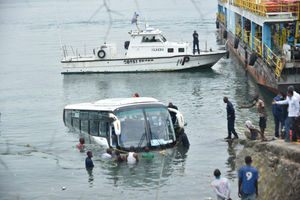
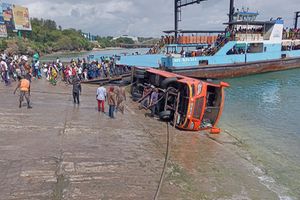
Mr Salim’s skills were tested once again during the tragic ordeal involving Mariam Kighenda and her daughter Amanda Mutheu at the Likoni Crossing Channel in Mombasa on September 29, 2019.
Mohamed Ahmed Salim (centre) trains divers in Mombasa.
Photo credit: Pool
He took part in the 13-day recovery mission before teams finally pulled the submerged vehicle and the bodies of the mother and child from the ocean seabed on October 11, 2019.
His most vivid rescue operation is the MV Bukoba disaster in Tanzania, which he cited as the worst mission he had ever taken part in. According to him, the tragedy was characterised by severe overcrowding and highly traumatic body recovery operations.
He said, unlike the MV Mtongwe ferry and other vessels, the MV Bukoba had first, second and third-class compartments.
“The rescue and recovery efforts there were heavily complicated. We risked our own lives in the water. It required very specialised equipment, and the depth was too much. As divers, we had to cut through the ship’s metal hull to reach victims to free bodies,” said Mr Salim.
Despite the dangers he faced and the years he spent responding to disasters without much recognition, Mr Salim says he remains proud of his service. He said his purpose had always been to make a difference and do the right thing for the people he served.
Mohamed Ahmed Salim (centre) trains divers in Mombasa
Photo credit: Pool
“I know I deserve formal state recognition, but what should I do if it doesn’t come? I am still proud that the work itself that I’ve done so far for all the years remains my greatest reward,” said Mr Salim.
He added, “Right now, I am focusing on what I can control, continuing to deliver high-quality results, and exploring where my skills can make the biggest impact moving forward.”
Mr Andrew Mwangura, an analyst and specialist in maritime governance and the blue economy, said Sessional Paper No 10 of 1965, which focused almost exclusively on land, agriculture and urban industrial growth to spur Kenya’s Gross Domestic Product (GDP), was partly to blame for the state’s failure to adequately prioritise the ocean.
Mr Mwangura said that, apart from Mr Salim, many other individuals had over the years contributed significantly to the ocean economy, built valuable expertise and achieved results that were genuinely worthy of state recognition.
“There are no medals, no ceremonies of special recognition, and no certificates of honour hanging on their walls. I wonder why, with such extraordinary services to humanity, including risking their own lives while rescuing others and salvaging property in the ocean, has continued to be cast aside by the very authorities who relied on their bravery during the darkest hours,” said Mr Mwangura.
Mohamed Ahmed Salim (centre) undertaking training of divers in Mombasa
Photo credit: Pool
He urged the National Heroes Council and the State Department for Blue Economy to consider and prioritise honouring local champions who have significantly contributed to Kenya’s maritime sector and ocean wealth.
Mr Salim was born in Majengo, Mvita Constituency. He is the second-born in a family of seven.
While in Form Four at Tudor Secondary School, he developed an interest in diving, which led to his enrolment in scuba-diving classes offered by German tourists at Mombasa’s Nyali Barracuda Diving School.
After completing his secondary education, Mr Salim ventured into sports diving and later commercial diving. He holds a certificate in Maritime Search and Rescue (SAR) and Training of Trainers (ToT) from Bandari Maritime Academy in Mombasa.