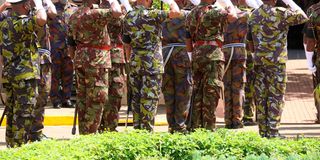
Twenty-five former Kenya Defence Force soldiers who were sentenced to life imprisonment for desertion of duty have been acquitted, bringing to an end a long-running legal battle that has exposed serious questions about the application of military law.
The soldiers, who were convicted by the Court Martial sitting at Mtongwe Naval Base, Mombasa, have been battling the case since 2014.
The High Court has now quashed the desertion convictions and life sentences, clearing the former Kenya Navy officers of the charges and bringing the proceedings to an end.
“The conviction of each appellant for desertion contrary to the Kenya Defence Forces Act is hereby quashed and set aside. The sentence of life imprisonment imposed upon each of them is hereby quashed and set aside,” the High Court said in the judgment issued on September 22.
The court declined to enter any substituted conviction for absence without leave or any other offence. The court also declined to order a retrial in respect of any of the 25 former Kenya Navy officers.
“Each of the soldiers is accordingly acquitted of the charge upon which he was convicted. The proceedings are accordingly brought to an end and the file closed. Any bond, bail or other order for release previously subsisting in these appeals is hereby discharged,” the judge said. The acquittal followed the identification of several legal and procedural defects in the prosecution, including questions surrounding the authority under which the soldiers were prosecuted. The prosecution was undertaken through an office whose statutory separation from the legal department, expressly required by Section 213(6) of the Kenya Defence Forces Act, had not been maintained. The defect went beyond a procedural irregularity, touching on the legality of the prosecutorial authority itself. The court also found that the law under which the former soldiers were prosecuted raised a separate problem. The conduct forming the basis of the charges occurred in 2007 and 2008, when the Armed Forces Act was in force. By the time the Kenya Defence Forces Act came into operation, the 90-day periods of absence relied upon in the desertion charges had already crystallised under the earlier law. “The 90-day periods of absence had crystallised under that law long before the Kenya Defence Forces Act came into force. The transitional provisions did not authorise retrospective imposition of the penal consequences of the later Act,” the court noted.
Some of the 25 ex-soldiers who had been sentenced to life by the court-martial for desertion follow proceedings at the High Court in Mombasa on August 21, 2015.
Photo credit: File | Nation
The legal difficulty was significant because the former soldiers had been charged and sentenced under a regime that exposed them to life imprisonment. Yet the evidence did not establish that they were on active service or had been placed under orders for active service at the material time. According to the High Court, the sentence therefore had no lawful foundation. The judgment further examined the circumstances surrounding the soldiers’ attempts to leave military service, drawing a distinction between applying for discharge and actually being discharged. The servicemen remained subject to service until formally discharged. But that status did not remove the obligation on the Court Martial to examine the evidence surrounding their applications and the steps they took in seeking to leave the service. “That, however, did not relieve the Court Martial of the duty to consider the evidence of applications, clearance, surrender of stores, refusals and unanswered requests when determining the criminal case,” the court noted The question of what constituted desertion also required more than establishing that a serviceman had been absent for 90 days. The court observed that although the 90-day mode of desertion did not require proof that every form of desertion was accompanied by an intention permanently to remain absent, the offence could not be treated as pure criminal liability without considering the mental element and the totality of the evidence. The prosecution therefore retained the burden of proving the offence beyond reasonable doubt. Another major concern was the extraordinary period between the soldiers’ alleged departures and their eventual arrests. The delay was inadequately explained and, the court found, had constitutional consequences for the former soldiers, whose ability to answer allegations dating back to 2007 and 2008 had inevitably been affected. Read: Espionage, betrayal, and murder: The untold story of East Africa’s most lethal women
The delay violated Article 50(2)(e) and materially affected the ability of the appellants to meet the historical allegations. The prolonged period of pre-trial detention raised a further rights issue. According to the High Court, the detention was not satisfactorily justified in accordance with the statutory safeguards and amounted to a violation of the soldiers’ rights. The Court Martial’s determination of the case was also found wanting. The High Court did not fault the military court simply because its finding was brief or because it did not follow the format of a judgment delivered by a civil court. The more fundamental problem was that the finding did not demonstrate that the material issues, evidence and defences had been considered and determined. The judgment also examined the former soldiers’ complaint that other service members had received discriminatory treatment. That complaint was not satisfactorily addressed in the Court Martial finding and became part of the wider challenge concerning the fairness and consistency of the prosecution. The various defects, viewed together, ultimately undermined the safety of the convictions. “These matters, considered individually and cumulatively, lead to the conclusion that the convictions are unsafe,” said the judge.
The judgment also drew a clear distinction between maintaining discipline in the military and securing criminal convictions through lawful means.
The court acknowledged that prolonged absence from duty undermines military discipline but said the seriousness of such conduct could not override the legal and constitutional safeguards governing criminal trials.
The life sentences, rather than justifying the convictions, made it even more important for the prosecution to establish the correct legal basis for the punishment. The court stressed that military discipline must operate alongside constitutional compliance, including within the command and prosecutorial structures. The judgment also urged the military justice system to learn from the historical case and ensure future prosecutions are handled expeditiously, fairly and strictly within the law, noting that this serves not only accused servicemen but also the KDF, the justice system and the national interest.
The rehearing pitted two fundamentally different accounts of the soldiers’ departure from the military against each other. The former servicemen argued that they had effectively left the military before travelling to the Middle East and therefore could not lawfully be prosecuted as serving members under military law.
They maintained that their alleged offences occurred in 2007 and 2008, yet they were convicted under the Kenya Defence Forces Act enacted in 2012. They also argued that Kenya was not at war when they left and that they had submitted resignation letters before leaving the service. The state accused them of deserting duties and taking up work with private American security companies in countries including Afghanistan, Iraq, Kuwait, Syria and Jordan. The State took the opposite position, insisting that the soldiers had never been formally discharged and therefore remained subject to military law. Their prolonged absence, it argued, exceeded the 90-day threshold for desertion. Most of the former servicemen were not commissioned officers and could not, in law, resign from service.
The prosecution also defended the validity of the charges, rejecting the soldiers’ argument that the Director of Military Prosecutions (DMP) had to personally prepare or endorse them. Senior Assistant Director of Public Prosecution Jami Yamina argued that military law permits investigators and unit commanders to initiate charges and transmit them through the chain of command. “The law does not require the DMP to endorse charges for them to be lawful,” the prosecution stated. The State further maintained that the soldiers’ departure exposed the country to serious security risks and that the convictions by the Court Martial were lawful. The rehearing itself followed a 2024 Court of Appeal decision which nullified an earlier High Court judgment acquitting the soldiers. The appellate court found that the High Court had failed to deliver separate judgments in each of the 25 appeals and had not independently re-evaluated the evidence in reaching its conclusions.