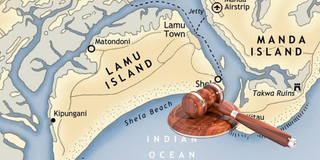
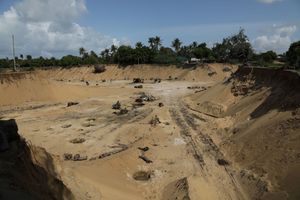
For years, the Abdalla family believed they had a straightforward claim to a large piece of land on Lamu Island.
They had a title deed issued in 1995, an official search confirming their ownership and witnesses who said five people had put up structures on the property.
But when the family went to court seeking the eviction of the alleged trespassers, the case turned on a surprisingly simple question: Were the structures actually inside the boundaries of their land?
The Environment and Land Court in Malindi has ruled that the family failed to prove this crucial point.
Justice Mwangi Njoroge dismissed the family's case, saying that while the plaintiffs had demonstrated ownership of land, they had not established that the five accused persons had encroached on the parcel.
“The question is whether the plaintiffs have established that the defendants are in wrongful or illegal occupation of the suit property,” the judge said in a ruling delivered on October 5.
The dispute involved Omar Abdalla Mohamed, Fatma Abdalla Mohamed, Aisha Abdalla Mohamed, Asma Abdalla Mohamed, Rehema Abdalla Mohamed, Athman Abdalla Mohamed, Mohamed Abdalla Mohamed, Jahi Abdalla Mohamed, Khadija Abdalla Mohamed, Amina Abdalla Mohamed and Shekha Abdalla Mohamed as plaintiffs.
They sued Ali Galole Dima, Omar Dhidha, Salim Said, Athman Bily and Lali Mohamed Lali.
The family told the court that it was the registered owner of the approximately 3.6-hectare parcel on Lamu Island and had been entitled to peaceful possession of the property.
According to their case, the defendants entered the land, erected structures, denied them access and interfered with their enjoyment of the property.
They wanted the court to declare them the lawful owners, order the defendants to leave permanently and award damages for trespass.
The defendants, however, denied occupying the land.
They claimed that Lamu residents regarded the area as public land and said squatters had occupied it for more than 15 years.
The court said the burden remained on the plaintiffs to prove that the alleged trespass had actually occurred on the land covered by their title.
Abdulrahman Abdullahi Omar testified that the plaintiffs were registered owners and that the defendants had interfered with the property for years.
He said they had cut trees belonging to his grandfather, built temporary structures and occupied the land.
Another witness told the court how one of the defendants had introduced him to the property in 2017, claiming it was government land and allowing him to occupy part of it.
The witness said that after the family produced its title deed, the defendant described the document as fake.
The family also called Mohamed Athman, who told the court that the defendants' houses were on the disputed land.
Village elder Bashir Korio Abdi confirmed that the defendants lived in the area and came from his jurisdiction.
The title deed showed that the property had been registered in the plaintiffs' names on December 18, 1995, at the Mombasa District Lands Registry.
An official search dated October 13, 2025, also supported their ownership.
However, ownership was not the only issue before the court.
The family had to establish that the alleged trespassers were physically occupying the specific parcel covered by their title.
“In this court’s view, the manner in which the plaintiffs could have proved that the defendants were in occupation of the suit property should have transcended production of mere photographs,” Justice Njoroge said.
Specifically, it should have produced a map demonstrating that each accused person's structure fell within those boundaries.
“The plaintiffs should have introduced by way of expert evidence a map of the suit property to demonstrate the boundaries thereof and that the structures of the defendants, one by one, were inside those boundaries,” the judge said.
That evidence, he added, was not presented.
The court noted that Lamu is expansive and that simply showing photographs of houses or identifying people who lived in the area did not conclusively establish that those houses stood on the plaintiffs' registered parcel.
Though the family had successfully demonstrated that it owned the land, the court was not satisfied that it had demonstrated that the defendants had encroached on it.
“That having not been done, this court is of the view that the plaintiffs have not demonstrated that the defendants have encroached on the suit land,” the judge ruled.
A title deed can establish a person's ownership of registered land. But when the owner asks the court to evict people for trespass, the court must also be satisfied that the alleged occupants are actually on that particular piece of land.