The Nairobi River, once a lifeline weaving through the capital, has become a scar of neglect and pollution.
What was once a free-flowing stream is now choked with raw sewage, factory effluent and plastic waste—its black waters a stark reminder of Nairobi’s broken waste systems and the uneasy coexistence between urban life and nature.
Beneath the Outering Road bridge, the desperation is impossible to ignore.
Here, street children comb through mounds of bottles and wrappers searching for anything of value. Others curl up on makeshift bedding, staring blankly at the polluted waters.
For decades, successive governments have launched clean-up drives that produced more press statements than results.
But in Mukuru kwa Njenga one of the city’s largest informal settlements, the tide may finally be turning.
Here, the National Youth Service (NYS) has been deployed to lead what is being described as Nairobi’s most ambitious clean-up yet. Thousands of young recruits, under the Climate Worx programme, swarm the riverbanks in rubber boots and gloves.
Nairobi County workers clean up a section of Nairobi River on May 15, 2019. PHOTO | COLLINS OMULO | NATION MEDIA GROUP
They squat on embankments, scoop out plastic bags and heave them into large sacks. The sacks are then tossed into waiting lorries bound for Dandora dumpsite.
“The garbage is collected by two or more trucks each day.Our teams work in shifts, two weeks at a time, both in the river and on the banks. It is continuous,,” explained an NYS officer supervising the operation.
In Mukuru, once-impassable piles of waste have been cleared to reveal water flowing again.
Before the clean-up began, however, the government ordered demolitions of buildings that had encroached dangerously close to the river.
Bulldozers flattened homes and businesses, displacing families and leaving ruins scattered across the banks—mangled iron sheets, splintered timber and household belongings half-buried in the mud.
“The excavator came and pulled down houses right here. Luckily, my store survived. But the memories of what people lost are still fresh,” he says.
Members of Komb Green Solutions clean up a section of Nairobi River in Korogocho, Nairobi, on October 10, 2024.
Photo credit: Wilfred Nyangaresi | Nation Media Group
“Before, you couldn’t even see the water—it was completely buried under garbage. Now, at least the river flows. But dumping continues.”
Even as he speaks, a boy trudges by, sack in hand and empties its contents into the river. The cycle continues.
“When we clear this litter today, people dump more at night. The next morning, we start over. It’s the same battle every day,” said a frustrated supervisor.
But without proper waste management infrastructure for Nairobi’s informal settlements—and without a cultural shift in how residents handle garbage—the clean-up risks becoming only a temporary fix.
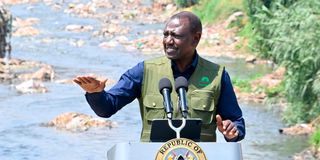
The Nairobi Rivers Commission chaired by Brigadier (Rtd) Joseph Muracia, is spearheading a regeneration plan that stretches beyond clean-ups.
“The government has realised that routine exercises are not sustainable,” he said during an inspection tour. “We are addressing the root causes of pollution so that we will have a regenerated, sustainable river system in the future.”
According to the National Environment Management Authority (NEMA), the plan includes rehabilitating riparian areas and building social amenities to support restoration and beautification.
At its heart is a massive investment in sewerage and drainage. More than 60 kilometres of new sewer lines will be laid, designed to serve the city for the next half century. The Kariobangi Treatment Plant will also be expanded to handle 60,000 cubic metres daily—enough to absorb much of the city’s waste.
But regeneration goes further: stabilising riverbanks, widening and deepening the river to prevent floods, and carving out walkways and cycling lanes along riparian corridors. These areas, once choked by waste and illegal structures, are envisioned as vibrant public spaces where Nairobians can gather, walk, and ride safely. Forty new bridges—pedestrian and vehicular—are planned to connect communities on either side of the river.
A boy jumps over polluted Nairobi River at Kibera, Nairobi, on August 2, 2020.
Photo credit: Sila Kiplagat | Nation Media Group
Aligned with the government’s 15-billion tree initiative, more than 800,000 seedlings are already prepared for planting along the riverbanks. Social and affordable housing projects are also planned for riparian land, complete with markets, sewer systems, and landscaped gardens.
At the centre of this effort is the Climate Worx programme, launched in October 2024. In Nairobi County alone, 40,000 youths have been employed to clean and patrol rivers.
“This uplifts economic empowerment, keeps young people engaged, and ensures community ownership,” the commission's chairperson said.
The recruits also receive training under the government’s TVET programme, with plans to award them formal certification.
For many young people, the initiative has brought dignity as well as income. “We are protecting our environment and also feeding our families,” said one worker in Mukuru. “It is hard work, but we are proud.”
Still, challenges remain. The Dandora dumpsite is stretched to capacity. Illegal dumping persists, often at night. Floods complicate progress, displacing thousands who later return to risky riverbank settlements.
A man looks at the polluted Nairobi River.
Photo credit: File | Nation
Contractors, supported by the Ministry of Defence, are working simultaneously along different five-kilometre stretches of the river’s 27-kilometre priority section.
“We believe we are up to the task,” Muracia said. “Within the next four to five months, we will begin to measure real progress.”
Today, the Nairobi River hangs between two futures: destruction and renewal. Each sack of waste collected is a step toward revival, yet every fresh load dumped under the cover of night pulls it back toward ruin.
For residents like Muthoka, the river’s fate is a daily reminder of Nairobi’s contradictions.
“It’s cleaner than it used to be,” he admits. “But unless people change, the work will never end.”
For now, the river remains suspended between hope and abandonment—a test of whether a city can finally repair its relationship with nature.