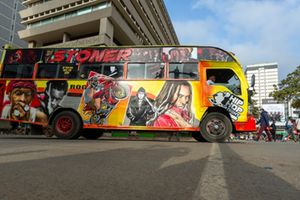
The daring stunts, booming music, colourful graffiti and celebrity status that have transformed Nairobi's nganya culture into a youth phenomenon are once again under scrutiny after a deadly crash along Enterprise Road left five people dead and at least 12 others seriously injured.
The accident, involving a heavily customised 33-seater matatu, has reignited a long-running debate over where artistic expression ends and recklessness begins in Kenya's public transport sector.
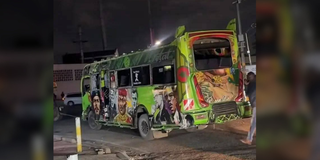
On Wednesday night, the matatu overturned while reportedly performing dangerous driving manoeuvres known in the industry as Nyoka Nyoka , Manyoka and twerking along Enterprise Road in Nairobi's Industrial Area.
How dangerous 'manyoka' matatu stunt left five people dead, many injured
Three conductors and two passengers died in the crash, while scores of others sustained injuries. The tragedy has left grieving families demanding accountability and renewed questions about a subculture that has increasingly blurred the line between entertainment and public transport.
His father, Samuel Maina, said he received the devastating call shortly before midnight.
“I was informed around 11pm that my son had been involved in a grisly road accident. Now he is dead. His body has been crushed beyond recognition,” he said.
“These stunts happen every day in the presence of police officers. The authorities have watched this culture grow without taking meaningful action,” he said.
Videos shared online hours before the accident showed the ill-fated matatu weaving through traffic while performing the same manoeuvres that have made some nganyas social media sensations. Other footage captured rescue workers pulling victims from the twisted wreckage after the vehicle rolled over.
The crash also claimed the life of Charles Wahome, a 32-year-old employee at Huduma Centre who was heading home after work.
“My brother was just going back home from work. What was supposed to be a normal journey ended in his death,” said his sister, Wanjiru Chege.
Wahome's brother, Michael Njoroge, who works in the matatu industry, said the crash was directly linked to the increasingly popular Manyoka stunt.
“The vehicle attempted the manoeuvre at the first roundabout near DT Dobie and survived. It tried again at the second roundabout and that is where it lost balance and rolled,” he said.
Mr Njoroge, who works in the Matatu sector, explained what “twerking and Nyoka nyoka” means in the Nganya culture. Twerking involves aggressively rocking the vehicle while maintaining contact with the road. Nyoka Nyoka , however, is far more dangerous because one side of the vehicle is deliberately lifted off the road surface to force it to lean one side before quickly regaining its balance. True to this stunt’s name, these nganyas do not move on a straight line; like snakes, they slither, and dangerously so.
“That is why it easily overturns. Once a vehicle loses balance, there is very little chance of recovering control,” Mr Njoroge said.
Ms Chege accused the driver, identified as Sam, of irresponsible behaviour.
“I know him. He was drunk. Even after the accident, he posted on Facebook from his hospital bed describing himself as a champion, yet families are mourning.”
Holding back tears, she described her brother as the family's brightest hope.
“Charles was the only graduate in our family. He had not even started his own family. Our mother is devastated.”
Makadara Sub-County Police Commander Judith Nyongesa confirmed the deaths and said investigations were ongoing. The vehicle has been detained at the station's accident yard pending further inquiries.
Nganya culture under scrutiny
While the immediate focus remains on the crash, the tragedy comes at a time when the future of Nairobi's nganya culture has become the subject of intense legal and political debate.
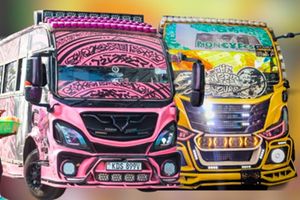
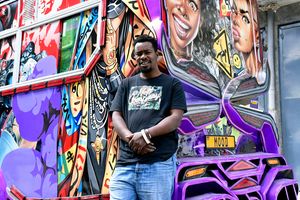
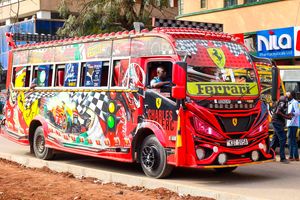
For decades, Nairobi's customised matatus have been more than just public transport. Covered in elaborate graffiti, fitted with expensive sound systems and flashing neon lights, they have evolved into moving art galleries and symbols of youth identity.
A public service vehicle (PSV) that was deemed to be crème de le crème during its time.
Photo credit: File | Nation Media Group
Routes serving Embakasi, Umoja, Kayole, Komarock, Rongai and Kasarani have become particularly famous for the culture, attracting thousands of young passengers who often choose vehicles based on branding and entertainment value rather than convenience.
The industry has also created jobs for artists, electricians, fabricators, DJs, marketers, photographers and social media influencers, forming a multi-million-shilling ecosystem around public transport.
On May 22, the President directed the National Transport and Safety Authority (NTSA) to allow matatu operators to continue using graffiti and artwork on public service vehicles.
Speaking from State House, Mombasa, President Ruto said artistic expression had become an important part of Kenya's transport culture.
“Recognising the important role of creativity and self-expression within our transport culture, I have directed NTSA to facilitate an enabling environment for matatu operators to continue utilising artwork and graffiti on their vehicles,” he said.
Public service vehicles on the streets of Nairobi on July 24, 2025.
Photo credit: Bonface Bogita | Nation Media Group
The directive came weeks after the High Court dismissed a petition challenging NTSA regulations governing graffiti, tinted windows and decorative lighting on public service vehicles.
The court upheld NTSA's position that the regulations were necessary to promote road safety and ensure visibility standards.
The ruling was welcomed by road safety advocates who have long argued that excessive modifications can obstruct visibility, distract drivers and compromise passenger safety.
However, operators insist the debate should distinguish between artistic modifications and dangerous conduct on the road.
On May 10, matatu operators, drivers, conductors and youth representatives met in Nairobi and resolved to challenge the government's crackdown through dialogue and the courts.
The group warned that aggressive enforcement against graffiti-covered nganyas threatened thousands of jobs supported by the industry.
“We support safety and order in the PSV sector. What we oppose is the criminalisation of artistic expression and livelihoods that have grown around this industry,” Matatu Owners Association Lawyer Outa Malela, said.
Industry leaders have argued that the real issue is not graffiti or artwork but the failure to target reckless behaviour.
That distinction is important because the Enterprise Road tragedy was not caused by colourful paintwork, expensive speakers or creative branding. It was allegedly caused by dangerous driving and a culture that rewards risk-taking for social media attention and street credibility.
The phrase painted on the crashed matatu — “Rebel Babies” — captured much of that mindset. Nganya operators have cultivated an image of defiance, presenting themselves as untouchable and beyond the reach of traffic laws.
The culture is often amplified by large crews of touts - at times more than ten who hang from doors, windows and even rooftops while encouraging drivers to perform stunts before cheering crowds and smartphone cameras.
The early Public Service Vehicle (PSV) that were presented early on November 24, 2013 during the 2013 Nganya Awards that takes place annually to reward the most safe, comfortable and convenient vehicle . Owners of long distance public service buses that operate at night will now have to seek fresh permits following the gazettement of new rules last week. The National Transport and Safety Authority will issue new licences to the operators. PHOTO | DENISH OCHIENG
Other road users frequently become unwilling participants, forced to brake suddenly, swerve or leave the road to avoid collisions.
Artistic expression and transport safety can coexist. What cannot coexist, though, is a public transport system where passengers are routinely exposed to life-threatening stunts in pursuit of fame.
Even as operators continue to defend the creative elements of nganya culture, the deaths on Enterprise Road demand stricter enforcement against reckless driving.
For families mourning loved ones at Nairobi Funeral Home, however, the policy arguments offer little comfort. Their concern is not whether matatus should carry graffiti or flashing lights; their concern is that five people boarded a vehicle expecting to arrive home safely and never did.
And as investigators piece together what happened on Enterprise Road, the crash remains a reminder that while Nairobi's nganya culture may be celebrated for its creativity, it must also confront the deadly consequences of the recklessness that too often accompanies it.