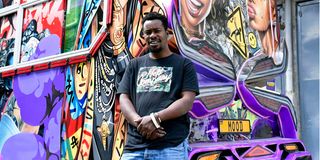
Mike Oby, a graffiti artist in Nairobi, has been painting matatus or nganyas for 10 years.
The 39-year-old works with a team. On a good day, he says, a senior designer earns Sh50,000 to Sh60,000 while a junior artist takes home Sh10,000 to Sh20,000, just from transforming bare matatus into moving galleries.
“It means the artists and designers who do the enhancements, the body kits and all the work, will be jobless,” he says.
Mike Oby is a seasoned design expert who has been a part of the matatu design industry for over a decade.
Photo credit: Francis Nderitu | Nation Media Group
Oby says transforming one matatu sustains many Kenyans – from mechanics who fix or add bumpers and side steps, painters, electricians, upholsterers to designers.
Five to 10 people prepare the matatu surface for painting. Then five to six artists arrive to do decorative work.
A lighting specialist is next, followed by the person who installs sound and entertainment systems.
After all that, conductors, relievers and drivers take over when the nganya hits the road.
“For one matatu, we require a team of about 50,” Oby says.
It is not only the graffiti artists that will lose jobs following the ruling on the National Transport and Safety Authority (NTSA) directive.
Some paint and lighting fixture sellers say they offered credit to artists in the hope that once the owners of the matatus cleared payment, they would get their money.
Oby says many clients have put projects on hold. He adds that the ban unfairly targets matatus “since it is not the art that leads to road accidents”.
“If a matatu hits another vehicle, it is not because of the art. It is the driver who should be investigated,” he says.
Babel Gody, 31, a graffiti designer on Kangundo Road, says a painted matatu is not just decoration, but part of Nairobi’s culture.
According to him, the ban puts at risk a unique urban transport culture. He says matatus known for colourful graffiti, neon lights, tinted windows, customised interiors and loud entertainment, give the city its distinctive street character.
“A painting on a matatu gives it an identity,” he says.
Mike Oby next to his artistic work on a matatu at a garage on Lunga Lunga Road, Nairobi on July 24, 2025.
Photo credit: Francis Nderitu | Nation Media Group
“Around 70 per cent of people in the matatu industry – from the music crew and lighting team to the body kit workers – will be rendered jobless. For people like us who have created business here, there is no other place to go,” Gody says.
“Those who filed the case should have come to the ground to see how many people depend on this sector. Why did the order come before the conversation?”
Gody is not sure if the rule will be applied fairly. He says tinted windows appear on all kinds of vehicles, not just matatus.
“If the law is fair as they say, the ban should be applied to those in power too,” Gody says.
“I went into art soon after completing high school. All my energy has been focused here,” Kimweli tells the Saturday Nation.
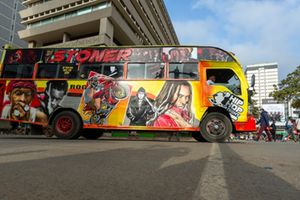
Public service vehicles on the streets of Nairobi on July 24, 2025.
Photo credit: Bonface Bogita | Nation Media Group
He even opened a workshop and hired two artists, two sticker specialists and a lead designer.
“Getting to where I am took years of hard work and saving money. Tools and machines cost a fortune. The airbrush alone is Sh40,000 to Sh50,000,” he says.
On an ordinary working day, Kimweli and his team can make Sh5,000 to Sh6,000. With the ban, he has put his projects on hold.
“Frustrated clients are calling,” he says.
Apart from making money, Kimweli says art helps him a lot.
“Drawing on a matatu is therapeutic, especially when I am sad or depressed. At least, I get to be productive,” he says.
“The ban does not make these people disappear. It only does away with the job that was giving them a purpose in life,” he says.
Cliff Khalifa, 29, a graffiti artist who lives in Kayole estate, says the job is what sustains his household.
From it, he has made money that helped him buy a car and improve his business.
There are concerns that the High Court ruling could hurt a growing tourism niche, as the matatus had begun attracting visitors looking for distinctive local experiences.
When American YouTuber Darren Jason Watkins Jr – popularly known as iShowSpeed and who has more than 150 million followers on social media – landed in Nairobi this year, he used nganyas.
He shot videos in the matatus, showcasing it as a must-do activity in Kenya.
In 2016, American singer Tremaine Neverson “Trey Songz”, made headlines while in Kenya when he rode in a nganya.
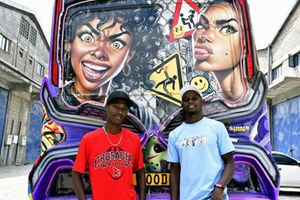
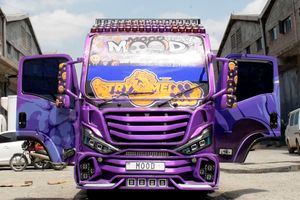
A public service vehicle nicknamed Mood pictured at a garage along Lunga Lunga Road in Nairobi on July 24, 2025.
Photo credit: Francis Nderitu | Nation Media Group
Even political figures, including German Foreign Affairs Minister Johann Wadephul, have experienced the nganya culture during their visits to the country.
Local musicians whose faces appear on matatus have weighed in on the ban too. Octopizzo said the ruling could destroy an entire artistic ecosystem.
Lang’ata MP Felix Odiwuor “Jalang’o”, said he would pay the legal fees if the issue returns to court.
“The nganya culture is here to stay. This industry drives Nairobi,” he posted on X.
Nandi Senator Samson Cherargei said the ban is a threat to freedom of expression, thought and creativity.