If seven-year-old Johnson Sakaja met his future self as Nairobi’s governor today, he would struggle to be impressed.
Recalling his childhood during his inauguration in August 2022, Mr Sakaja blamed bad leadership for poor services in parts of Nairobi, promising: “Let’s make Nairobi work”.
“I grew up in Ngara, here in Nairobi. I remember as kids, we lived in a neighbourhood of stark contrasts — while we weren’t poor, our estate wasn’t the best either. It wasn’t clean or organised,” he told the crowd.
He said he later discovered that a nearby, better-organised neighbourhood had “selected good leadership, and things worked”. At seven, he organised a protest with other children and said they “started seeing change”.
What the governor probably forgot was that what presents itself to citizens as bad leadership — poorly maintained roads, lack of medicine and garbage-strewn streets — is often a result of wastage, mismanagement and theft of public funds.
Four years on, the capital does not seem to be working as Mr Sakaja promised.
Nairobians have missed Sh22 billion worth of projects as the county executive spent much of its money on salaries, official travel and running offices, while billions more cannot be accounted for.
Over Mr Sakaja’s four years in office, the county spent Sh125 billion, Controller of Budget (COB) reports show.
Only Sh15.4 billion (12.36 per cent) went to development between July 2022 and June 2026, against Sh109.5 billion on recurrent activities.
This breaches the Public Finance Management (PFM) Act 2012, which requires at least 30 per cent of county spending to go to development.
Had Nairobi met that threshold, residents would have had projects worth Sh22 billion, including markets, roads, hospitals, business facilities and schools.
“Nairobi has repeatedly been ranked the worst or among the worst-performing counties nationally on development spending and absorption,” the Centre for Economic Governance (CEG) says.
CEG says Nairobi’s low project spending dates to the onset of devolution, driven by heavy recurrent costs such as wages, legal fees and garbage collection, prioritised over capital investment.
A Nation analysis of COB expenditure reports since devolution shows Mr Sakaja ranks lowest in development spending, a key measure of government priorities.
His Sh15.4 billion development spending over four years is down from Sh15.7 billion under Mike Sonko and Ann Kananu during a similar period after the 2017 elections, and Sh12.1 billion under Governor Evans Kidero’s first four years.
Development spending accounted for 12.36 per cent under Mr Sakaja, compared with 14.6 per cent under Mr Sonko and Ms Kananu and 13.8 per cent under Mr Kidero.
Overall spending under Mr Sakaja rose by Sh17.5 billion from the Sh107.4 billion spent by his predecessors, but he spent Sh253 million less on development, while spending Sh11.7 billion more on salaries and Sh6 billion more running the executive.
Previously, total spending rose by Sh19.8 billion (22.6 per cent), with development spending increasing by Sh3.6 billion (29.5 per cent) and recurrent spending by Sh16.2 billion (21.5 per cent). Under Mr Sakaja, the additional resources have therefore not translated into similar growth in capital investment.
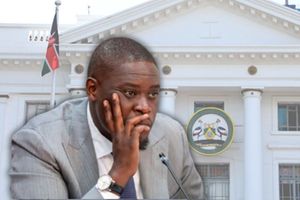
Nairobi Governor Johnson Sakaja.
Photo credit: File | Nation Media Group
In 2025/26, development accounted for just 11.7 per cent of the county executive’s Sh31.8 billion expenditure.
COB Margaret Nyakang’o said development spending was only 28.5 per cent of the budget, leaving Sh9 billion unspent. The executive allocated Sh3.9 billion to development in 2024/25.
“The decline in development expenditure was attributed to cash flow challenges that included the low revenue collection which was at 72 per cent of the annual target,” she said.
Projects included roads at Sh591.5 million, Dandora Dumpsite construction materials at Sh570.5 million and trade debts at Sh786 million. By June, 57 projects worth more than Sh2 billion had stalled, including a Sh256 million medical block at Mbagathi Hospital, Mwiki Social Hall and a Sh30 million maternity wing at Umoja 1 Health Centre.
Others were proposed hawker sheds along 10 lanes, highlighting the number of projects awaiting completion. Ms Nyakang’o attributed stalling partly to contractors abandoning sites over non-payment and urged the county to prioritise viable projects.
CEG says Nairobi has the highest value of stalled projects of any county, with low development spending leaving contractors unpaid.
“The service-delivery effect is likely to be uneven. Informal settlements and peripheral wards may experience greater service gaps when development projects are delayed,” CEG Programme Officer Ashley Wambui Mwangi says.
CEG says informal settlements and peripheral wards are exposed because they depend more heavily on county-funded infrastructure. The Daily Nation sought Mr Sakaja’s response on several occasions, directly and through his communications team, but he did not respond.
Questions included the rationale for spending patterns, development Nairobians had missed, high wage-bill spending, payroll management and gaps in solid waste and legal departments.
An August 2026 Parliamentary Budget Office (PBO) report ranked Nairobi last in 2023/24 and fifth-last in 2024/25 in overall use of public resources.
The PBO’s County Fiscal Performance Measurement assessed budget use, development spending, own-source revenue, wage-bill and pending-bills burdens, and audit outcomes.
The PBO report is intended to help senators monitor counties and hold them effectively accountable for public resources in Nairobi.
A Nairobi-based public finance expert says county budgets should reflect the needs of citizens struggling with incomes and prioritise essential services.
More than half of Mr Sakaja’s Sh125 billion expenditure over four years went to salaries and allowances. The Sh63.3 billion wage bill accounted for 50.65 per cent of total spending, higher than his predecessors’ record in both proportion and absolute terms.
Mr Sonko and Ms Kananu spent Sh51.58 billion, or 48 per cent of Sh107 billion, on salaries and allowances during their first four years. Mr Kidero spent Sh51.1 billion, or 58.36 per cent of his Sh87.6 billion expenditure.
The law prohibits counties from spending more than 35 per cent of revenues on wages, but many continue to breach the limit.
COB said personnel emoluments totalled Sh17.82 billion in 2025/26, or 51.3 per cent of revenue, and noted the executive had processed salaries for only 10 months. It owed workers Sh3.21 billion by June.
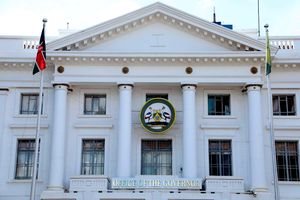
The headquarters of the Nairobi City County Government located along City Hall Way, Nairobi.
Photo credit: File I Nation Media Group
This would put the four-year wage bill at Sh66.47 billion, or 51.9 per cent of total spending.
The county workforce rose from 13,354 in June 2023 to 19,258 in June 2025, partly due to staff transferred from the defunct Nairobi Metropolitan Services (NMS) and new hiring.
A review of audits shows the county executive employed about 5,000 workers under Mr Sakaja, including 3,834 in 2023/24 and 1,075 in 2024/25.
In the 2024/25 audit, Auditor-General Nancy Gathungu flagged a Sh1.9 billion withdrawal from the county’s salary account that the county could not explain.
The audit also flagged Sh840.4 million reported as employee costs without beneficiary lists, claim forms, invoices or approvals, and more than Sh200 million spent on overdraft penalties and charges.
The county’s 2024/25 wage bill was Sh19.8 billion, or 62 per cent of its Sh31.8 billion revenue.
A special payroll audit blamed City Hall for hiring thousands of staff without plans showing where they were needed or whether funds were available.
“The lack of annual recruitment plans and lack of confirmation of availability of budgets can result in either overstaffing, understaffing, or hiring staff for roles that do not align with organizational priorities,” Ms Gathungu said.
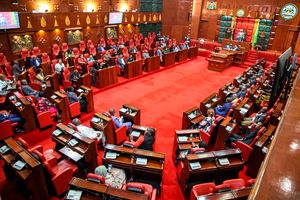
CEG says responsibility rests with the County Public Service Board, Finance and Treasury officials, the governor and County Assembly, which approves and oversees the budget.
It has urged a freeze on net hiring, except budget-neutral replacements and exits, and a central payroll system to eliminate manual payrolls.
The county has also incurred high costs on garbage collection and legal services, raising concerns over procurement and value for money.
Audit reports indicate Sh1.7 billion was spent on garbage in 2024/25, while City Hall data puts solid-waste spending at Sh3 billion.
The Auditor-General flagged Sh361 million in unsupported payments and said there were no consolidated records showing waste volumes, locations serviced, hours worked or independent verification.
CEG says legal and garbage spending are legitimate but oversized cost centres, reflecting weak procurement and contract management.
The county spent Sh2.6 billion on external lawyers in 2024/25 despite having more than 100 internal counsel.
The Auditor-General has also flagged overpayments, missing documentation and legal pending bills exceeding Sh20 billion by June 2024. The problem predates Mr Sakaja.
As Governor Sakaja enters his final year, he faces a major test to address the challenges holding Kenya’s capital back.
Nairobi drives nearly a third of Kenya’s economy, larger than 29 counties combined, and was valued at Sh4.1 trillion in 2024, equivalent to about Sh11.2 billion in economic activity every day.