The drive to turn Maai Mahiu in Naivasha into a major regional economic hub and gateway for trade across East Africa has received a boost, with South Sudan among the first countries to begin construction of a dedicated Inland Container Depot (ICD) within the Naivasha Special Economic Zone.
The move comes after the government activated the Maai Mahiu-based Special Economic Zone, as a strategic hub for clearing transit cargo bound for neighbouring countries, in a move aimed at easing persistent congestion at the Port of Mombasa.
Juba is betting on the facility to cut the time and cost of moving its cargo through Kenya with the construction of a dedicated inland container facility in Naivasha.
Whereas Kenya has an operational Inland Container Depot (ICD), within the Naivasha Special Economic Zone, it allocated each East African nation 10 acres in an effort viewed largely as a move to strengthen its role as a regional logistics gateway.
The initiative, according to officials, also aims to shift long-haul transit cargo clearance away from the Port of Mombasa, to the Naivasha Special Economic Zone.
On Thursday South Sudan began the construction of her dry port on a 10-acre land it was allocated by the Kenyan government.
The facility, whose construction is expected to be operational within 12 months and will bring together the Kenya Revenue Authority and South Sudan Revenue Authority to handle cargo destined for the landlocked country.
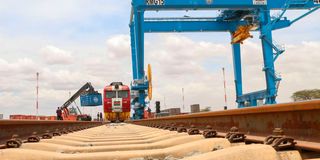
Containers being offloaded from a Standard Gauge train at the Inland Container Depot at the Naivasha Special Economic Zone on October 8, 2026.
Photo credit: Boniface Mwangi | Nation
South Sudan’s Ambassador to Kenya, Simon Juach Deng, said the facility upon completion will make it easier to track containers and coordinate customs clearance between the two countries. He said the project would also create jobs during construction and after the depot begins operating.
The project is being developed under the Northern Corridor regional cooperation framework, which links the Port of Mombasa to landlocked markets in East and Central Africa.
For South Sudan, which relies on neighbouring countries to move much of its imported cargo, the facility is intended to provide a more predictable way to monitor shipments and complete customs procedures.
“What this will do is going to help us ease the congestion at the Mombasa port where containers destined for South Sudan. Most of them will be shipped there, where we can be able to manage tracking them easily,” he said.
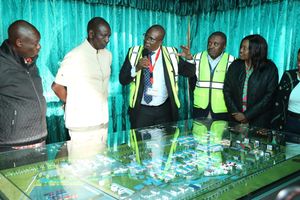
Speaking during the facility's ground-breaking ceremony, Public Service Cabinet Secretary Geoffrey Ruku, who represented his Transport counterpart Davis Chirchir, described Naivasha as an emerging logistics hub, with 6,000 acres designated for manufacturing, logistics, and trade facilitation.
"The establishment of the logistics facilities in Naivasha will boost trade and turn the area into an economic hub and trade gateway in East and Central Africa," said Mr Ruku.
"With South Sudan taking the lead, Rwanda, Burundi and Uganda are next in line. This investment will accelerate cargo evacuation, boost intra-regional trade, improve turnaround times along the Northern Corridor and significantly reduce congestion at Mombasa Port,” added Mr Ruku.
According to Mr Deng, the South Sudan Ambassador to Kenya, South Sudan ranks third among countries whose cargo passes through the Port of Mombasa.
"A dry port in Naivasha will provide a long term solution to the congestion at the Coast, strengthen regional trade cooperation and protect South Sudan traders from losses linked to delays," said Mr Deng.
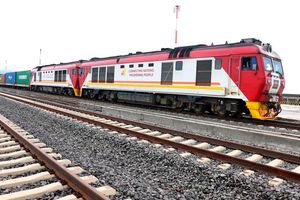
A cargo Standard Gauge train loaded with steel metal roles at the Inland Container Depot at the Naivasha Special Economic Zone on October 8, 2026.
Photo credit: Boniface Mwangi | Nation
By 2025, South Sudan accounted for 12.7 percent of total transit cargo through Mombasa, underscoring the port’s role in regional trade.
Special Economic Zones (SEZA) Chief Executive Officer (CEO) Dr Kenneth Chelule said that the Naivasha ICDs, all which will be located within within the Naivasha Special Economic Zone, will now be prioritised for long-haul cargo destined for South Sudan, Rwanda, Uganda and the Democratic Republic of Congo (DRC), to allow the Port of Mombasa to focus on domestic and short-haul traffic.
"The utilisation of the logistics facilities will reduce congestion at the Mombasa port, shorten clearance timelines, and cut transport costs for regional traders, while maximising the efficiency of the Northern Corridor,” Dr Chelule explained.
The Naivasha ICDs will be linked directly to the Port of Mombasa via the Standard Gauge Railway (SGR), cutting down road-haul distances and transit times for landlocked neighbours.
The decision comes amid a sharp rise in cargo volumes at Kenya’s main seaport-Mombasa, which has strained infrastructure, slowed clearance processes, and increased logistics costs for importers and regional traders.
Official data shows that the Mombasa Port handled 45.45 million metric tonnes of cargo in 2025, up from 40.99 million tonnes in 2024.
Kenya's ICD has a handling capacity of 4,000 twenty-foot equivalent units (TEUs), but is currently operating at about just 40 per cent occupancy.
The Naivasha Special Economic Zone, which has so far received a Sh20 billion funding from the African Export -Import (AfriExim) Bank is shaping up, with the drive to operationalise the industrial zone and turn it into a major economic hub in Kenya and East Africa, becoming a reality.
Containers being offloaded from a Standard Gauge train at the Inland Container Depot at the Naivasha Special Economic Zone on October 8, 2026. A number of neighbouring countries have started to construct their inland depot at the zone to minimize cost of transport and decongest the port of Mombasa.
Photo credit: Boniface Mwangi | Nation
The Naivasha SEZ's proximity to key transport and logistics infrastructure -including the Standard Gauge Railway and the existing Inland Container Depot -positions it as a gateway for trade across East and Central Africa.
Already, more than 24 investors are lined up to set base at the economic zone as it takes shape. The firms will inject more than Sh100 billion to the economic zone, according to the Special Economic Zones Chief Executive Officer (CEO) Dr Kenneth Chelule.
Mr Chelule further revealed that the government has allocated Sh604 million in the financial year 2026/2027, for the development of Naivasha Special Economic Zone.
An additional 5,000 acres of land have been allocated to the SEZ, adding to 1,000 acres already set aside to accommodate more investors.
The developments at the Naivasha SEZ have now raised the region's stakes higher, with investors, locals and leaders upbeat that the projects will spur economic growth in the region.
According to the Special Economic Zones authority, more investors have lined up for investments ranging from players in iron and steel, textile, logistics, apparels and leather, paper and paper products, bottling and cold storage facilities and industrial warehousing.
The government has already introduced certain incentives to woo investors to the special zones such as exemption of Value Added Tax on supply of goods or taxable services.
Investors will also pay corporate tax at 10 percent for the first 10 years of operations, 15 per cent for the next 10 years and 30 percent for the subsequent years.
The government has also committed to provide cheaper power tariffs to spur up investments offered at a rate of Sh5 per unit that will make the cost of manufacturing reduce drastically.
Governor Susan Kihika on Thursday termed the Naivasha Special Economic Zone (SEZ) as a game-changer, that will turn Nakuru into a major industrial hub in Kenya and East Africa.
"The funding is a major boost to the operationalisation of the Naivasha Special Economic Zone. Once the SEZ is fully operationalized, over 100,000 jobs will be created for locals and deserving youths," said Governor Kihika.
Recently, President William Ruto also launched a 90 MVA power station that will serve the Naivasha Special Economic Zone and issued licenses to six investors, which include both local and foreign companies.
The investors are set to generate 2,486 jobs across diverse sectors including bottling, EV cars, logistics, power, energy, steel mill and plant essence extraction.