The row over the failure by the government to compensate 15,000 families evicted from the Mau Forest complex has taken a new twist, with angry victims torching an assistant chief’s house in Narok South constituency.
This comes in the same week that hundreds of residents left out of the compensation programme returned to their former farms in the forest, whose title deeds have been handed to the Narok County Government by President William Ruto .
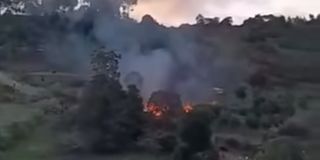
On Friday, some residents torched Mr Robert Kirinyet’s two houses and a store in Enoosogon Sub Location. They accused the administrator of tampering with the list of victims of the eviction.
The incident occurred just a few hours after Narok County Commissioner Kipkech Lotiatia had toured the area and urged residents not to invade the forest.
“I would like to appeal to all of you to refrain from re-entering and subdividing the forest land amongst yourselves. There are open government channels to which you can direct your grievances, ranging from the local administrators to the Presidency,” said Mr Lotiatia, adding that legal action would be taken against those found to have flouted the law.
The administrator said that he had neither received any petition nor delegation from the affected families detailing their complaints, and that invading the forest would be treated as a criminal act.
On 26 August, President Ruto issued KSh 200,000 to each of the 13,000 families evicted from the Mau Forest Complex eight years ago as compensation. This has sparked another dispute, with the beneficiaries stating that the money was tool insufficient.
However, 15,000 were left out of the compensation programme, with the government having registered 28,000 as genuine evictees.
Mau forests evictees at one of the Internally displaced persons (IDP) camps in 2022 after being displaced during successive government-led eviction exercises.
Photo credit: File | Nation Media Group
Earlier, another 2,000 victims who were in two internally displaced persons (IDP) camps had been paid Sh300, 000 each as compensation by the government.
Former Rift Valley Regional Commissioner George Natembeya, now Trans Nzoia governor, stated during the eviction, 61,000 families had been evicted from the forest.
“The burning of the assistant chief’s house was unnecessary and criminal. While the evictees have a point in being left out of the compensation programme, they should seek justice through legal channels,” said Ms Edna Chepkorir, also known as Cheptongilo, a local leader.
Ms Chepkorir said it was incumbent upon President Ruto to address the issue and alleviate the suffering of people who had lost loved ones, including children and the elderly, over the past eight years and had nowhere to bury them.
“The affected families have buried their loved ones by the roadside and on relatives' land, which has caused them great mental anguish. Children have dropped out of school due to a lack of funds and have joined their parents as casual labourers,” said Ms Chepkorir.
Mr Bernard Sang, a local leader, accused the government of abandoning the affected families.
“Rather than solving the current problem, government officials have exacerbated the situation, turning hope into despair for families who have chosen to return to their former farms to resume their agricultural activities,” said Mr Sang.
Local leaders, including Narok Governor Patrick Ole Ntutu and Narok South Member of Parliament Kitilai Ntutu, have been criticised by residents for failing to address the issue that has caused immense suffering for affected families.
An Internally Displaced Persons (IDPs) camp in Narok South subcounty on June 28, 2022 where Mau Forest evictees put up after being evicted
Photo credit: FILE
Leonard Cheruiyot, leader of the South Rift Democracy for Citizens Party (DCP), said it was unfortunate that the government had excluded families from the compensation programme, while those who benefited were not evictees.
"The majority of the 13,000 families who were compensated did not receive the money from the government. Meanwhile, people who were not evicted and who come from the Nyanza, Western and Mount Kenya regions were paid Sh200,000," said Mr Cheruiyot.
However, the families say that the money is too little compared to what other victims were paid previously, which included the allocation of land.
'During the regimes of former presidents Mwai Kibaki and Uhuru Kenyatta, internally displaced persons were each paid Sh450,000 and given an average of between one and a half and two and a half acres,' said Alfred Kiptanui Langat of the General Conference Church of God Seventh Day.
Bishop Kiptanui said: “Compared with what President Ruto’s administration has paid the Mau evictees, it is a drop in the ocean. Sh200,000 cannot buy even a small portion of land.”
The first eviction in the area was conducted in 2005 during former President Mwai Kibaki’s tenure, with former Lands Cabinet Minister Amos Kimunya coming under attack for terming title deeds the families held as “mere pieces of paper”.
The second eviction was done in 2019 during former President Uhuru Kenyatta’s regime. This is despite Mr Kenyatta and Dr Ruto, who served as Deputy President, promising the first lot of evictees that they would be resettled by the government.
Eviction of the families from the Mau Forest complex has become a campaign issue in the last 21 years, with President Ruto recently stating that he had closed the sad chapter on the eviction and compensation of the families.
“People who lived in IDP camps were rained on, and their children died from severe weather conditions. It is unfortunate that they had to endure all that… We are closing the chapter on Mau Forest eviction today. It is no longer going to be a political question in the subsequent general elections,” Dr Ruto said at Tendwet Primary School grounds while distributing the money to eviction victims.
Despite the President’s assurance, the issue has remained high on the political agenda in the region ahead of the 2027 General Election.