For Otieno Mak’Onyango, the struggle for a democratic Kenya came at a steep price.
Political detention, state persecution, courtroom battles and a long, frustrating wait for justice became defining chapters in a life spent confronting the excesses of power.
When death came calling on Sunday, October 25, the veteran journalist and former politician had endured decades of battles that stretched far beyond the corridors of Parliament.
His was a story of a man who lost years of his freedom, watched his journalism career cut short and spent a substantial part of his later life pursuing compensation for violations of his fundamental rights.
Yet even after a court acknowledged the injustice he had suffered and awarded him millions of shillings in damages, the promise of justice remained painfully elusive.
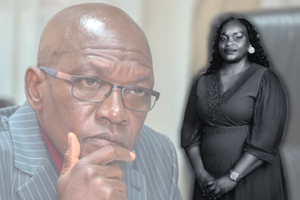
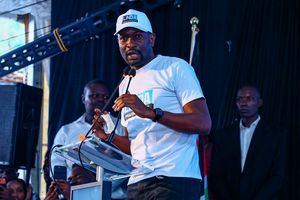
The Chairperson of the National Assembly Budget and Appropriations Committee, Alego Usonga MP Samuel Atandi.
Photo credit: Dennis Onsongo | Nation Media Group
On Sunday, Alego Usonga Member of Parliament Samuel Atandi announced the death of his predecessor, who passed away while undergoing treatment at a Nairobi hospital.
“We have this evening lost the Hon Otieno Mak’Onyango, Former MP, Alego Usonga Constituency, while undergoing treatment at a Nairobi Hospital. May his soul rest in peace,” Mr Atandi said on his X account.
The announcement triggered an outpouring of condolence messages from political leaders across the divide, many remembering Mak’Onyango not merely as a former legislator but as one of the men whose sacrifices helped open the door to multiparty democracy.
Orange Democratic Movement Leader and Siaya Senator Dr Oburu Oginga eulogised Mak’Onyango as a former colleague, veteran journalist, patriot and hero of Kenya’s second liberation.
“Otieno Mak’Onyango was a towering figure in our nation’s history, a fearless champion for political pluralism, and a steadfast hero of our second liberation. His immense sacrifices, unyielding integrity, and dedication to the democratic ideals we hold dear left an indelible mark on Kenya’s political and media landscape,” Dr Oginga said.
Long before he entered elective politics, Mak’Onyango had already found himself on the wrong side of a government that viewed dissent with deep suspicion.
In the aftermath of the failed August 1982 coup attempt against President Daniel arap Moi’s government, a dragnet of arrests swept beyond the military officers and politicians directly associated with the revolt. Journalists, intellectuals, political activists and other perceived government opponents were also caught in an atmosphere of fear and repression. Mak’Onyango was among them.
On August 17, 1982, while working as a journalist at the East African Standard, now The Standard, he was arrested on allegations linking him to the attempted coup.
He would spend approximately four years in detention, sharing the experience with several prominent figures, among them the late Raila Odinga, who would later become Kenya’s Prime Minister.
His prosecution was discontinued in March 1983, but the withdrawal of the case did not restore his freedom. He remained behind bars under public security laws until December 1987.
During the legal proceedings, Mak’Onyango told the court that he had been tortured while in custody and that his arrest had brought his journalism career to an abrupt end.
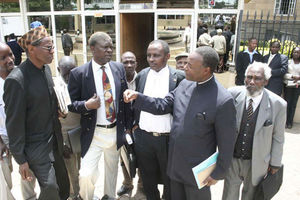
Former MPs Koigi wa Wamwere, Otieno Mak'Onyango, Wanyiri Kihoro Njeru Kathangu and an activist outside the High Court.
Photo credit: File | Nation
His death came exactly one year and 10 days after Mr Odinga died. The two men shared the painful history of political detention and treason-related charges, although their political careers and public legacies would take different paths.
While Mr Odinga emerged as one of the defining figures of modern Kenyan politics, Mak’Onyango’s battles continued long after his single term in Parliament had ended.
He eventually transitioned from journalism and political activism to elective politics, riding the wave of change unleashed by the return of multiparty democracy.
In the landmark 1992 General Election, Mak’Onyango captured the Alego Usonga parliamentary seat, defeating the late Oloo Aringo in the first multiparty elections following the restoration of political pluralism.
However, his tenure lasted only one term, from 1992 to 1997.
Mr Aringo reclaimed the seat in the 1997 General Election and served for another five years before losing it in 2002 to Mr Sammy Weya of the National Rainbow Coalition Party.
In 2003, more than two decades after his arrest, Mak’Onyango took his fight for redress to court, accusing the government of unlawful arrest, detention and prosecution.
He sought compensation for violations of his fundamental rights, hoping the legal system would finally provide an answer to the injustices that had shadowed his life.
In June 2012, High Court judge Kalpana Rawal awarded him Sh20 million in damages after finding that his constitutional rights had been violated.
It was a significant legal victory for a man who had spent years seeking recognition of the wrongs he said he had suffered at the hands of the state.
Mak’Onyango continued to face difficulties accessing the compensation and accrued interest, leaving him grappling with financial hardship even after the court had ruled in his favour.
As his circumstances deteriorated, he reportedly struggled to meet basic needs and raise money for medication.