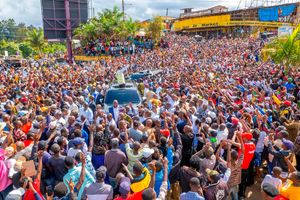
President William Ruto’s five-day tour of Nyanza beginning on Sunday, September 13, is shaping up as more than a working visit to initiate and inspect development projects.
It is a carefully timed political test in a region where the President has long struggled to establish a foothold, and where the death of former Prime Minister Raila Odinga has opened the most consequential political vacuum in decades.
From Kisumu, Siaya and Migori to Homa Bay, Dr Ruto will spend much of the coming week traversing constituencies that for years formed the political heartland of Mr Odinga and his Orange Democratic Movement (ODM).
The President is expected to crisscross the region, inspecting and commissioning roads, water and sanitation projects, a police headquarters, an airport control tower, markets, a hospital, a stadium, housing projects and other infrastructure.
He will also attend a church service in Kisumu on Sunday, meet thousands of leaders and is also expected to hold a Cabinet meeting at the Kisumu State Lodge in the course of the week.
For an administration that has increasingly presented development as its principal instrument for winning political support, the tour provides an opportunity to put that message before voters who overwhelmingly backed Mr Odinga in successive presidential elections.
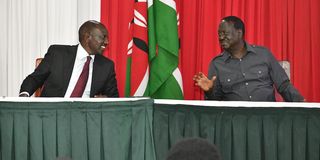
President William Ruto and Raila Odinga at State House, Nairobi, where Odinga was officially unveiled as Kenya’s candidate for the chairperson of the African Union Commission on August 27, 2024. Odinga passed away on October 15, 2025.
Photo credit: Photo | PCS
Mr Odinga’s death on October 15, 2025, removed the region’s most formidable political mobiliser and left behind a contest over who will inherit his influence, networks and voters.
In a recent exclusive interview with Nation , the President acknowledged the profound effect Mr Odinga’s presence had on the political equation.
“His presence would certainly have influenced the situation,” Dr Ruto said, describing Mr Odinga as a “phenomenal person”.
But he was quick to add that he was a lucky man, who is now facing “an increasingly incoherent and plan-less opposition.”
The President recalled their long political journey with the late Odinga — from opponents to partners in the broad-based government.
“I have said before that if Raila had won the last election, he would have done many of the things I have done because he had the courage, mettle and understanding,” Dr Ruto said.
He pointed to areas of policy convergence, including housing and universal healthcare, arguing that the political differences between the two leaders did not necessarily translate into fundamentally different development priorities.
Dr Ruto and Mr Odinga worked together in the 2007 elections, the most contested presidential election in the history of Kenya, where Odinga was later named Prime Minister under the Grand Coalition government.
“If you look at the ODM manifesto, housing was central. Universal healthcare was there. These were areas where we shared fundamental perspectives,” President Ruto told Nation .
That political argument is likely to form an important part of the President’s message in Nyanza: that the broad-based government created with Mr Odinga’s political support was not simply a temporary arrangement but a vehicle through which the region can continue to participate in national government.
President William Ruto chairs a Cabinet meeting at State Lodge, Kisumu on October 9, 2023
Photo credit: PCS
Several politicians associated with Mr Odinga and ODM are now serving in his administration, including Energy and Petroleum Cabinet Secretary Opiyo Wandayi, who has become one of the administration’s most visible links to the region.
Others are Treasury CS John Mbadi, Hassan Joho (Mining) and Wycliffe Oparanya (Cooperatives), all former senior ODM party officials.
Political analysts say that the President is therefore likely to frame development and political inclusion as two sides of the same message — that Nyanza does not have to remain permanently opposed to State House to secure national resources and representation.
Even before Mr Odinga’s death, Nyanza had been central to Kenya’s presidential contests because of its sizeable voting population and its ability to deliver overwhelmingly for a single candidate.
Mr Odinga’s influence transformed that electoral advantage into one of the most dependable opposition blocs in the country.
For years, the political calculation was relatively straightforward: a presidential candidate could expect Nyanza to rally behind Mr Odinga, while Mr Odinga could use the region as the foundation of his national bargaining power.
While Mr Odinga is gone, ODM is undergoing an internal struggle over leadership and succession.
The opposition is divided over the choice of a presidential candidate, while competing groups are already touring the region seeking to position themselves as custodians of his political legacy.
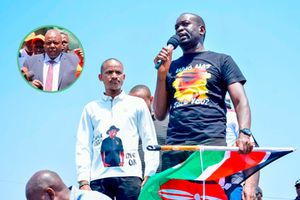
The Linda Mwananchi movement has been particularly active in presenting itself as a vehicle for carrying forward Mr Odinga’s political ideals.
Its leaders have warned residents against being won over by what they describe as “shiny things” — development projects which, in their view, should not substitute for accountability, constitutionalism and good governance.
That puts the President’s development-heavy tour in direct political competition with an opposition message centred on governance.
Kenya's President William Ruto and Song Hailiang, the chairman of China Communications Construction Company Limited, attend the launch of the extension of the Standard Gauge Railway (SGR) from Naivasha to Kisumu and the Uganda border, in Narok Kenya, March 19, 2026.
Photo credit: Reuters
Where the government points to roads, markets, housing, water projects and the expansion of infrastructure, the opposition is expected to ask whether development can compensate for concerns over the economy, police conduct, alleged abductions and the broader question of constitutional governance.
For Ruto, however, Nyanza presents an opportunity.
The President’s proposed itinerary suggests an attempt to take the State directly into local constituencies rather than confine the visit to Kisumu, traditionally the region’s political and commercial centre.
According to State House, in Kisumu County, the President is expected to commission an airport control tower and a sub-county police headquarters before inspecting the Mamboleo-Miwani-Chemelil-Muhoroni road.
He is also scheduled to commission a Lake Victoria water and sanitation project, inspect the Rabuor-Chiga road and visit the Jua Kali sector.
The emphasis is significant because it allows the administration to tell a constituency-level story of government delivery.
Muhoroni MP Onyango Koyoo said residents would be looking beyond political speeches to specific commitments.
“What I expect the President to address is the pending completion of the Kipsitet-Muhororoni-Mamboleo Road, construction of the Koru-Soin Dam and the progress of the leasing of state-owned sugar factories,” Mr Koyoo said.
For residents, the question is less about whether the President can erase Mr Odinga’s legacy overnight and more about what his government can deliver.
For fishermen, it is safety and investment around Lake Victoria. For cane farmers, it is payment and the future of the sugar industry. For boda boda operators and young people, it is employment and affordable living.
The President is expected to inspect the Dhogoye Bridge, several roads, Siaya Hospital, stadium and housing projects, as well as water projects and the road network around Bondo, Ugenya, Alego Usonga and Rarieda.
President William Ruto, ODM party leader Oburu Odinga ( right) and Suna East MP Junet Mohammed arrive for Idd-ul-Fitr luncheon at Kisumu State Lodge in Kisumu County on March 19, 2026.
Photo credit: PCS
Dhogoye Bridge has been a longstanding concern for residents of Usenge in Bondo Constituency, owing to its critical role in connecting the area to key parts of the region.
The bridge, which spans a section of Lake Victoria, has deteriorated significantly, raising safety concerns among residents and fuelling fears of a potentially disastrous accident.
Bondo MP Gideon Ochanda said the development of the Dhogoye Bridge would mark a major milestone for residents, given its strategic importance in connecting communities and facilitating movement and trade across the area.
“The development of Dhogoye Bridge will be a key milestone for the people of Bondo and, particularly, the residents of Usenge. It will improve connectivity, enhance safety and ease the movement of people and goods across the region,” said Mr Ochanda.
Siaya is perhaps the most politically sensitive stop because it is the home county of the Odinga family and has historically provided the strongest expression of Mr Odinga’s political influence.
A presidential visit there is therefore likely to carry symbolic weight far beyond the individual projects on the itinerary.
President William Ruto during the launch of the landmark construction of the Naivasha-Kisumu-Malaba Standard Gauge Railway line in Narok.
Photo credit: PCS
In Migori, the President will inspect roads in Uriri, Awendo and Suna East and visit the Masaba substation in Kuria West.
Homa Bay, another former ODM stronghold, will receive the President through projects including markets, the Sindo KMTC and town roads.
Across the four counties, the administration is also expected to highlight larger projects, including the Sh1 billion Usenge Pier, Muhuru Bay Pier, Kabonyo-Kanyagwal aquaculture project and the proposed Naivasha-Kisumu-Malaba SGR extension.
For local leaders, however, the wish list remains longer.
They want the completion of the Koru-Soin Dam, Mamboleo-Miwani-Chemelil road and Moi Stadium, alongside greater support for Jaramogi Oginga Odinga Teaching and Referral Hospital.
Kisumu West MP Rozah Buyu urged the President to use the visit to lower political temperatures rather than deepen them.
“When the President visits, he must stay above all his competitors, including those who have attacked him, and instead give Kenyans confidence that we are one and that we are safe,” she said.
Ms Buyu also wants Dr Ruto to address tensions surrounding foreign traders, arguing that government directives should not be interpreted as a licence for attacks against non-Kenyans.
“This directive could have been issued another way that doesn’t give an opportunity to rogue businessmen to attack non-Kenyans,” she said.
President William Ruto shakes hands with Kisumu Governor Anyang Nyong'o after he laid a foundation stone for the construction of an affordable housing project in Kisumu County.
Photo credit: PCS
Security preparations have been heightened across the region following an incident in Siaya on September 8 in which police arrested 12 suspects after youths allegedly attempted to obstruct a convoy of dignitaries attending a women’s economic empowerment function hosted by First Lady Rachel Ruto.
Nyanza Regional Commissioner Onesmus Kyatha said the President’s visit was a working tour focused on development.
“This is a working tour for the President. He will assess the progress of development projects across the region,” Mr Kyatha said.
“We have beefed up security ahead of the President’s tour. We have made the necessary arrangements to ensure the visit proceeds smoothly,” he said.
Mr Kyatha also warned against disruptions, telling leaders engaging young people to ensure the President is received peacefully.
“To the youths, let us welcome the President well. Those who misbehave will be dealt with accordingly,” he said.
That warning underlines another dimension of the tour: the administration is acutely aware that Nyanza remains politically sensitive territory.
The President’s five-day blitz, pundits say, is an attempt to rally the region to his political side before the opposition settles its own succession question.
“The President is not merely seeking to win a region that has historically rejected him. He is seeking to prevent the opposition from retaining the automatic electoral advantage that Mr Odinga built over decades,” political analyst Geoffrey Mboya says.
The question confronting voters, he says, is no longer whether they remain loyal to Raila’s political tradition.
“It is whether that tradition can survive without Raila, who can credibly inherit it, and whether Ruto can persuade a region accustomed to bargaining with presidents from the opposition side that its interests are better served by working from within government,” Mr Mboya added.