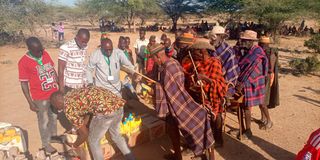
Some of the neglected old people at Karoge village in Turkana South Sub County receiv relief food from Cornerstone Ministries International church in partnership with Turkana Home of Mercy on December 7, 2024.

Adukon Lochuch, who is in his 70s, should be enjoying his sunset years in dignity.
Instead, securing even a meal has become a daily struggle.
He is not alone. In his village of Karoge in Turkana South, many elderly residents depend on neighbours for meals because of a drought that depleted their livestock and gaps in social protection that leave many struggling to meet their most basic needs.
Frustration is growing in arid Turkana County over the plight of older people struggling to secure food and care as drought, rising living costs and unreliable relief supplies deepen their hardship.
Karoge village, where pastoralism once sustained families, now has only a handful of goats and sheep as prolonged drought has left livestock without pasture. Even charcoal burning, an alternative source of income, is becoming less viable because indigenous trees are dwindling.
“This village is ravaged by drought and a deepening economic crisis as the current alternative economic activity, charcoal burning, is also affected by the reduced number of indigenous trees,” Mr Lochuch said.
He believes the village’s location along the Lokichar-Lodwar road has worked against it, with humanitarian agencies and well-wishers often prioritising remote and hard-to-reach settlements.
His experience reflects the growing challenges facing older people across the county, where harsh climatic conditions, rising living costs and gaps in social protection are combining to leave some struggling to meet their most basic needs.
According to Mr Joseph Egelan, a local human rights defender, access to relief food had become unpredictable.
“Unreliable supply of relief food was subjecting older persons to malnutrition. Most of the older persons are also not benefiting from social protection services,” he said.
The problem extends beyond Karoge. Relief food distribution remains irregular across Turkana, with villages in banditry-prone areas such as Lokwamosing, Lopii, Ng’ilukia and Napeitom among the worst affected. Insecurity often restricts movement in and out of these villages, limiting residents’ access to nearby towns and assistance.
Even families earning small amounts from charcoal burning or basketry struggle to afford nutritious food and meet the special dietary needs of older relatives.
Mr Egelan called for an expansion of the Inua Jamii Cash Transfer Programme, proposing that the eligibility age be lowered from 70 to 60 years.
“We want the number of older persons enlisted under the Inua Jamii Cash Transfer Programme increased by lowering the qualification age from 70 years to 60 years,” he said.
In Karoge, the hardship is visible to younger residents who are themselves struggling to secure basic necessities.
Ms Agnes Esinyen, a mother of three, said older people in the village were suffering despite some having educated and employed children who, she claimed, had neglected them.
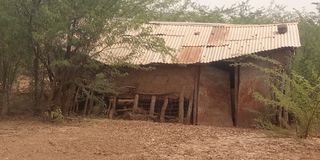
One of the abandoned houses at Lokangai village in Turkana West Constituency on September 12, 2026 that was destroyed by flash floods last year. Lokangai is among villages in Turkana that are prone to both drought and floods.
“If I struggle to get water for domestic use for my family and I am this healthy and strong, then our elderly people are really suffering and must be helped by authorities,” she said.
She said some older people suffered from arthritis and other age-related difficulties that made walking painful, yet they still had to move around seeking assistance.
“Relevant government officials need to hold mobile registration of the older persons for special care services. Due to harsh climate, those in their 50s and 60s are suffering because they lack access to nutritious meals. Most rely on white maize and sometimes beans,” she said.
More beneficiaries
The government says it has increased the number of beneficiaries under the older persons and severe disability cash-transfer programmes in Turkana, but concerns remain over those who are yet to qualify or receive assistance.
According to Mr James Kiptoon, the county coordinator for the Directorate of Social Development, the combined number of beneficiaries under the two programmes had risen from 20,000 to 26,000.
The additional 6,000 beneficiaries are all older persons. Before the expansion, the programmes covered 18,000 older people and 2,000 people with severe disabilities.
Mr Kiptoon said the relatively low number of beneficiaries with severe disabilities was partly due to the strict eligibility criteria, which require applicants to need round-the-clock care.
“The low number of people with severe disabilities is because of the criteria where a beneficiary must be somebody who requires 24-hour care. The beneficiary must have a family member who cares for them all the time, to the point that he or she cannot have time to engage in any form of income-generating activity,” he said.
Under the Inua Jamii Older Persons Cash Transfer Programme, eligibility is currently restricted to Kenyans aged 70 and above who possess national identity cards and do not receive a pension.
Beneficiaries receive Sh2,000 monthly through M-Pesa. The amount has remained unchanged for about 14 years, despite the rising cost of living.
For older people who are not enrolled in the programme, the expansion offers little immediate relief. Residents say many still struggle to access food, water and other essential services, while those aged between 60 and 69 remain outside the older-persons programme despite facing similar hardships.
Turkana Deputy Governor John Erus said the national and county governments had expanded the social protection framework to help older people live in dignity.
“Beyond expanding the social protection policy, the county government is working out modalities for providing housing for the elderly,” he said.
A home that remains a dream
For some residents, however, cash transfers alone may not be enough to support older people who have been abandoned, lack family support or need regular care.
Plans to establish what would be the county’s first home for the elderly at Karoge have yet to materialise because of funding constraints, despite the community having offered land for the project.
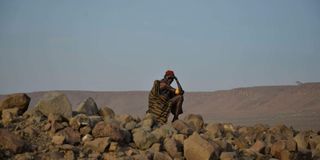
A Turkana elder seated on a rock along the shores of Lake Turkana.
The initiative was started by Mr Isaac Eregae, who is working with partners and well-wishers to mobilise resources for the proposed home and a church.
Mr Eregae said the community had provided land free of charge, but most of his partners in the United States were yet to provide funds for construction.
“Karoge is a perfect location for the home because elders themselves have volunteered to give the land. What is remaining is the financial commitment from partners. At the moment, due to unreliable relief food supplies, I, through my friends and well-wishers, organise relief food distribution for the elders. The last relief food distribution I conducted was in June,” he said.
He said he planned to inform the Directorate of Social Protection about the proposed home and seek the necessary support.
Mr Kiptoon, however, said he was not aware of plans to establish a home for the elderly at Ka-roge but was ready to meet those behind the initiative and offer guidance.
The county coordinator for social development said there was a need for a rescue centre to provide temporary support to older people who had been abandoned or lacked care.
“Though many elderly people are abandoned, there is need for a rescue centre where they are supported for a certain period of time. However, we encourage our communities to take care of our elderly people in their homes,” he said.
Bishop Julius Atsango of Cornerstone Ministries International said the idea of establishing a home emerged after he visited Turkana and witnessed the difficulties older people faced in their villages.
Last year, he partnered with Turkana Home of Mercy Community-Based Organisation to distribute assorted groceries, including maize and wheat flour, sugar and beans, to more than 500 older people in the village.
“One of the church officials from the village, who always checks on his elderly mother, Mr Isaac Eregae, initiated the mission,” Bishop Atsango said.
The proposed home is intended to provide accommodation, food and medical care for older peo-ple who lack support. The plan also includes a health facility and a borehole, with surplus water intended for growing crops to supplement food supplies.
However, the project remains dependent on funding before construction can begin.
Calls for water and reliable support
Local pastor Baraka Loote said the climate crisis had hit older people particularly hard, with some going weeks without bathing because of water shortages.
“We also appeal for the county and national government to ensure that the villages with large numbers of older persons have access to water and all of them are enrolled in national safety-net programmes like Inua Jamii from the village level,” he said.
For Mr Lochuch and other older residents of Karoge, the immediate challenge remains getting enough food and water to survive each day.
While the increase in cash-transfer beneficiaries offers some relief, those who remain ineligible or lack family support continue to face uncertainty.
With relief food supplies irregular and the proposed home for the elderly still awaiting funding, residents fear that those least able to cope with drought and economic hardship will continue to bear the heaviest burden.
Follow our WhatsApp channel for breaking news updates and more stories like this.