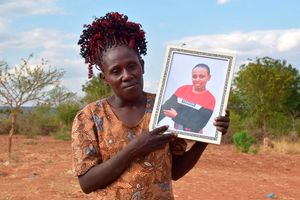
For more than nine months, the family of 10-year-old Philip Epuu has lived with a question no family should have to ask: where is their son?
Since November 26, 2025, Mr Sonny Epuu's family in Lopangai village has neither buried their kin, whom they believe was attacked by a crocodile during a fishing expedition on Lake Turkana, nor found him alive.
After a long search along the lake's shores, the family recovered what they believe was about 70 per cent of Philip's body from nearby Nariamet village.
The recovered remains included one hand bearing a distinctive beaded bangle Philip had been wearing, as well as his chest, intestines and back. The family took the body parts to the Lodwar County Referral Hospital mortuary.
But even after the discovery, the family has been unable to bring the matter to a definitive conclusion. Mr Epuu said bureaucratic delays have complicated efforts to obtain compensation from the Kenya Wildlife Service (KWS) and secure the necessary clearance to bury their kin.
DNA examinations conducted separately on him and his wife, he said, did not match the recovered body parts.
“After a long search along the shores of the lake, we were able to find about 70 per cent of the body of my 10-year-old son, Philip Epuu, in nearby Nariamet village. The parts included one hand with an easily noticeable beaded bangle that he had before we lost him, chest, intestines and the back, which we took to the Lodwar County Referral Hospital mortuary,” Mr Epuu told the Nation.
“When DNA examination was conducted separately with me and my wife, we were told the body parts didn't match. Where is our son over a year now and why is no one yet to come forward to claim the body from my village?”
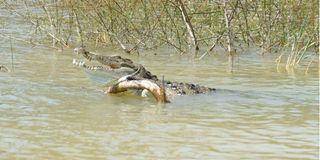
Philip's case is among a growing number of incidents along Lake Turkana in which fishermen have been killed by crocodiles while others have suffered life-changing injuries.
For affected families, the danger does not necessarily end when an attack is over. They can be left without a breadwinner, with damaged or lost fishing equipment and, in cases involving missing or unidentified victims, facing a lengthy process to establish what happened before compensation can even be considered.
The attacks are taking place as rising water levels in Lake Turkana push crocodiles towards areas increasingly occupied by people.
Turkana County KWS Warden William Tanui confirmed that crocodiles are moving closer to human settlements as their natural habitat is disrupted.
“Due to rising water levels in Lake Turkana, crocodiles have left their natural habitats and moved dangerously close to human settlements. During this breeding season, their aggression increases, thus heightening the risk of attacks,” Mr Tanui said.
KWS has deployed rapid-response units to monitor crocodile movement and intervene in high-risk areas, including Todonyang, Lowarengeak, Namukuse and Long'ech villages.
Mr Tanui said the agency was also conducting community sensitisation on crocodile behaviour, safe access to water and emergency procedures.
“We strongly advise that children should not be involved in fishing activities. Livestock must also not be left unattended near water sources,” he said.
Turkana Governor Jeremiah Lomorukai encountered families affected by crocodile attacks during a development tour of the lake region in Kerio Delta Ward in February.
Angered by what he described as inadequate intervention by KWS, the governor supported plans by locals to kill crocodiles posing a threat, saying his administration was prepared to provide boats with high engine capacity for the exercise.
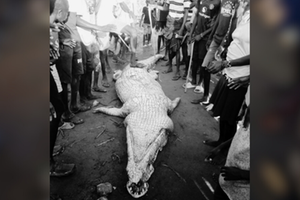
“Over 40 people have been killed by crocodiles on Lake Turkana. During my recent tour to Kerio, we met a crocodile that we dealt with on a section of the road that is about to be swallowed by the lake. The crocodiles must be killed, or they will better attack the rangers, not locals,” he said.
He said boats distributed by his administration to support fishermen in Kerio, Kalokol and Lake Zone wards could be used in a crocodile-hunting expedition if authorities failed to take responsibility.
“If KWS can't safeguard the crocodiles within their protected area, we will deal with them when they invade villages. We are forming a team to deal with that menace,” the governor said.
While attacks continue, KWS says some cases are being complicated by delays in reporting.
The shores of Lake Turkana.
Photo credit: Shutterstock
Mr Tanui said many cases being followed up for compensation were never reported at nearby police stations, making it difficult to establish structured searches, document missing persons or verify recovered body parts.
“There are local structures in place at village level where claims start before final approval to guarantee compensation,” he said.
But for families with little knowledge of the claims process, navigating those procedures can be difficult, particularly after a sudden death or disappearance.
Turkana Central MP Emathe Namuar said residents were being hit hard by rising lake waters and the increasing threat of crocodile attacks.
“Despite Lake Turkana being a danger zone, compensation is also not forthcoming. This should be urgently addressed because most youth are risking their lives to engage in transport services and fishing activities,” he said.
He urged KWS to fast-track the processing and payment of compensation to families affected by human-wildlife conflict, saying timely compensation was both a legal obligation and a humanitarian imperative.
He also called for compensation for displaced families, including residents of Ng'imuria village, which has been completely submerged by the rising waters and forced people to leave their ancestral land.
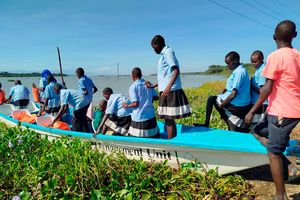
As crocodiles move closer to communities, fishermen have also been trying to make the lake safer through their own structures. Through the Turkana County Department of Fisheries, fishermen have registered more than 30 Beach Management Units (BMUs).
The BMUs have demarcated three breeding areas — Ekoyo in Kalokol Ward, Nariokotome in Lake Zone Ward and Nakurio in Kerio Delta Ward — as part of efforts to manage fish stocks sustainably.
The decline in fish stocks has forced fishermen to take a greater role in protecting breeding areas through monitoring and surveillance.
BMU officials say the measures have also improved safety. Mr Stephen Ekuwom, one of the officials, said demarcating the breeding areas has helped reduce the exposure of fishermen to crocodile attacks.
But the economic pressure remains. Ms Dinah Akeno, a resident of Kalokol town, said families were struggling as men increasingly kept away from the lake because of fear of attacks.
“Many boats have been damaged or swept away, while fish processing and trading activities have been severely disrupted due to rising waters. Unlike before, cases of fishermen missing due to crocodile attacks or capsized boats have increased,” she said.
For families dependent on fishing, staying away from the lake is not always an option. Keeping men off the water may reduce exposure to crocodiles, but it also threatens the income that puts food on the table.
The rising waters have compounded the crisis for communities living along the shores. Homes and settlements have been displaced, fishing grounds disrupted and transport routes affected.
For residents of Ng'imuria, the threat has already become reality: their village has been completely submerged, forcing families from ancestral land. Mr Namuar said such displaced families should not have to wait indefinitely for assistance.
The same concern applies to victims of crocodile attacks. For a family that loses a fisherman, the economic consequences can be immediate. A death can mean the loss of income, fishing equipment and a household's ability to meet basic needs.
A fisherman loads fish on a bicycle at Kalokol area of Lake Turkana in Turkana County.
Photo credit: Jared Nyataya | Nation Media Group
For families such as the Epuus, however, there is an additional burden-uncertainty.
More than a year after Philip disappeared, his family still does not know where their son is. Body parts they believe belong to him remain unresolved after DNA tests failed to establish a match with his parents.
And while the family waits for answers, the broader danger along Lake Turkana continues.
KWS says it is increasing surveillance, deploying rapid-response teams and educating communities on how to avoid crocodile attacks. Fishermen are establishing protected breeding zones and monitoring the lake. Local leaders are demanding stronger intervention and faster compensation.
But for families already caught between a changing lake, hungry crocodiles and a complicated compensation system, prevention alone is not enough. They need a system that responds quickly when tragedy strikes, one that can establish what happened, identify the dead, help families bury their loved ones and deliver compensation without forcing already devastated households through years of uncertainty.
But for now, the search for answers continues far beyond the lake, in mortuaries, government offices, DNA laboratories and the bureaucratic maze between an attack and the compensation meant to help its victims.