For 600 members of the Ilimanyang community in Kapua village, Turkana, staying cool can be a matter of survival. In temperatures that can reach 39 degrees Celsius, they say they cannot sweat normally and must repeatedly sprinkle water on their skin to keep their bodies from overheating.
It affects newborn care, education and social acceptance. The Ilimanyang are seeking formal recognition of their medical needs as persons with disabilities, hoping this will open access to specialised healthcare, social protection and other government support.
The National Gender and Equality Commission (NGEC) has pledged to bring in medical experts to assess the community and establish what interventions are needed. Once the assessment is completed, the precise condition affecting the group will be formally established.
Nancy Ebolon, a community member who has campaigned for recognition, described a routine shaped by the need to keep cool and eat frequently.
“An Ilimanyang person faints if they don’t eat within an hour or don’t get water to sprinkle on their bodies after half an hour. If the situation worsens further, they die,” she said.
Ms Ebolon said members have hairless skin that becomes tight and painful in the sun without water. Dental development can also be abnormal; some men, she said, go decades without teeth before developing only two.
The greatest fear, she said, is for children born with the condition. Some newborns reportedly die within hours or days of delivery, with families struggling to provide the constant cooling and delicate feeding they need.
“Our greatest challenge is that most children die in the initial hours or days after a safe childbirth,” Ms Ebolon said.
The reported deaths have not been medically attributed to a confirmed diagnosis, underscoring the need for specialist assessment and neonatal care.
The challenges do not end at home. Ms Ebolon said some fathers reject children born with the condition, regarding them as a bad omen and comparing them to fish, snakes or evil beings. Such stigma can leave mothers and children isolated when they most need support.
Schooling brings another burden. Some candidates must travel long distances to sit national examinations, in a region already affected by extreme heat, water scarcity and limited access to services. NGEC chairperson Rehema Jaldesa said some pupils travel up to 60 kilometres to an examination centre and the same distance back.
“How can a child cover 120 kilometres in the harsh climatic condition a day just to sit for the national examination?” she asked, calling for a national discussion on affirmative action and examination arrangements for pupils facing exceptional barriers.
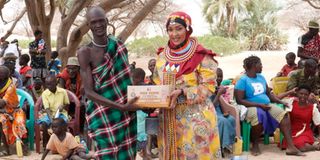
National Gender and Equality Commission (NGEC) Chairperson Rehema Jaldesa hands over donations to an Ilimanyang representative at Kapua village in Turkana Central Sub County on October 8, 2026.
Photo credit: Sammy Lutta | Nation Media Group
Ms Jaldesa warned that girls making such journeys could also face sexual abuse and raised the issue with Education Cabinet Secretary Julius Ogamba.
Turkana County Chief Officer for Medical Services Gilchrist Lokoel said the symptoms described by the community are consistent with hypohidrotic ectodermal dysplasia (HED), a genetic disorder affecting the development of sweat glands, hair and teeth.
However, an assessment is needed to determine whether this is the condition affecting the Ilimanyang.
Reduced or absent sweating makes it difficult for the body to release excess heat, raising the risk of hyperthermia and potentially life-threatening heatstroke. In Turkana’s hot, arid climate, the risk is serious.
Dr Lokoel said affected people need access to water to cool their skin and should, where possible, stay in well-ventilated homes and cooler environments.
HED can also cause dry eyes, reduced saliva, dry skin and dental problems. Dr Lokoel recommended individualised dental care, artificial tears, skin moisturisers and genetic counselling to help families understand inheritance.
The Ilimanyang are already recognised as a minority and marginalised community, but say that status does not address their medical needs. Ms Ebolon said they believe they descend from the Turkana and El Molo communities, associated with Lake Turkana.
They also face poverty, hunger, water shortages and limited access to medication. They told the NGEC they struggle to obtain identity cards and birth certificates and called for more schools and a reliable water supply.
Water scarcity complicates cooling, while limited healthcare can delay treatment. Without documented medical needs and targeted interventions, the community fears it will remain overlooked.
Ms Jaldesa said the commission would work with health experts and relevant institutions to establish the community’s medical needs. It also plans to convene inclusion-sector stakeholders, including the National Council for Persons with Disabilities, to consider what support may be available.
“We will bring a medical camp to do a thorough medical assessment for the community to establish the condition of the Ilimanyang people,” she said, adding that the absence of evidence about the condition itself was part of the problem.
Formal recognition could improve access to social protection, healthcare, specialised funds, scholarships or assistive devices, depending on the findings and applicable eligibility requirements.
The assessment is expected to help identify appropriate medical, educational and social interventions; it does not, however, guarantee registration or benefits.
Cabinet Secretary Beatrice Askul welcomed the NGEC’s new regional office in Lodwar, saying it would address discrimination against marginalised groups.
Deputy Governor John Erus said the county was incorporating inclusion into its programmes. County Assembly Speaker Charles Lokioto pledged to advance social protection and disability legislation.
For the Ilimanyang, the next step is a medical assessment that can replace uncertainty with evidence—and help determine what support is needed for children and adults to live more safely and participate fully in public life today.