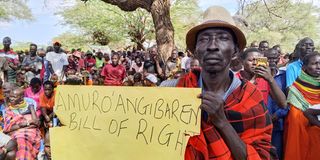
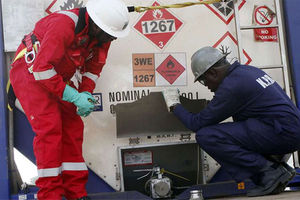
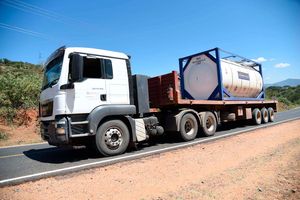
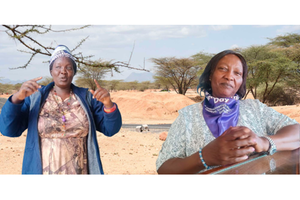
Turkana residents are mounting a fresh resistance against Kenya’s renewed push for commercial oil production, warning Parliament and investors that they will not tolerate ‘secretive deals’ that “marred” previous oil exploration in the county.
With memories of broken promises still fresh, communities around the South Lokichar Basin say they are determined to ensure that history does not repeat itself, as the government revives plans for commercial oil production under the new investor, Gulf Energy E&P BV.
The local communities are pushing back against what they describe as opaque oil deals that previously excluded them from benefits during Tullow Oil’s tenure.
Their demands for transparency, inclusion and fair benefit-sharing come into sharp focus this week as the Senate Standing Committee on Energy and the National Assembly Departmental Committee on Energy begin public hearings on the South Lokichar Field Development Plan (FDP) and associated Production Sharing Contracts.
Lawmakers are now racing against a February 24 deadline to conclude their review of the plans and incorporate public submissions.
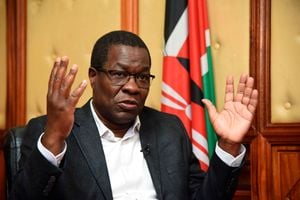
While appearing on Monday before a joint sitting of the Senate and National Assembly energy committees, Energy Cabinet Secretary Opiyo Wandayi defended the government’s decision to approve the South Lokichar FDP, saying the project is legally compliant, economically viable and critical to Kenya’s petroleum sector.
turkana
Photo credit: Sammy Lutta | Nation
The demands by the local communities are expected to dominate public consultations also scheduled across Turkana, West Pokot, Lamu, Mombasa, Trans Nzoia, and Uasin Gishu counties, placing Parliament in the spot of a high-stakes decision over Kenya’s long-delayed oil ambitions and whether local communities will finally secure a meaningful share of benefits.
Crude oil discovery in Turkana County in 2012 raised expectations that South Lokichar would experience rapid economic transformation.
During the exploration phase, an estimated 560 million barrels of recoverable oil were identified, leading to a boom in local businesses and job opportunities around Lokichar.
However, when petroleum activities later halted, many families were left struggling, with livelihoods collapsing after businesses closed amid rising banditry, prolonged drought and limited economic activity.
Lokichar town, once vibrant during oil exploration, has since slipped back into economic stagnation.
“We refuse to repeat the painful history where resources meant for the host community were looted by political elites, with the silent approval of oil deals. That era is over. This time, corrupt politicians and complicit companies will meet firm resistance from a united and determined people,” declared Mr Nangiro Lemuya, a Turkana South youth leader.
Mr Lemuya said residents are demanding full transparency, direct community participation and legally guaranteed and enforceable benefits for people living around the South Lokichar Basin.
This, he added, includes rightful compensation for land, employment and revenue sharing.
“If these demands are ignored, we are prepared to mobilise, resist and defend our rights by all lawful and legitimate means,” he said, accusing some former local representatives of the community of enriching themselves by exploiting the oil discovery as a political bargaining tool.
Residents say the discovery of oil reshaped their lives, even though tangible benefits remained elusive.
“Through Tullow Oil scholarships, some of us acquired technical skills like plumbing and electrical work. But when operations stopped, those skills became useless,” said Mr Davidson Lokale, a resident of Kapese village and Lokichar Youth Chairman.
“We want an opportunity to put these skills into practice and improve our lives,” he said.
Mr Lokale said many young people have been left idle since Tullow Oil halted operations, pushing some into drug and alcohol abuse due to hopelessness.
“We welcome Gulf Energy’s entry and are happy that it is resuming oil production. But the government should ensure locals are prioritised for jobs and contracts,” he said.
President William Ruto and Turkana East MP Nicholas Ngikolong Ngikor (right) join traditional dancers in a jig during the Turkana Tourism and Cultural Festival the Tobong'u Lore, in Lodwar town, Turkana County.
Photo credit: Photo/PCS
Last December, President William Ruto said his administration was keen and committed to unlocking Turkana’s oil resources through a new National Petroleum Policy, which he said would improve revenue management and ensure host communities benefit directly.
He spoke at the 9th edition of the Turkana Tourism and Cultural Festival, popularly known as the Tobong’u Lore festival.
“The new policy will improve revenue management and guarantee that the people of Turkana benefit directly from their oil resources,” the President had said.
However, residents say policy assurances must be backed by enforceable safeguards.
They have openly opposed what they describe as backroom deals, secretive negotiations and political interference that previously locked them out of benefits from petroleum activities during Tullow Oil’s tenure, even as oil was framed as a national economic asset.
“Let it be known that the people of Turkana South are awake, organised and ready. We shall closely monitor every stage of this process from licensing, engagement, compensation, employment, procurement, and revenue sharing,” Mr Lemuya said.
Mr Samwel Lopeyok, a resident of Lokiriama, said Turkana’s poverty levels expose the failure of past resource governance. He noted that despite Turkana’s oil wealth, eight out of ten residents live below the poverty line.
“The county primarily relies on equitable revenue sharing. Any resource extracted from Turkana must first lift our people out of extreme poverty,” he said.
Parliament under pressure
Opinion leader Sylvia Lapur said Parliament faces a defining test, and that it was time it acknowledged decades of neglect suffered by Turkana communities.
“For decades, Turkana has borne neglect and hunger. As Parliament reviews oil development plans for our land, our voices must finally count. This oil must not become another story where resources leave while our people remain poor,” she said.
She called for an oil development model that protects land, water, and grazing fields, while creating jobs. infrastructure and social services such as schools, hospitals, roads, and irrigation systems, as well as guaranteeing a fair share of revenue for local communities.