At sunrise in Natirira village in Baringo County’s remote Tiaty Constituency, the first movement of the day is not children heading to school or herders driving cattle to pasture. It is women stepping out of their homes with plastic jerrycans strapped to their backs, beginning a journey that will take hours, in search of a drop of water.
Their destination is the Kerio River, more than 10 kilometres away.
Some days, they return with murky water scooped from shallow pools dug in the sand. On other days, the riverbed is dry, forcing them to walk even further in search of the precious resource that defines survival in Kenya’s arid north.
For the residents of Natirira, the journey has become routine, repeated through generations. Yet it is also a reminder of a promise, a decade gone, that was meant to end such hardship. This was the promise of water projects funded under Kenya’s devolved system of government.
A woman pulls a jerrican of water in Kanamkuny village,Turkana County, on October 11, 2022. As climate change intensifies, women face higher rates of violence, displacement, and poverty.
Photo credit: File | Nation Media Group
Thirteen years after devolution introduced county governments with the aim of bringing services closer to citizens, many villages in Tiaty still lack a single functioning borehole today, despite locals repeatedly prioritising water projects during public participation forums.
In Tiaty, water scarcity dictates the rhythm of everyday life and determines when families stay and when they must leave. The pattern repeats itself every year.
On paper, millions of shillings have been allocated to address water shortages in the arid regions. Yet on the ground, many villages still lack a single functioning borehole, raising uncomfortable questions about whether the funds ever translated into actual projects.
Across Tiaty Constituency in Baringo County and Turkana County, national amd county budgets show millions of shillings were allocated over the various financial years for boreholes intended to ease chronic water shortages.
But on the ground, many of these projects are either completely missing as they were never implemented, or are incomplete, dysfunctional, and untraceable.
The result is a growing sense of betrayal owing to the troubling gap between budget allocations and the reality faced by residents who still walk kilometres in search of a drop of water, hence the persistent question among residents: if the money was budgeted, where did it go?
108 non-existent boreholes
In Turkana County, authorities recently disclosed that 108 boreholes listed in official records cannot be traced, while about 600 of the county’s 2,161 boreholes have broken down.
For local communities already battling drought, the revelations have deepened questions about how water projects are planned, funded and managed and why so many appear to stall before reaching the people who need them most.
In Tiaty, where villages remain deserted during the dry season because of families migrating in search of water, food and pasture for livestock, residents say they expected that the introduction of county governments in 2013 would gradually reduce the need for such movements by investing in permanent water infrastructure.
During public participation budget meetings held under trees or at local trading centres, villagers have repeatedly voiced the same priority - drill boreholes to provide reliable water throughout the year.
Year after year, the request appeared in development plans and county budgets. But many of the promised projects never materialised.
For locals like Ms Chepokapisioch Akoritepa, a resident of Natirira village in Kolowa sub-County, the wait for water has stretched across decades.
She says she has walked the same dusty path to the Kerio River for more than 30 years, carrying jerrycans across terrain that becomes increasingly unforgiving during prolonged droughts.
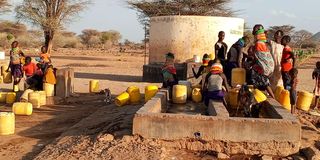
Residents of Lomelo village in Turkana East fetching water that had been trucked by the military on February 17, 2025
Photo credit: Steve Otieno I Nation Media Group
Ms Akoritepa remembers attending community meetings many years ago when her 17-year-old son was still an infant. During those gatherings, residents unanimously prioritised drilling a borehole in their village, believing that devolution would finally address their longstanding water shortage.
“For more than ten years, we have sat under trees during public participation forums asking for a borehole. But none has been drilled,” she says.
Today, her son attends similar meetings and hears the same requests being made. It troubles her that her children are now repeating the same journey.
“My firstborn son is now 17 years old. He has grown up seeing men move with cattle every dry season because there is no water here,” she narrates.
The impact of the water shortage extends beyond daily hardship. As families migrate to areas near the Kerio River or into neighbouring West Pokot County, often taking their school-going children with them, education is frequently interrupted.
“Children end up dropping out of school because families must move in search of water,” Ms Akoritepa says.
When Daily Nation visited the village recently, the consequences of the water crisis were visible.
Out of roughly 75 families living in the area, more than 55 had migrated with their livestock in search of water and pasture, leaving only a handful of households behind. Schools were largely deserted because many children had travelled with their parents.
Other residents in Natirira say they have repeatedly selected borehole projects during annual budget consultations, only to see them stall or disappear without explanation. Projects just never reach the ground.
A villager, Mr Sammy Samali, says the village has little to show for its participation in the development planning process aside from the construction of an Early Childhood Development Centre that began this year.
He says the community has prioritised drilling a borehole in their area nearly every financial year since the introduction of county governments.
“Despite allocating money for it again and again, the project has remained a dream,” he says.
Even during the 2023/2024 financial year, residents once again prioritised a borehole project using the Equalisation Fund. While some other projects selected during the same process have been implemented, the water project has yet to start.
Water experts say the persistence of shortages in areas such as Tiaty reflects a combination of financial constraints, technical challenges and weaknesses in project planning.
According to the Centre for Enhancing Democracy and Good Governance, access to clean water in Baringo County stood at about 39 per cent in 2022, with Tiaty lagging far behind at roughly 10 percent.
Mr Evans Kibet, a programmes officer at the organisation, says improving water coverage in such remote areas requires substantial investment, particularly because of the logistical costs involved in transporting drilling equipment and construction materials.
He also notes that some parts of Baringo lie along geothermal belts where groundwater can be highly saline and unsuitable for human consumption, forcing authorities to abandon certain boreholes after they are drilled.
Another challenge arises from the participatory budgeting process itself. Although communities are allowed to choose which projects should be implemented, they often lack the technical information needed to determine how much funding is required.
As a result, many villages allocate around Sh2 million for a borehole project, far below the amount needed to drill, equip and pipe water to households.
According to social audits conducted by civil society groups, about 80 percent of community-selected water projects are underfunded, meaning they either stall midway or remain incomplete for years.
Women and children who were spotted looking stranded in Sinoni area in Mochongoi, Baringo County on February 16, 2023. They were returning to their homes in Seretion village from Romulel village, 10 kilometres away, where they normally spend their nights out of fear of being attacked by armed bandits armed at night.
Photo credit: Jared Nyataya | Nation Media Group
Several borehole projects in Tiaty illustrate these challenges. Kapluk, Sertonje, Chebutii and Citadel boreholes were drilled during the 2019/2020 financial year but could not be completed within the same period, forcing the installation of equipment and piping systems to be carried forward to the 2020/2021 financial year.
Investigations by the Daily Nation also reveal that some projects approved in county budgets have yet to move beyond the planning stage. Among them is the Ngenypokwetetin borehole in the remote Tirioko Ward, which was allocated Sh2.4 million in the 2021/2022 financial year but has not been drilled to date.
Another project, the Cheprechpoch borehole, received an allocation of Sh2.5 million in the same financial year but remains unimplemented, leaving residents without the reliable water source they expected.
In neighbouring Turkana, one of the country’s driest regions, authorities recently revealed that 108 boreholes listed in official records cannot be traced, while about 600 out of 2,161 boreholes across the county have broken down.
The revelations emerged during a heated session of the Turkana County Assembly as county officials briefed legislators on drought conditions.
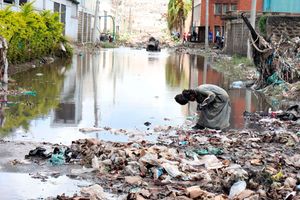
The shortages have forced residents in some areas to walk more than 20 kilometres to reach the nearest working borehole, leading to congestion and occasional conflict at water points, while others resort to unsafe water sources that expose them to diseases.
According to Turkana County Water Executive Willy Justus Akwalata, the failures stem from a mix of environmental and logistical challenges.
He told MCAs that many boreholes were experiencing declining yields due to prolonged drought, which has placed enormous pressure on groundwater reserves.
Groundwater levels are falling due to prolonged drought, placing heavy strain on existing boreholes, and many water systems also lack preventive maintenance.
He also cited the lack of preventive maintenance programmes in remote areas, where mechanical failures often go unrepaired for months because spare parts are unavailable or difficult to obtain, meaning repairs can take months, or never happen.
“Hand pumps and solar pumping systems break down frequently due to wear and tear, sand abrasion, corrosion and electrical faults,” he told the county assembly.
The crisis triggered a heated exchange between county officials and Members of the County Assembly over who bears responsibility for the failing water infrastructure.
Several legislators accused the county water department of neglecting certain wards and failing to repair broken boreholes, while officials countered that some leaders had not allocated sufficient funds for sustainable water projects.
Kangatotha MCA Mathew Alany said more than a dozen boreholes in his ward were not working, while declining water access had forced students to abandon school.
Other MCAs complained that emergency water trucking, often the only relief during drought, used to supply villages facing acute shortages, had not reached many. But county officials said such interventions are costly and cannot replace permanent infrastructure.
Mr Akwalata turned the blame back on politicians. He accused some leaders of promoting short-term fixes such as water trucking instead of funding permanent solutions like boreholes. In other cases, he said, wards had failed to allocate sufficient funds for water projects.
The County Water CEC proposed allocating about Sh30 million from ward development funds to establish spare-parts stores at the sub-county level, allowing quicker repairs when boreholes break down.