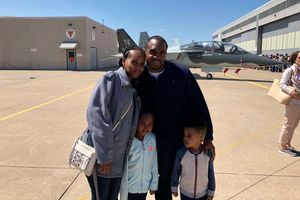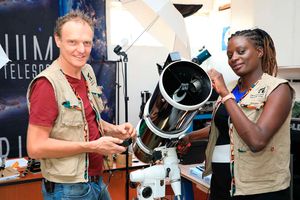
Mr Samuel Ndaro, an aeronautical engineer working with Boeing. He took part in the construction of a component that will be used in the launch of the Orion spacecraft.

As the Orion spacecraft thundered off the US state of Florida to the skies on Wednesday night, marking a critical step in the Artemis II mission, Kenyan-American engineer Samuel Ndaro was an excited man.
The Mombasa-born alumnus of the Alidina Visram High School was watching the Artemis II launch but with keener interest than a typical spectator.
It is because in the mission preceding this, Artemis I, he was part of the thousands who made the system that propelled the rocket to space.
He has been an employee of US aircraft maker Boeing since 2013, and Boeing was in the team making the “large cylinders” that burn fuel and enable the top-most part – the spacecraft – to pierce past the atmosphere and onto space.
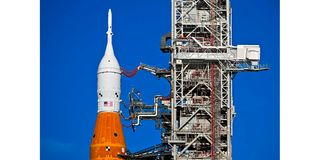
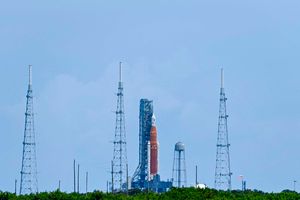
The Artemis I unmanned lunar rocket sits on its launch pad 39B at NASA's Kennedy Space Centre in Cape Canaveral, Florida.
When he spoke with the Nation in 2022, he explained that he was part of the liaison engineers for the project that made the intertank, a key connector of the cylinders. The Orion spacecraft for Artemis I went into space on November 16, 2022 and went round the moon for six days. It returned to Earth on December 11, 2022.
The spacecraft that carried four humans to space is also called Orion and although it was made with the same design principles as that in Artemis I, it was built anew.
“My team was part of Artemis I development and majority of them are still part of Artemis II,” Mr Ndaro, 42, told the Nation on Wednesday ahead of the launch.
Mr Samuel Ndaro, an aeronautical engineer working with Boeing. He took part in the construction of a component that will be used in the launch of the Orion spacecraft.
“I am hoping for a successful mission. This will be key for the future of exploration,” added the former US army soldier.
Artemis II made history by sending a black man, a woman, and a non-American to deep space for the first time. It is also the first time humans are going beyond 2,000 metres of the earth’s surface since 1972.
On the record-breakers in the flight, Mr Ndaro said: “The world has evolved. I think it is a normal thing now. They are all well qualified crew to be part of the mission. They have a job to do and I am sure they are trained to execute the assignment flawlessly.”
The astronauts in the Artemis II mission are Reid Wiseman, Victor Glover, Christina Koch and Jeremy Hansen. Their spacecraft will go round the moon, passing over the far side that is permanently out of humans’ view, then back to Earth.
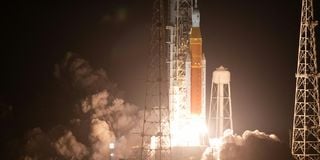
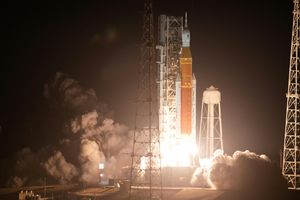
In this handout photo provided by NASA on November 16, 2022, the Artemis I unmanned lunar rocket lifts off from launch pad 39B at NASA's Kennedy Space Center in Cape Canaveral, Florida. NASA's Artemis 1 mission is a 25-and-a-half day.
Artemis III will follow, which will take astronauts to low earth orbit for tests, before Artemis IV takes humans back to the moon in 2028.
The Kenya Space Agency told Nation that Artemis II is a “significant milestone”.
Mr Jacques Matara, the acting deputy director for Space Research and Innovation, said the launching of the four astronauts “serves as both an inspiration to Stem [science, technology, engineering and mathematics] professionals and a catalyst for innovation, research and potential technology transfer”.
“This mission reinforces confidence in humanity’s ability to push the boundaries of exploration and unlock new possibilities through emerging technologies. As efforts toward a sustained human presence on the Moon progress, the pathway to Mars becomes increasingly realistic, with Artemis II serving as a critical precursor to future deep space missions,” said Mr Matara.
To Kenyans who have expressed scepticism as to whether man has ever landed on the moon, Mr Matara said the evidence is out there with the Apollo missions of the late 1960s to the early 1970s that saw American astronauts set foot on the moon.
“The Apollo missions are widely supported by extensive documentation, data, and international collaboration within the global space community. The Apollo missions are widely supported by extensive documentation, data, and international collaboration within the global space community,” noted Mr Matara.
Follow our WhatsApp channel for breaking news updates and more stories like this.