As more than 1.1 million learners settle into their April holidays, the dust is beginning to settle on a milestone in Kenya’s education calendar.
This was the term that saw the transition of the inaugural Grade 10 cohort from junior to senior school.
While the Ministry of Education celebrates a “99 per cent” transition rate, a look on the ground reveals a system stretched to its limits.
What was envisioned as a bold leap into the competency-based education (CBE) has exposed fragile infrastructure, a staffing crisis and an assurance vacuum that threatens to undermine the reforms intended to modernise schooling.
Kenya Union of Post Primary Education Teachers (Kuppet) Chairman, Omboko Milemba, said this began when then-Education CS George Magoha fast-tracked the construction of thousands of classrooms in secondary schools in preparation for the CBE shift, only for the Presidential Working Party on Education Reforms to recommend that junior schools remain hosted in primary schools.
“Classrooms remain idle in senior schools while junior school learners are squeezed into spaces that lack the specialised environments required for the new curriculum,” Mr Milemba said.
He is now pushing for “cross-fence operations”. The Emuhaya MP argues that the separation between a junior and a senior school is just a fence in many cases.
“Why should students suffer in one compound when a fully equipped but unused laboratory is just metres away?” he asked.
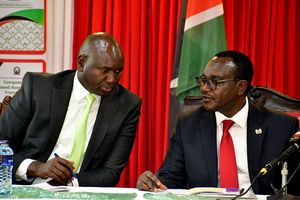
Chairperson Kenya Union of Post-Primary Education Teachers (Kuppet) Omboko Milemba (centre) addresses the media flanked by union officials after a consultative meeting at Sports View, Kasarani, Nairobi, on March 3, 2026.
Photo credit: Wilfred Nyangaresi | Nation
Lack of facilities is particularly biting for a system that places emphasis on Science, Technology, Engineering, and Mathematics (STEM).
While the government built 23,000 classrooms in the 2024/25 financial year, the laboratory gap is still glaring.
The government has pledged to build 1,600 laboratories this year, but for students, the wait for practical learning continues.
Mr Milemba has raised the alarm over a growing street market for examinations, saying lack of an organised assessment framework in junior schools has made teachers resort to buying papers from vendors.
He has called for greater autonomy for junior schools to allow instructors who understand the specific needs of learners manage their testing.
Without proper quality assurance, there is fear that learning is being replaced by testing using substandard materials.
While junior schools struggle with physical space, senior schools face “brain drain” of a different kind.
The CBE system introduced diverse career pathways, including aviation, marine and fisheries, sports science and building and construction. However, the Teachers Service Commission (TSC) has not deployed specialists for these areas. In the 8-4-4 system, aviation was only offered by a few national schools.
Kenya Secondary Schools Heads Association (Kessha) Chairperson Willie Kuria describes the situation as “navigating an uncharted territory”.
Kenya Secondary School Heads Association Chairperson Willie Kuria addressing journalists in Mombasa during the 2024 International Confederation of Principals World Convention in Mombasa on August 22, 2024.
Photo credit: File | Nation Media Group
“I don’t think there is a school in Kenya fully staffed with teachers for subjects like aviation or marine technology,” Mr Kuria told the Nation.
The Murang’a High School head added that principals are made to hire professionals using Board of Management funds.
“Because of little capitation, it becomes difficult for schools to operate. The school fee structure was developed and implemented in 2014 but this is 2026. Inflation is a reality for school leadership,” Mr Kuria added.
He said the annual Sh53,000 fee for boarding school per student is not enough. Senior schools expect Sh22,000 per student from the government, but only Sh14,000 hits the accounts.
During a meeting called by Head of Public Service Felix Koskei, principals aired their frustrations.
“In first term, only Sh6,500 was sent, yet school heads expected Sh11,000. The fee required for a student in boarding school is Sh95,000, not Sh53,000,” Mr Kuria said.
Acting TSC Chief Executive, Evaleen Mitei, says the commission is talking to partners – including the Kenya School of TVET – to source and absorb technical professionals.
Oxford University Press Publishing Lead Rosemary Jepchirchir (right, in blue t-shirt) briefs Education Cabinet Secretary Julius Ogamba (left) on the school books on display during the launch of the distribution of Grade 10 textbooks at English Press Ltd offices on January 22, 2026.
Photo credit: Francis Nderitu | Nation Media Group
Director of Quality Assurance, Reuben Nthamburi, says CBE has expanded specialised subjects like aviation to other schools.
“Kibabii, Lugari and Kagumo teachers’ colleges have completed training students in new subjects, but the TSC is waiting for certification before absorption,” Dr Nthamburi said.
Despite the crises, the Ministry of Education remains optimistic. Basic Education PS Julius Bitok says the country is undergoing a necessary transformation.
Prof Bitok adds that the government released Sh5.6 billion for textbooks and other learning materials.
He says the government owed publishers Sh10 billion at the start of the year, but half of it has been settled, allowing Grade 10 books to be distributed.
Higher Education PS Beatrice Inyangala says graduates from the Technical University of Kenya and Kenyatta University can teach aviation in senior school, but they must complete a postgraduate diploma in education.
The learners at home pray that the promises given by Prof Bitok will be kept when they return to school for the second term of the academic year.