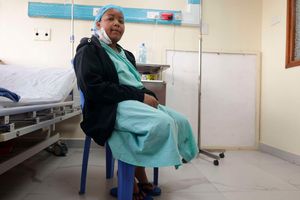
On October 29, 2015 a young woman walked out of the Kenyatta National Hospital, having given birth to a bouncing baby girl just days earlier.
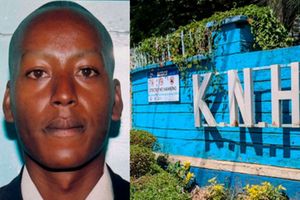
Hospital staff reported to their superiors that they had spotted a veteran security guard walking side-by-side with the woman and her child, out of ward 3B and towards the exit.
The same hospital staff reported that when asked, the security guard claimed to be escorting the woman to a clinic within the facility, and that he would ensure she returned to the ward.
That security guard was not on duty, as his leave had been approved.
The woman left the hospital with her child, without paying the Sh52,511 bill that had accumulated at that time.
The security guard was dismissed following an internal disciplinary hearing, but he successfully sued for wrongful termination as the court found that KNH did not give the former worker a chance to cross-examine other staff who claimed to have seen him sneak the woman and her child out.
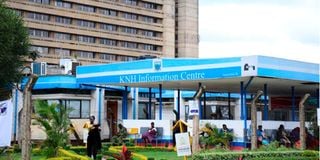
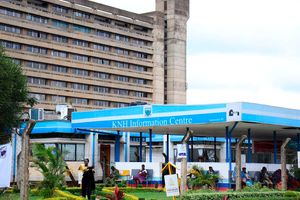
Kenyatta National Hospital.
Photo credit: File
As for KNH, that Sh52,511 bill is among those left unpaid by at least 17,906 runaway patients and whose debts to the hospital Auditor-General Nancy Gathungu now says have accumulated to Sh866.5 million over a number of years.
The unlawful termination case against a former KNH worker hinted at how collusion with insiders could have aided some of the nearly 18,000 patients managed to outsmart in-house and outsourced security personnel tasked with ensuring all bills are paid before exit.
Usually, a discharged patient is required to present stamped documents, including receipts, to security personnel at the exit before being allowed to leave.
Audit: Value for money questionable
Abscondment Revenue Loss
0
Outsourced Security Cost
0
Avg. Bed Occupancy
0
Average Length of Stay
0
Asset Value: Sh 12.7B — Operational Readiness: Significantly Deficient
Data Visualized by Geoffrey Onyambu
Source: Auditor-General
In her audit report on KNH for the 2024/25 financial year, Ms Gathungu says that the hospital spent Sh74.5 million on outsourced security services, but may not have got value for money as runaway patients still got away with unpaid bills, while two mysterious murders also occurred on the premises.
She was referring to the murders of Gilbert Kinyua and Edward Maingi Ndegwa in February and July, 2025 respectively.
Ms Gathungu in her audit says that the runaway patients absconded over an undisclosed period and have now exposed weaknesses in the hospital’s security system, though the facility spends millions of shillings on private security guards annually.
Auditor-General Nancy Gathungu.
Photo credit: File | Nation
“In addition, the hospital has accumulated over the years an amount of Sh866,570,817 from 17,906 patients with abscondment cases indicating lapses in ward-level access controls, patient monitoring, and surveillance,” Ms Gathungu said.
The public auditor now questions the effectiveness of internal controls at KNH, flagging weaknesses in its physical security controls.
This is a damning revelation on Kenya’s biggest health facility where hundreds of thousands of Kenyans are treated every year.
KNH management says it is working with oversight institutions to address weaknesses raised on its operations, though it did not respond to specific questions such as the rationale for spending millions of shillings to outsource security services, but still having cases of patients killed and escaping from wards.
“The hospital continues to work closely with relevant government oversight institutions to address the matters raised and strengthen systems that support quality patient care,” KNH’s acting Chief Executive Officer (CEO) Richard Lesiyampe said.
Mr Lesiyampe, however, declined responding to specific questions on the issues raised, indicating that the issues are before Parliament’s Public Investments Committee (PIC) where the hospital will address them.
“The hospital will provide the necessary clarifications through the established parliamentary oversight process and will be guided by the committee’s direction on the same,” Mr Lesiyampe said.
Nearly half-a-million Kenyans were treated at KNH during the year ending June 2025, including 390,000 who sought outpatient services and 65,000 who were admitted at the hospital, KNH documents show.
The treatments included 37,318 specialised surgeries, 1,045 heart surgeries and 22 kidney implants, underlining the hospital’s crucial role in the country’s healthcare system.
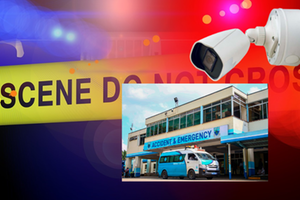
An ambulance, parked at Kenyatta National Hospital, Accident and Emergency wing, on June 21, 2025.
Photo credit: File | Nation
“This financial year, the hospital carried out 9,419 minimally invasive surgeries. It also conducted 22 kidney implants as well as provided a range of other renal services totaling 16,136 procedures, some of which include Continuous Renal Replacement Therapy, Tissue Typing, Venesection, Haemodialysis, Dialysis Catheter procedures, as well as renal biopsy,” Mr Lesiyampe said in the KNH annual report.
The Auditor-General also says KNH is facing a shortage of beds that has seen it admit up to 40 percent patients beyond its capacity, and that patients are now being admitted for longer periods at the hospital.
Wards in the medicine, general surgery, pediatrics and specialized medicine are most affected, with average length of stay at the hospital raising from 8.2 days to 10.2 days.
“The prolonged stays and increased OBD (occupied bed days) have resulted in persistent congestion and over-utilization of inpatient beds,” Ms Gathungu says.
This is besides deficits in equipment across different departments, particularly the accident and emergencies, where critical life-saving equipment such as ventilators, cardiac monitors and suction machines are in short supply.
The hospital also has a shortage of Intensive Care Unit (ICU) beds, support equipment used in emergency interventions such as ergonomic chairs and x-ray viewers, while resuscitation and critical-care equipment such as automated defibrillators and cardiac monitors are obsolete.
The hospital’s leadership acknowledged the challenges with equipment it has been using and noted that it has started upgrading them.
“Modernising hospital infrastructure remained a key strategic focus. Key capital projects included the renovation and upgrading of existing hospital facilities to enhance service delivery environments, along with the phased replacement of outdated medical equipment,” KNH Chairman, Abbas Gullet, said in the hospital’s annual report.