'The shame of wearing diapers as an adult hurts': A cancer patient's plea
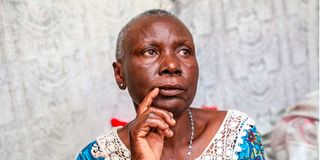
Wilkister Adhiambo, a cervical cancer patient, in a pensive mood during the interview at her home in Ongata Rongai, Kajiado County on February 9, 2026.

What you need to know:
- At her iron-sheet house in Ongata Rongai, Ms Adhiambo exists somewhere between treatment and abandonment.
- Ms Adhiambo's journey with cervical cancer began in 2022, though she did not know it at the time.
Two catheter tubes protrude from Wilkister Adhiambo's body. One hangs loose. The other is broken, a fragment lodged deep inside her kidney, visible only by the hole where it was once attached. Both were supposed to be removed in September last year. Six months later, they remain; not because the medical procedure is complex, but because she cannot raise the Sh32,000 required to have them taken out.
At her iron-sheet house in Ongata Rongai, Ms Adhiambo exists somewhere between treatment and abandonment, between hope and despair, between dignity and humiliation. Her Social Health Authority (SHA) card, which was supposed to be her ticket to treatment, ran dry long ago. Now she waits for a well-wisher, for a renewed card, for anyone, while her body rebels against foreign objects that have overstayed their welcome.
"I am in so much pain," she says. "The tubes hurt. The infection hurts. The shame of having to wear diapers as an adult hurts. The begging for help hurts. I need someone to come to my rescue."
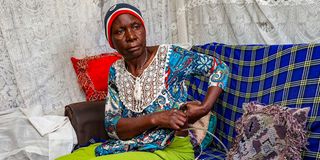
Wilkister Adhiambo, a cervical cancer patient, during the interview at her home in Ongata Rongai, Kajiado County on February 9, 2026.
The site where the broken tube sits is now oozing pus, a sign of infection that could spiral into something far more dangerous if left untreated. The other tube simply hangs there, useless. She went to the hospital, desperate for removal, for relief, for an end to this particular nightmare. The answer was blunt: pay Sh32,000 first.
Ms Adhiambo's journey with cervical cancer began in 2022, though she did not know it at the time. It started with a discharge from her private parts.
Like many women, she initially dismissed it, bought drugs over the counter, and assumed it would resolve on its own. When it persisted, she visited Kibera Health Clinic, which referred her to Mbagathi Hospital.
At Mbagathi, a biopsy was performed and the tissue sample sent to Kenyatta National Hospital (KNH) for testing. Two weeks later, the results returned: Cancerous. Stage 4.
She immediately began treatment: 30 sessions of radiotherapy and five rounds of chemotherapy, all completed within that same year.
"Though I had side effects, they were manageable," she says. "I finished my sessions and attended my clinics in 2023 and 2024, going for regular check-ups. But all was not well. The cancer was not defeated."
In 2025, the symptoms returned. The discharge came back. Doctors recommended another round of chemotherapy, six sessions to beat back the disease. Ms Adhiambo, already exhausted from her previous battle, steeled herself for another fight.
She completed three sessions. But this round was different. The chemotherapy did not just attack the cancer; it drained her blood and left her so weak she could barely function.
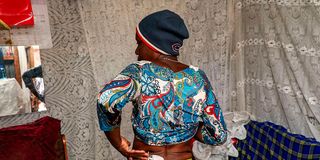
Wilkister Adhiambo displays her urinary catheter during the interview at her home in Ongata Rongai, Kajiado County on February 9, 2026.
She was rushed to Mbagathi Hospital, where doctors transfused blood back into her depleted veins, trying to restore what the treatment had taken away.
But she was too weak to continue. With three sessions still to go, she dropped out of treatment. And because she did not complete the full course, no drugs were prescribed for her afterwards; no maintenance medications, no follow-up treatments, nothing to hold the cancer at bay.
"The cancer cells could be spreading right now, but I have nowhere to turn," she says. "I am waiting for the SHA card to be renewed so that I can start my treatment again."
What followed the three sessions was a cascade of complications that transformed her suffering from merely difficult to absolutely unbearable. The aggressive chemotherapy had damaged her kidneys. She lost control of her bladder entirely.
"I would relieve myself anywhere," she says. "To this day, I live with that shame. I am unable to control myself, and I have to wear diapers."
At KNH, doctors attempted to address the problem by placing two catheter tubes to drain urine directly from her kidneys. For a time, the tubes worked, giving her back some semblance of control over her body. But that solution, too, failed. The tubes stopped functioning properly, and she found herself back where she started - in diapers, bearing the shame, living with the constant fear of public humiliation.
The tubes, placed in June last year, were supposed to be removed in September after three months of drainage, once her body had stabilised. But September came and went. Ms Adhiambo's SHA card had been depleted by the accumulated costs of her treatments. Without coverage and unable to raise the Sh32,000 required for the removal procedure, the tubes stayed.
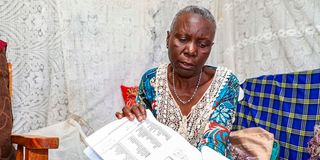
Wilkister Adhiambo, 50, goes through her medical records at her home in Ongata Rongai, Kajiado County on February 9, 2026.
Now, she waits for her SHA card to be topped up in the next cycle. She waits for a well-wisher, for relief from a body that has been at war with itself for three years.
"I am waiting until someone, anyone, comes to my rescue, or for my card to be renewed, so that the tubes can be removed," she says. "I need help even to buy the diapers to manage my shame."
She pauses, then adds quietly: "I would wish to have a better life, but I can't."
Ms Adhiambo waits and hopes that, somehow, she will get to continue her treatment and reclaim her life.