At what age should girls start to develop breasts? Is nine too early? Is 16 too late? Should teens check for lumps? These are questions that many parents and girls worry about, especially since puberty no longer follows a set timeline, and breast cancer can affect younger women.
Dr Mukuhi Ng'ang'a, a breast surgical oncologist at Aga Khan University Hospital, says that previously, girls would develop breasts around ages 12 or 13, and perhaps as early as 11.
"But right now, we have girls as young as nine developing breasts, and we can't explain why. We don't worry about it, but we acknowledge the shift."
However, if a child younger than nine years old, such as a four-year-old, is developing breasts (precocious puberty), it requires investigation.
On the other end of the spectrum, Dr Mukuhi says that developing breasts at ages 16 or 17 is considered late. Even then, there are other factors to consider because some women will have very minimal breast tissue throughout their lives.
"If the girl has received her period, then she is on track. If not, then we start looking inside. Do her organs appear purely female or male? Are her hormones off?"
While there is no need to go for breast examinations, Dr Mukuhi says teaching girls how to do it at home, especially when they are taking a bath, is important.
Dr Mukuhi says it is unusual for a pre-pubescent under-10 to get a breast lump and that it is not something you would routinely check for. However, for teenage girls, lumps should be checked once a month.
She says this can be done by first taking away the shame and shyness of the breast and desexualising it early for the girl.
"This way, she knows what the normal shape of her breasts and nipples is. Using the fleshy part of the palm, she should check for lumps the size of a pea and report anything she finds."
Breasts can be painful as they develop due to hormonal changes. According to Dr Mukuhi, the glandular tissue responds to these changes by becoming very sensitive.
A lot of young girls will complain of discomfort at certain times during their menstrual cycle. For most women in their 20s, this discomfort gets worse at a certain point, but then it settles down. They may still experience some discomfort just before their periods, but overall, it is nowhere near what they experienced when their breasts first developed."
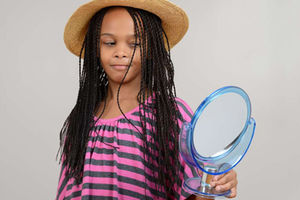
Developing breasts at ages 16 or 17 is considered late.
Photo credit: Shutterstock
Breasts are made up of different tissues, and both men and women have them. The breast has skin, fat, and glandular tissue. The whole breast sits on muscle, and there are ribs behind it.
Generally, lean people are unlikely to experience enlargement of fat tissue in their breasts. "If you look at the child holistically, they tend to be on the heavier side if they have a fatty enlargement of the breast. So, if a child is a normal weight and has big breasts, then you know something is not right."
Dr Mukuhi shares that children should not use deodorant because the armpit changes that lead to pungent sweat occur during adolescence.
"Deodorants will not make a girl get breast cysts, but hormonal changes during puberty will," she adds.
Breasts are sisters, not twins. That is why one breast is bigger than the other. However, Dr Mukuhi says that if the difference is significant, then there is a problem.
"An easy way to tell if there is a significant difference in breast size is to look at the cup size. For example, if one breast is a B cup and the other is a D cup, that is a significant difference."
But if both breasts are B cups and the difference is subtle, such that you can feel that one breast does not fit quite as well as the other, then doctors are not too concerned."
What medical conditions affect normal breast development in children? "It's rare, but children can occasionally be born without breast tissue. Even with a baby, if you touch their breast area, you can feel the tissue under the nipple."
Additionally, when girls' breasts are developing, there is a milk line from the top to the bottom. Dr Mukuhi says that for some people, more than two breasts can develop, or two breasts can develop with extra nipples along the line.
"When girls reach their teenage years, most develop small lumps. While we don't worry too much about them, given the trend of younger women getting breast cancer, we encourage young girls to let us take a look if they notice anything unusual."