BBROOD Kenya, an artisanal bakery, has challenged conventional bread consumption patterns since its establishment a decade ago.
White bread, a common breakfast staple in many Kenyan households, belongs to a fast‑moving consumer goods sector long defined by efficiency, high‑volume production, standardised taste, and affordability achieved through industrial processes that minimise both time and cost.
Yet part of the market is beginning to diverge, driven by shifting consumer preferences, growing concern about ultra‑processed foods and artificial ingredients, and greater exposure to global food trends.
The bakery is part of this emerging niche, departing from traditional mass production by adopting longer fermentation processes.
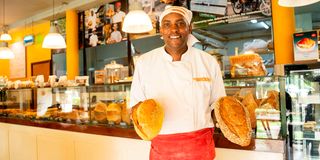
Daniel Githinji, a baker at BBrood Kenya, displays freshly baked loaves of bread.
Photo credit: Pool
Established in Nairobi in 2016 as a partnership, BBROOD Kenya is run by Hans Meijers and Maaike Joenje and forms part of a network founded in Amsterdam in 2008 by third‑generation baker Renee Pater.
Its main product is sourdough bread made through natural fermentation, a process that can take up to 48 hours.
“Unlike standard baking, which relies on commercial yeast and additives to accelerate output, sourdough depends on naturally occurring bacteria and yeast cultures,” says Hans.
Demand for such products has grown among middle‑ and upper‑income consumers, particularly those prioritising ingredient transparency and alternative food processing methods.
“In Nairobi, this is visible in the proliferation of specialty coffee shops, organic markets, and boutique eateries. Our entry into the market corresponded with that trajectory,” he says, adding that the expansion was not incidental but linked to East Africa’s urban growth, young population, and relatively undeveloped sourdough‑focused bakery markets.
“When we finally opened the bakery, we introduced not just a product but a concept. Customers could watch bakers at work, which created transparency in production,” he recalls.
The dough is prepared using a starter culture, fermented over extended periods, and shaped by hand before baking. The process limits output compared to automated industrial systems.
To maintain supply across multiple outlets, a central bakery on Magadi Road operates on a hybrid energy system combining solar power and grid electricity, producing about 1,000 loaves overnight for exclusive distribution to BBROOD retail shops each morning. Measures to reduce environmental impact include electric bike deliveries through a partnership with Roam Electric Bodas, as well as the use of eBee bicycles, reducing reliance on mainstream transport.
The bakery operates multiple outlets across Nairobi, including six locations in retail centres such as Sarit Centre, Village Market, ABC Place, and Adlife Plaza.
Freshly baked bread that remains unsold at the end of the day is collected and channelled into charitable distribution networks.
Head of Operations Harun Ndirangu explains that artisanal baking is not standardised like industrial production systems.
BBrood’s main product is sourdough bread made through natural fermentation, a process that can take up to 48 hours.
Photo credit: Pool
“Natural ingredients, long fermentation times and skilled labour all contribute to higher production costs compared to industrial bakeries. This necessitates higher pricing, which limits the customer base,” he says.
The company prioritises quality over volume. Its bread, which Ndirangu describes as “pure” and produced without additives or preservatives using traditional methods, retails between Sh120 and Sh650.
The range includes products made largely from locally sourced ingredients such as rye, millet and corn, as well as multigrain bread. It also features bread made from spelt imported from Europe. Production structure also feeds into pricing, with Hans explaining that scaling introduces cost pressures.
BBROOD’s products are sold mainly to Kenyan urban professionals, alongside expatriates and health‑conscious consumers. Beyond product differentiation, environmental and social considerations are integrated into operations, including biodegradable packaging and efforts to reduce waste by redistributing unsold bread.
In line with the United Nations Sustainable Development Goals, BBROOD has a long‑standing relationship with the Don Bosco Centre, a charity that supports vulnerable children by providing basic needs, education, and vocational training.
“We donate bread and other bakery products to them, while they collect used flour sacks to convert into reusable bags, which we then sell to customers as part of the packaging system,” Hans explains.
In Nairobi’s consumer market, corporate practices are increasingly under scrutiny, with sustainability considerations influencing purchasing decisions among some consumers.
“When the company was starting, staff exchanges between its African operations and the Netherlands allowed bakers to learn techniques from European baking traditions.”
The technical exposure and expertise gained over the years have enabled the company to establish in‑house training programmes. The bakery operates in a market that includes large industrial bakeries and smaller artisanal producers, where established brands benefit from economies of scale and distribution networks, while newer entrants focus on niche offerings.
Daniel Githinji, a baker at BBrood Kenya, prepares to bake bread at the artisanal bakery that produces sourdough bread.
Photo credit: Pool
“Demand for artisanal and health‑oriented foods continues to grow, opening opportunities across parts of the food sector, including for farmers, suppliers, and entrepreneurs,” Hans says.
Over the past two years, the company has diversified into complementary offerings through a partnership with Stean’s Beans Kenya, a specialty coffee roaster co‑owned by Hans that sources beans from East Africa and produces exclusive bean‑to‑cup blends tailored to BBROOD’s specifications.
The collaboration supplies coffee across the bakery’s outlets, with roasting carried out in small batches at an on‑site facility along Magadi Road, linking BBROOD’s operations to a local coffee supply chain involving smallholder farmers.
As the company enters its next decade, changing consumer preferences continue to shape product development, pushing the bakery to introduce new pastries and adapt its offerings to the tastes of younger generations.
“The challenge going forward is whether these deliberate adjustments, strategic partnerships, and the careful curation of the bakery and its wider network will continue to appeal to the next generation of bread and pastry consumers,” Hans says.