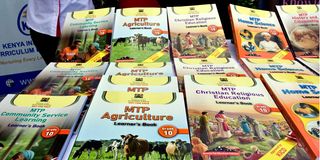
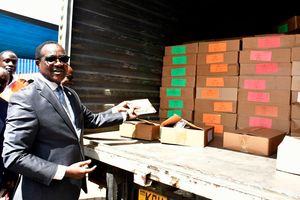
The government does not have accurate data on how learners in Grade 10 selected senior school pathways and this has affected the distribution of textbooks, with some schools still waiting for the learning resources mid-year.
This is the latest hitch regarding data to hit the Ministry of Education which has for long been unable to give accurate data on enrolment in schools despite having the National Education Management Information System (NEMIS).
According to the CEO of the Kenya Institute of Curriculum Development (KICD) Prof Charles Ong’ondo, some principals of senior schools submitted inaccurate learner enrolment data, saying the inconsistencies disrupted the distribution of books for Grade 10 under the competency-based education (CBE).
Kenya Institute of Curriculum Development (KICD) Director and CEO Prof Charles Ochieng' Ong'ondo speaking during the launch of value-based Education programme in Nairobi on April 2, 2026.
Photo credit: Lucy Wanjiru | Nation Media Group
The KICD evaluates and awards contracts for procurement of textbooks to publishers based on the enrolment and subject selection by learners. The institute then provides publishers a list of schools for the distribution of textbooks.
For Grade 10, the Ministry of Education provided KICD with projected enrolment figures to facilitate the printing and distribution of the textbooks.
"Last year, because we did not want learners to begin Grade 10 without textbooks, the Ministry of Education gave KICD a list of books, schools and the projected number of learners for every subject. Come January 2026, we distributed those materials faithfully. What happened during school selection, you know," Prof Ong'ondo said.
He explained that the projections changed significantly after learners selected their senior schools and career pathways.
Prof Ong’ondo said that when the institute asked school principals to submit data on the Grade 10 enrolment, some schools overstated enrolment figures while others underestimated them, resulting in some institutions receiving excess textbooks and others facing acute shortages.
"In some schools, the projected enrolment was 500 learners, but they now have 1,500 students. In other schools, we projected 500 learners, but only 50 enrolled. As a result, the learning materials are no longer commensurate with the number of learners," he said.
Prof Ong'ondo urged school heads to submit accurate enrolment figures, including the number of learners taking each subject, to enable the government to redistribute books and plan for future textbook supplies.
Under the CBE, learners specialise in one of three pathways Science, Technology, Engineering and Mathematics (STEM), Social Sciences, or Arts and Sports Science with progression to higher education aligned to those pathways.
Principals who spoke to Nation said that some learners are unsettled and have been switching between the pathways, making it difficult to compile accurate data.
“We are still receiving requests from learners who want to change pathways. Some enrolled in particular schools because of their reputation without fully understanding whether the pathway they wanted was available. Every transfer affects our class organisation, staffing and resource planning," said a principal in Bungoma County.
“We had hoped the movement would settle by the end of the first term, but learners are still reconsidering their choices. Each time a learner changes pathways, we have to adjust timetables, subject allocations and update the enrolment records we submit to the Ministry. The biggest concern is that we cannot accurately project the number of textbooks required until learner numbers stabilise. If we submit figures too early, we risk either receiving excess books or ending up with shortages,” said another principal.
A teacher collects newly arrived Grade 10 textbooks from the collection centre in Nakuru Day Senior School on February 3, 2025.
Photo credit: Boniface Mwangi | Nation Media Group
"I am desperate for principals to give us the correct number of learners in every subject and indicate the subjects they are taking. I have sent letters to principals, reached out to individual administrators and even published notices in newspapers," Prof Ong’ondo said.
Prof Ong’ondo revealed that although Kenya has about 10,000 secondary schools, only 5,996 institutions have submitted their enrolment data. Even then, he said, the information received contains major inconsistencies.
"The data has some interesting information. Some schools have submitted data four times, and all the figures are different," he said.
According to Prof Ong'ondo, KICD and the Ministry of Education must first verify the data before instructing publishers the distribution.
"What should happen is that KICD and the Ministry collate the figures and then direct publishers. For example, if a publisher is distributing books in Bungoma County, they should know which schools are offering which learning areas and the exact number of learners in each school. We cannot do this for every school in isolation. That is what is causing the delay," he said.
He warned that failure to clean up the data now could create even bigger logistical challenges when the current Grade 10 learners transition to Grade 11 next year.
"If we do not correct this now, we shall have even more trouble in Grade 11 because that is the same list we are using. Grade 11 books are already ready. Once this list is verified, we shall ask publishers to begin distributing Grade 11 books to schools in September," he said.
Prof Ong'ondo added that curriculum designs for both Grade 11 and Grade 12 are available on the KICD website.
"As we continue compiling the enrolment data, I want to assure Kenyans that this country has textbooks for every learning area. If any school is stranded, they should reach out to me," he said.
“Preliminary analysis of the subject selection data indicates strong interest in the STEM pathway, followed by Social Sciences while Arts and Sports Science currently records comparatively lower uptake,” Prof Ong’ondo said.
The chairperson of the Kenya Publishers Association Musyoki Muli acknowledge the challenge publishers have had distributing books to schools.
“Of course, we don’t have the correct data. When we were supplying Grade 10, we supplied very few quantities. As a result, learners in schools don’t have adequate materials. But we can’t supply to the required numbers without an order, and that order is dependent on data. The government is trying to sort that out,” he told Nation.
Grade 10 learners from Langalanga Senior School in Nakuru County attend a Chemistry lesson on February 5, 2026.
Photo credit: Boniface Mwangi | Nation Media Group
“When the government gives us the quantities of books to supply per school, we supply those quantities, and we have accomplished that 100 per cent. Technically speaking, we can’t say we don’t have data to supply because, if that’s what the government needed, we’ve given them exactly what they asked for.”
“The data showing the actual need can only come from the Ministry of Education, and therefore it can only come from schools. Whatever data KICD gives us is the data that we supply to. That is the basis upon which we print and distribute textbooks,” Mr Muli said.
He went on to say the government cumulatively owes publishers Sh9.2 billion in books supplied but not paid for. He warned that this threatens their capacity to supply books for Grade 11.
“It will affect the next level of supply because we printed on credit. We owe printers, we owe other suppliers, we owe our designers, we owe our illustrators, and we also owe authors who have not received their royalties,” Mr Muli said.
“If you tell an author to continue writing when they didn’t earn their royalty or receive their payment from the last supply, they begin to feel that you’re not being truthful,” the KPA chair added.
“Grade 11 is coming in the next few months. By December, all schools should have books for Grade 11 so that by the time learners report in January, the books are already available. By now, for Grade 10, schools should already know how many learners have settled in each pathway. Once that data is available, it will be possible to determine the difference between what was supplied and what still needs to be supplied.”