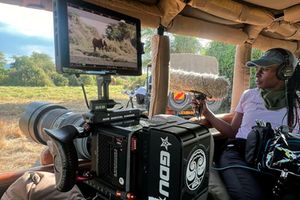
A centuries-old Maasai tradition, in which young warriors prepare to leave one stage of life and embrace another, has become the subject of a documentary seeking to preserve a cultural heritage that its custodians fear could gradually disappear.
Titled Maasai Eunoto , the film takes viewers into the remote bushlands of Maasailand, along the Kenya-Tanzania border, where three young warriors join approximately 400 of their agemates for the week-long Eunoto ceremony.
Under the guidance of elders, the young men undergo a significant transition in their lives, marking the end of one phase of their journey and their preparation for the next.
Senior cultural chief of all Maasailand, chief Daniel Nkoitoi Ole Kipilosh, a prominent Maasai cultural leader who serves as the secretary-general and cultural senior chief representing the Maa-speaking communities across East Africa.
Photo credit: Pool
But beyond the spectacle, songs, rituals and communal celebrations, the documentary explores a deeper question: what happens to a community when the traditions that have defined its identity for generations come under pressure from modernisation?
Directed and written by Kire Godal, the film offers an intimate account of the ceremony, told through the voices of Maasai elders and warriors in the Maa language, with subtitles and text cards helping audiences follow the story.
Senior Maasai Cultural Chief Daniel Nkoitoi Ole Kipilosh has been invited to Kolkata, India, to represent Kenya and present the film at Fest5 (F5) International Film Festival 2026 running from November 20-24. The authentic Maasai representation will bridge Kenyan cultural heritage with international audiences in India.
The filmmakers say they waited 15 years for an opportunity to document the rare ceremony. They were eventually invited by Maasai elders who feared that the gathering could be among the last traditional Eunoto ceremonies.
In her director's statement, Godal traces the ceremony to the historical social organisation of Maa-speaking communities, whose pastoralist way of life was structured around age-sets.
The system, she explains, provided a sense of belonging and collective responsibility, with members organised into groups governed by shared community values.
Today, Maasai communities face pressure to adapt to national systems of schooling and public life, while their leadership continues efforts to preserve traditional practices.
The documentary therefore becomes both a cultural record and an invitation to reflect on the place of indigenous traditions in an increasingly modern society.
Its significance is also underscored by the filmmakers' decision to combine contemporary footage with five decades of archival photographs documenting Maasai initiation ceremonies.
Renowned photographers Angela Fisher and Carol Beckwith contributed their extensive collection of historical images, adding depth to the visual account of a community whose cultural practices have attracted international interest for generations.
The production was developed in collaboration with Maasai leadership, with field producer Joel Kanchori helping bridge community trust, cultural authenticity and the filmmaking process.
Paleoanthropologist Dr Donald Johanson, known for his association with the discovery of the fossil popularly called Lucy, described the documentary as an unusually immersive experience.
“Not staged. An instant classic. This film is accessible to everyone. I felt it personally as a firsthand experience. You walk away understanding how sophisticated this culture is,” he said.
Young Maasai men wearing a ceremonial headdress made of ostrich feathers take part in the Eunoto ceremony near Kilgoris, Kenya on August 18, 2023.
Photo credit: AFP
Witney Schneidman, a former US Deputy Assistant Secretary of State for African Affairs and Brookings Institution associate, also praised the production.
“The film is extraordinary, powerful, challenging and compulsively vibrant. What a treasure,” he said.
For British-Nigerian screenwriter Misan Sagay, the documentary's greatest strength lies in its ability to capture moments that might otherwise be lost to time.
“Triumphantly done. We are looking at things that could be passing unless we treasure them, but we can’t treasure them if we don’t know they are there. Those immensely moving moments of Munge and his best friend are beautiful,” she said.
The film's emotional dimension is particularly evident in its focus on the relationships between the young warriors, including Munge and his best friend. Their experiences offer a human perspective on a ceremony that might otherwise be viewed simply as an anthropological or historical event.
Producer Lucy Gakii Chodota, an African filmmaker born in Tanzania and raised in Kenya, is among the team behind the production. She worked alongside Godal, Fisher and Beckwith, with executive producers and community partners supporting the project.
The documentary also has an educational ambition beyond the cinema. According to the production team, Maasai elders have officially blessed the film and are using it to educate communities, national governments, schoolchildren and international audiences about Maasai traditions.
Its international reception suggests that the story has found an audience beyond East Africa. The press kit records participation in 21 film festivals and 10 awards, including recognition at the Osaka International Film Festival in Japan, where it won Best Documentary Short in 2026. It also received awards for Best Cinematography and Best Ethnographic Film at the Orion International Film Festival in Berlin in 2025.