It was a sundowner I will never forget. We were sitting out on an open plain in the Tsavo East National Park – not so different from the fenlands of East Anglia where I grew up. It was good to be with Mike Kirkland again. It was good to be enjoying his special ‘dawa’.
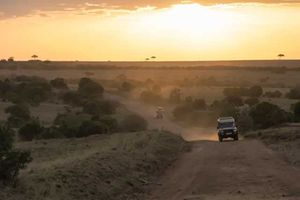
It was good to be talking about the times when we first met – times when the Safari Rally was living up to its cheetah emblem as the wild one in the world championship series of rallies. Then Mike said, ‘Let’s stop talking for a few minutes and just enjoy the sunset’. Yes. It was a sunset of a kind you could never see in Europe.
You can actually watch the sun going down; see it slowly, very slowly, disappearing beyond the Sagala Hills, as a warm glow spreads across the western sky. We were with my nephew, Paul, and his wife, Marina, who were also from the East Anglia fenlands and were here in Kenya for a couple of weeks’ holiday. I know that they, too, were seeing a sunset they will never forget.
In Roger Barnard’s book, Safari Rally: The First 40 Years , he has a chapter headed by Mike Kirkland – Kenya’s ‘Nearly Man’. Barnard must have known that anyone reading his book, likely to be a rallying enthusiast, would know that he wasn’t casting any aspersions on Mike’s manhood. I guess Mike did feel that way once – in 1988 when someone at the Nissan works team felt that Mike was perhaps no longer quick enough and so he had to submit to a ‘driving test’.
Mike was hurt and furious. But he eventually took the test, drove like the fast and fearless man he is, and he was offered the Safari drive. It was in that rally that he would have won had not some hooligans placed a pile of rocks across the road in the Aberdares and Mike, clear in the lead, slammed into them and badly bent the car’s steering rack. He finished in second place – hence Barnard’s nickname, ’Nearly Man’. I interviewed Mike when he arrived back in Nairobi. I had never seen him so angry and so frustrated.
Mike, of course, has another life – the life of a very successful businessman. He took over Southern Cross Safaris, which now has an office in South Africa and in Australia as well as here in Mombasa. It seems he is just as proud and competitive in business as he was in rallying. His Southern Cross website says ‘Nobody knows Africa better than us’. He also owns the Satao Camp in Tsavo East. And that is where we were staying. There is one big advantage about being in Tsavo East rather than in Tsavo West – you encounter far fewer safari vehicles, because there are so few lodges or camps. Tsavo East has a more rugged terrain, with its huge open plains and semi-arid scrub, as well as its woodland areas and the lush vegetation along the Galana River. It is Kenya’s largest conservation area.
After the unforgettable sundowner that first evening, we were driven back to the camp – back to the large but warmly-lit lounge. We had another dawa with Mike before enjoying the buffet dinner at a table roofed only by the star-lit sky.
That first night, back in our tent, we soon awoke to the loud roaring of a lion. It was as if it were on the tent’s verandah. And there were other noises we couldn’t identify – snorts, scuffles, squeals. A few nights before, we had been watching animals on the Ark’s saltlick through the windows of a comfortable viewing lounge. But at Satao we were actually living among the animals. In the morning, we were told that the lion had chased an impala through the camp-site. There is no fence. And that is the glory of the place. After breakfast, we sat outside our tent, as antelopes grazed close by, warthogs scuffed in the dust, guinea fowls scuttled through the yellow grass, and a hornbill flew into a tamarind tree.
A small family of elephants was resting by the waterhole – a natural, not a man-made one. And, with the help of our binoculars, we could see a male lion sprawled on a small hillock and under the fragmented shade of an acacia tree. A couple of hours later, he was still there, as we left for a bush lunch at the Lugard Falls.
Ken was our driver again. He had picked us up the day before at the SGR station at Voi, and he was our driver on all the trips we had over the three days. It was a longish drive to the falls – made longer by all the times we stopped to watch animals or to identify birds. We were lucky to have Ken with us; he has a sharp eye and a stock of knowledge about all that we were seeing in the park. The falls are on the Galana River; they are not really falls – not at all vertical, but a dramatic series of white-water rapids, as the river forces its way through a stretch of volcanic rocks of various colours. Then we made our way to the shade of trees on the river bank, where the bush lunch was laid out for us.
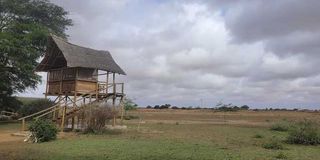
Back at the camp, our sundowner was up a watchtower, where we enjoyed our last drinks of Mike’s dawa, while watching the usual animal clients at the softly-lit waterhole. The lion had left his hillock, but elephants were still around. And a lone waterbuck put in an appearance. Back in our tent, at some point during the night, we heard a lion’s subdued roar, but there was no rampaging among the tents. In the morning, after a leisurely breakfast, Ken drove us to meet the train that would take us back to Nairobi. We had enjoyed an amazing, active and wonderful time at Satao. Don’t leave it to foreign tourists – check its website and find out its resident rates.