By the time you read this, cobwebs will have started regenerating in some houses in rural Kenya as their occupants return to work in various urban areas after the festivities.
Such houses present a dilemma. While they cover a basic need, some critics argue that it is not the wisest investment to spend millions on a house where one spends less than a month a year.
However, some of the proud owners of such structures would hear none of that argument. To them, there is no better way to say “home is best” than by constructing a well-furnished abode on or near their ancestral land.
Lifestyle spoke with three owners of such properties who let us in on the story of constructing their houses and why they attach a premium to the structures.
Dr Morris Wambua, economist
As an international business magnate, Morris Wambua spends the better part of the year in boardrooms and hotels across the world. When he jets back home, he prefers to retreat to his countryside home which is tucked at the sleepy Mang’elete village in Makueni County.
“Nothing beats the tranquillity of a countryside home. This is the most ideal place to unwind,” the economist says while showing us around his palatial home.
One goes through two manned gates and well-manicured lawns to access the homestead which sits on an erstwhile-degraded parcel of land which Dr Wambua rehabilitated. Assorted trees which dot the compound engulf a bungalow that has remained the talk of the village for years.
Maurice Wambua stands outside his home at Mangetele Village in Makueni County on December 31, 2025.
Photo credit: Pius Maundu | Nation Media Group
“This is work in progress,” Dr Wambua says of the bungalow which has seven fully furnished bedrooms. It has 13 rooms in total, making it the biggest house in the village and beyond.
“We are in the process of setting up detached guest houses in various corners of this compound,” he says.
While the design of the house is Kenyan, the furnishing is inspired by Persian culture.
“On matters landscaping, we have borrowed heavily from our business travels. Many of the trees in this compound come from Israel, where our travel business is based,” Dr Wambua says.
A space which serves both as a community meeting point and a helipad, seven servant quarters, a detached garage meant for holding 10 cars and a gazebo meant for private outdoor meetings add to the main features of Dr Wambua’s palatial homestead.
Investing in a rural homestead
To set up the homestead, he contracted an architect for the design and used local artisans and masons to bring the concept to life. The economic slowdown caused by the COVID-19 pandemic made it easy for him to supervise the construction.
Dr Wambua would not be drawn to reveal the cost of the palace, which started with acquiring and rehabilitating a degraded parcel of land through aggressive landscaping.
The investment speaks to Dr Wambua’s philosophy on development. He dismisses the theory that building a home in the countryside does not make economic sense. Instead, he believes that investing in the countryside promotes sustainable development.
“Anyone claiming that investing in a rural homestead is a waste of money is misadvised. We do not always have to look at investments through academic lenses. There are other values which an investment such as a homestead in the countryside should create,” he says.
“When we set up homesteads in the countryside which match the ones in cities, we are deliberate in establishing a direct connection with the countryside, which is key in the country’s economic future. A rural homestead significantly unlocks the economy of the countryside through creating job opportunities and influencing infrastructure development in the remote regions.”
A growing trend in the country in which consumerism among elites fuels the mushrooming of palatial homesteads in the countryside worries Dr Wambua.
“Many of the elites setting up palatial homesteads in the countryside are doing so half-heartedly. They are either competing among themselves or avoiding the embarrassment which is associated with being homeless when friends come calling or in the event of death. This should not be the main motivation,” he argues.
Modest five-bedroom house
He, however, advises homeowners to plan the investment in such a way that it can easily carry its weight after some time. He has achieved this by setting up a farmland around his homestead.
“This is where we grow all the food we need in Nairobi,” he says while taking us through a farmland teeming with cabbages, onions, green maize, tomatoes, watermelons, bananas, and oranges.
“As a country, we cannot afford to leave the countryside behind in our development plans. It is in the countryside where we grow all the food and keep all the animals that feed the urban population. We should be deliberate in developing the countryside,” Dr Wambua says.
Steve Juma, communications consultant
You can tell Mr Juma treasures his house in Rarieda, Siaya County by how he regularly posts photos of himself in the house. He lives in Nairobi but regularly visits his rural home.
He describes it as a “modest five-bedroom house”, and he says it took him over 15 years to put it all together.
While sharing the secrets of constructing such a building, Mr Juma says anyone planning to build a house should not overthink the requirements.
“Do not be tied to too much pre-planning,” he says. “Just follow the required protocols then put up your house step by step. In fact, you should not even think of where mabati (roofing sheets) will come from. Don’t even think where the cement and the metals used will come from. You do what you can do at that particular time.”
An inside view of communication consultant Steve Juma's five-bedroom house in Rarieda, Siaya County.
Photo credit: Pool
“We are not in the era of building a big house as a show of might or as a sign of our prestige. In this era, you can build a small house and just live inside like a king,” he adds.
“I think the power is in the design, and the so-called interior and exterior design,” he said. “Choose the one that suits you, and these days you can even change it. You can paint a wall today the way you want. Even now as I speak to you [on December 30], I’ve just painted a wall. You can change paints like you do with [a phone] wallpaper.”
Mr Juma doesn’t buy the “dead capital” argument regarding houses like his. He thinks it is either a scapegoat term for those who don’t want to build houses or a tranquiliser for the well-to-do who already have houses away from their rural homes.
“There’s nothing like dead capital. Assuming that you lost your job; and assuming that you have a family at that point, where would these people fall back to?” he poses.
“Let me tell you: There’s a shift in migration. It used to be rural-to-urban migration. Because the country is developing, now we have a new shift to urban-to-rural migration, slowly but surely. People are now investing back at home. I’m at a rural centre that used to have nothing. Today, electricity is all over. You can invest at home,” adds Mr Juma.
When Kenya went the devolution by dint of the 2010 Constitution, he says, a stimulus was injected into Kenya’s rural areas.
“Where there were no roads, we have roads; tarmacked roads to our doorsteps in the rural area. We have power and a strong internet connection here. We can even work from home in the villages. Everything is opening,” argues Mr Juma.
His position is that whereas there is no harm building in cosmopolitan areas like Kitengela in the case of Nairobi, one’s rural home takes the cake.
“Home is home, unless you’ve lost touch with the villagers. Home has a healing value,” he argues.
George Okeno, sales expert
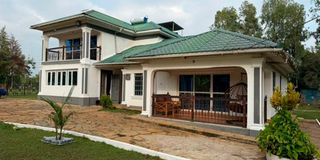
Former hockey player George “Jakadady” Okeno is also a proud owner of a covetable residence in Gem, Siaya County.
“A house in the countryside is nice. For me, since I moved out of Nairobi, even when I go back to Nairobi, I don’t even stay one day. I always go straight to the village,” he says.
He built the first section of his house within a year when he was working in the city, starting off with just Sh100,000 and at some point enlisting the assistance of friends to place the roof. The first section was a bungalow. He later erected a one-storey structure right next to it, so that it looks like a single building. On his compound are also gazebos.
A view of salesman George Okeno's residence in Gem, Siaya County. The former hockey player says he began with a bungalow then later built the storeyed portion next to it.
Photo credit: Pool
“After you build, it gives you the morale to go home,” Mr Okeno argues.
Like Mr Juma, he is also an advocate of taking baby steps in the construction journey.
“I tell people that the hardest part of building is when you start building. If someone comes to my home today and they ask, ‘How much did it cost?’... I always tell them, ‘Don’t ask how much it cost, because it will discourage you. So, you just start polepole (slowly).’”
“In the long run, you’ll want to go back to your roots,” he says, going back to the 2007 post-election violence where some people were uprooted from places they had called home for years because they were of a different ancestry from the majority of the locals.
“Then there is US president who is deporting people left, right and centre. Assuming you get deported and you don’t have a place to start, you will get stressed and depressed for no good reason. So, I always say there’s nothing like a dead capital,” argues Mr Okeno.
“I like to host. Almost every day, I have about 10 visitors in my home,” he says.