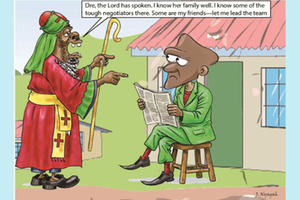
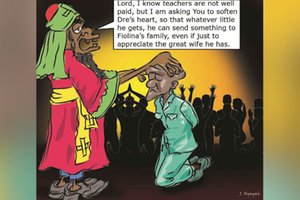
When we parted ways here last week, the people around me were in the middle of planning a visit to Fiolina’s family for dowry negotiations. I am not a fool when I say the people around me were doing the planning. I had taken a step back from the process because the people around me saw themselves as more knowledgeable than I was.
Even as this was going on, little did I know that some enemies of development were up to mischief, with the intention of bringing me down. As the saying goes, kikulacho kinguoni mwako .
It must have started in the staff meeting we had last Monday. After discussing critical issues, Saphire, who was attending his first meeting this year, said he had an AOB (Any Other Business). Nobody knew whether to take him seriously or not, for Saphire is many things to many people, but never serious with work.
"Dre, we hear you have some celebrations this weekend. Can you please invite us?" he asked.
"Yes, please let us join you so we can go get you a wife," said Lena, her terrible hair in tow.
"I do not understand what you are talking about. Which celebrations?" I asked, shocked that even the school was aware and wanted to be part of something that I didn't even know whether it would happen or not.
"Dre, everyone in Mwisho wa Lami—even the crows, goats, trees, and sheep—knows that you will be going to pay the dowry for your wife, Fiolina," Nzomo started.
"We are not just your colleagues or subordinates; as a staffroom, we are family, and we want to celebrate together."
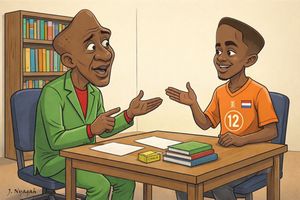
"Thank you for your concern," I started. "However, these are my personal issues, and as a rule, I do not mix work with personal matters."
I went on: "What I would like us to focus on is improving studies this term so that we can deliver great results."
"We know that, Dre," started Nzomo. "But I remember you attended my dowry negotiations—the one where Kwame couldn't raise what my family asked of him. We can also support you. In fact, we are not just coming to attend, but we are already raising some money for you."
"Oh, you are?" I said. "That is good, very good." I almost added that they should give me that money almost immediately. But knowing they would say I only accepted because of the money, I instead said, "Thank you very much, but the event will remain a private one."
The mood in the staffroom changed instantly, and for the next few days, we did not talk much. On Wednesday, when I arrived at school, I found a matchbox at my office door. I did not need a calculator to know that it was a sign of danger. I immediately called for a staff meeting to discuss the matter, but no one was interested in speaking.
You could see all the teachers looking down. I was expecting anger and the need for us to act quickly. But in that meeting, I was speaking to myself, as no teacher answered emphatically, just saying yes to everything I said. No discussion happened.
If the matchbox was not a warning enough, other signs followed. The students were making noise the whole day. When I walked around, a class would be quiet at first as I passed by, but they would burst into noise as soon as I was past their door. Two teachers who tried to go to class came back saying the kids were unruly and very noisy.
"I can't stay there, I don't want to die," said Lena, coming back to the staffroom after going to class.
Nzomo also came back, saying she valued her life.
"Wanafunzi wakiniua mtanipeleka Nunguni kweli? Mimi siendi classroom tena ." (If the students kill me, will you really take my body to Ngunguni? I am not going back to the classroom).
By afternoon, the school had degenerated into a big, noisy marketplace. I tried to walk from class to class to talk to the students. These were not the students that I knew; they were unruly, noisy, and full of demands.
Bottle of kerosene and matchstick
"We want half-term! We want half-term!" they shouted. Even the girls and the lower classes had similar demands.
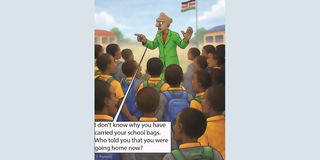
I called for a special parade at 2.30pm. You should have seen how they came to the parade quickly, all of them carrying their school bags, ready to go home.
"I don't know why you have carried your school bags. Who told you that you were going home now?" I asked jokingly.
Shouts of "Half-term! Half-term!" rent the air. As for the teachers who were in school, Lena and Nzomo did not join me for the parade. They said the students were wild and feared they could rough them up. I had to think twice. I decided to inform the students to go home for half-term.
There was celebrations everywhere, the student even did not wait for me to finish my statement, did not wait to hear the day they needed to return, they left.
As they left, I walked back to my office. Soon after, the watchman called me, asking where I was. I told him I was in the office. I expected him to come in, but instead, I heard a scuffle outside. When I checked, he was pushing a student toward the staffroom—a huge boy.
The watchman told me he had caught him with a bottle of kerosene and a matchstick, which he couldn’t explain why he was carrying.
"I also saw this boy walking around your office in the morning, but I didn't know what he wanted – he ran away when he saw me" the watchman added.
When I asked the boy what he was up to, he claimed innocence, saying that the kerosene was for his mother, who had sent him to buy it alongside a matchbox. But if indeed he had just bought them for his mother, he couldn't explain why he had them at school.
I took no chances. I called the OCS of the Mwisho wa Lami police post, and a policeman came to the school. He shocked the boy with one huge, loud, painful slap.
"It is Saphire who gave them to me!" the boy confessed. "He asked me to burn the HM's office and the staffroom so that the school could be closed for a while. I was going to do that today night"
I asked if he was the only one involved. He said two other boys were part of the plan. The other boys were rounded up and they corroborated exactly what he had said. A manhunt for Saphire was started. He was found after two days and placed in custody, and the boys were released.
I will not report this matter anywhere to the Ministry, but I will let him cool his heels in the police cells for a few days. He must learn his lesson. I was just thankful that I sent kids for half term. It would be another matter altogether!