When Caro, Mwisho wa Lami’s Minister for Misinformation, Miscommunication, and Broadcasting Lies heard that I had been summoned for dowry discussions by Fiolina’s people, she did what she does best. She went around informing everyone who cared to listen—including trees.
Of course, you expect Caro to add some salt. And it all depended on whom she was talking to.
“Wacha wamalize pesa yake, amekuwa akiringa nayo sana ,” she would tell someone she thought did not like me. Or she would say, “Na huyu Mkono birika mwenye pesa yake haioni jua atatoa pesa kweli? Wacha wamalize! ”
“Surely, huyo ni bibi wa kulipia mahari kweli? ” she would ask another person whom she thought disliked Fiolina. “Mwanamke amejengewa nyumba smart na ni mchafu ti ti ti! ”
“Mimi ndio naandika list ya kwenda mahari, niongeleshe vizuri niongeze jina yako ,” she would tell someone she thought was interested in joining the delegation.
If you think I spent the week looking for tough dowry negotiators, then you clearly do not understand how things work in Mwisho wa Lami. The moment Caro made sure that everyone knew about it, the entire village suddenly expressed interest in being part of the delegation to Fiolina’s home.
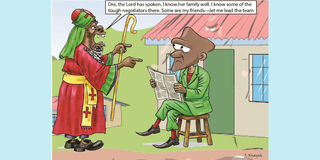
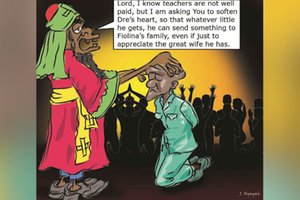
Earlier in the week, Apostle Elkana, the Principal Spiritual Superintendent of The Holiest of All Ghosts (THOAG) Tabernacle Assembly, was the first to arrive. He found me outside the house pretending to read a newspaper, though in reality I was studying it the way people study escape routes from a prison they have not yet entered.
“Dre,” he said, “the Lord has spoken.”
I asked him what exactly the Lord had said this time, and he calmly informed me that he had been instructed to accompany me to Fiolina’s home. I told him this was a family matter, but he insisted that there was no better place for spiritual intervention than a family matter that was already going wrong.
Before I could object further, he had already announced to half the village that he would be leading a delegation. I do not know when dowry negotiations became diplomatic missions, but in Mwisho wa Lami, things escalate quickly.
The next day, Rasto arrived carrying a notebook like a legal consultant. He told me he had prepared negotiation points, reminding me that he had been part of Fiolina’s negotiations before and had even kept some notes.
“I know her family well. I know some of the tough negotiators there. Some are my friends—let me lead the team.”
He had three options: refuse everything, walk out dramatically, or demand a refund. He explained proudly that he had borrowed the strategy from football transfers.
I closed the notebook slowly, wondering whether ignorance could sometimes be legally safer than enthusiasm. Nyayo joined the next day, claiming experience because he had attended several dowry ceremonies as an “observer,” which in Mwisho wa Lami usually means someone who eats first and asks questions later.
The delegation grew without permission, as if I was no longer going for negotiations but a concert.
Maina, the shopkeeper, although he did not express interest in going, told me to act tough. Hitler, on the other hand, demanded that I settle his debts first, adding that I had accumulated interest longer than my relationship with Fiolina.
“Please remember that I wear shoe size 10,” he told me when he came to visit, just as he was leaving.
“Last time you gave me size 8, ilinifinya sana, hata sikukula vizuri ,” he said. He even insisted the shoes be brown since he already had black ones.
“Suit iwe blue ama black, sio green ,” he added, not letting me speak.
When I asked further, he told me Caro had added his name to the list.
Anindo, Nyayo’s wife, also came to see me with demands. She advised me on the materials to be bought for the ladies going for dowry negotiations.
“I know someone who can sell you the material wholesale, very good quality imported from Eastleigh,” she added. As for shoes, she said I should go for Ngoma—they are easy and comfortable.
It was only later that I learned Caro had been collecting money from people promising that I would dress them on the day. When I heard this, I told the two to go and demand refunds from Caro.
In the meantime, I was having other problems at home. My father was looking for me every day, and he had drawn a list of over 15 people he thought should accompany me for dowry negotiations. I wondered whether we were going for negotiations or a pilgrimage. He also wanted a new suit, shoes, and a new pair of glasses—which he does not even wear.
There was also another crisis. Since my mother passed on some time ago, several women had appointed themselves to fill her role, which the expected they will earn from handsomely.
First was my sister Yunia, our deputy “mum,” who demanded to sit on my father’s left handside during negotiations and be given full honours, including a new dress.
The second claimant was Senje Albina, my father’s sister, who had not visited for a long time. She claimed that since she was my mother’s agemate, she was the only qualified person to take the role.
“Andrea ni kama mtoto wangu, na mimi ndio nilimtafutia bibi ,” she added, a statement that immediately disqualified her.
Alphayo’s wife also joined the race, but Alphayo insisted she withdraw because he heard that his wife would wear matching clothes with my father. He could not stand that.
My late mother’s sister also entered the race, but Caro warned her not even to try. She had already been bribed by Yunia and was therefore in Yunia’s corner.
Fiolina had already presented a budget for the day, which I did not even take seriously at first because it was unbelievable: 10 chickens, 10kg of beef, 3 crates of soda, 2 crates of beer, 50kg of rice, and a jerrican of milk.
Then came the shocking items: New suits for her father and brothers, matching dresses for her, her sisters, and her mother, several tents, a big banner, and a cake.
She said events are done in tents, not houses.
“No, it is my special day,” she said, adding that if I truly loved her, I should make the day special.
The total cost for her side came to over 65,000 shillings, and that is before I even sorted out my own side of the delegation. That was more than the dowry that I owe her family, which today stands at a whopping Sh27,500.
There was no way I was going to accept this. While I will not throw good money after bad, I have not stopped anyone from planning, so I have left everyone to continue preparing—for an event that may not happen after all.