Two years after the Gen Z-led protests against the 2024 Finance Bill shook Kenya, The People Shall continues to travel across festivals, screening rooms and political conversations as both a record of a historic uprising and a memorial to one of the filmmakers who helped capture it.
Co-directed by filmmaker Mark Maina and the late Nick Wambugu, the documentary has become a chronicle of the protests while also permanently logging the cost of telling difficult truths in contemporary Kenya.
As another contentious Finance Bill looms under President William Ruto’s government, Maina tells Lifestyle that the film remains painfully relevant — a reminder of the lives lost, the questions still unanswered, and the political awakening that continues to shape a generation.
For Maina, the recent success of the documentary has been inseparable from the memory of Wambugu, who died in January after battling Hypercellular Myelodysplastic Syndrome (MDS), a condition that affected his body’s ability to produce healthy blood cells.
The late Nick Wambugu was an award-winning filmmaker, creative visionary and storyteller.
Photo credit: Wilfred Nyangaresi | Nation Media Group
“Nick made a very big contribution to the film,” Maina says. “James Smart (NTV) was the initiator of the project. I was initially supposed to work with Vincho Nchogu, but after she got selected for a Red Sea Film Festival workshop, Nick stepped in. He became co-director, producer and director of photography. Those are three huge roles in one film.”
The two filmmakers were introduced by Smart in January 2025, though Wambugu was already familiar with Maina’s previous work. At the time, Wambugu had begun shooting footage for another documentary project called Baddies, which focused on women participating in the protests.
“But when we joined hands, we realised the footage could become part of The People Shall ,” Maina recalls.
“We told ourselves we could always return to Baddies later because what was happening was unique. Traditionally, protests in Kenya were seen as spaces for men or for hired goons. Suddenly, you had young women, Gen Zs, carrying water bottles, placards and handkerchiefs, all coming out to make their voices heard.”
The filmmakers paused Baddies and concentrated on documenting the broader movement — from the online hashtags that ignited public outrage to the massive demonstrations of June 18, June 20 and June 25.
The film eventually brought together different voices that reflected the anatomy of the movement. Lawyer Faith Odhiambo offered legal insight into the protests, while activist Hanifa Adan spoke about fundraising efforts.
Boniface Mwangi contextualised the idea of a “leaderless, fearless and tribeless” uprising. Feminist activist Zaha Indimuli linked the protests to the earlier anti-femicide marches that had shown peaceful demonstrations could still mobilise Kenyans effectively.
Human rights activist Boniface Mwangi gestures during an interview at Mageuzi Hub on September 16, 2025.
Photo credit: Francis Nderitu | Nation Media Group
“Kasmuel was also part of the movement then,” Maina says. “And then Justine and Victoria helped us get into the experience of the streets.”
Originally conceived as a 52-minute television documentary for NTV, the project quickly evolved into something more ambitious.
“The TV version aired in early July and got a lot of good feedback,” Maina says. “But Nick and I are filmmakers. We wanted the film to live beyond television and enter festivals as well.”
That ambition led to a second cut — a 61-minute feature-length version designed for the international festival circuit. The documentary premiered at the Nairobi Film Festival in October 2025 to an audience of more than 300 people at Prestige Cinema. But behind the successful screening, Wambugu’s health had already started deteriorating.
“At first I thought it was stress from the court case, because he had been arrested three months earlier in relation to another documentary, Blood Parliament by the BBC,” Maina says.
Wambugu required constant blood and platelet transfusions that reportedly cost nearly Sh100,000 weekly as friends and colleagues tried to raise money for a medical transplant in India. Before those plans could materialise, he developed pneumonia.
“His body was too weak to fight the infection,” Maina says quietly. “Unfortunately, on January 7, we lost him.”
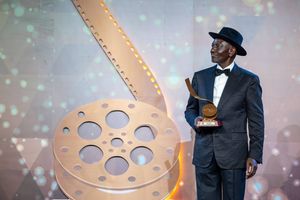
The late Nick Wambugu displays his trophy during the Top 40 Under 40 Men Awards gala dinner in Nairobi on December 5, 2025.
Photo credit: Bonface Bogita | Nation Media Group
Wambugu’s death transformed the documentary into something even more emotionally charged. The January screenings that had originally been intended to raise money for his treatment instead became memorial screenings, with proceeds going to his family.
“A lot of people became interested in the film because of Nick,” Maina says. “He was very respected in documentary filmmaking. You could see it in the screenings — almost always full houses. That’s a testament to the kind of person he was.”
The film’s journey has since stretched far beyond Kenya. The People Shall has screened in France, Finland, Jamaica, Germany and the United Kingdom, while also touring local venues such as Alliance Française, Nomad Film Society and Film Garage Society screenings.
At Kitale Film Week, the documentary won Best Documentary, Best Film and Best Impact Storytelling. It also earned an Africa Magic Viewers’ Choice Awards (AMVCA) nomination and seven Kalasha Awards nominations, eventually winning Best Documentary and Best Editing.
“At Kalasha, I honestly felt accepted,” Maina says. “A lot of officials told me it was a brave film to make in the current political climate.”
Still, he admits he had feared politics might influence the awards, especially with President William Ruto attending the ceremony.
“I thought maybe they wouldn’t reward something controversial because they wouldn’t want to upset the hand that feeds them,” he says. “The president had already left by the time our category was announced, and honestly, I had already prepared a speech wondering how I would say it with him sitting there.”
For Maina, the recognition validated the difficult editorial decisions made during post-production, especially after Wambugu’s arrest heightened fears around state scrutiny.
Politically conscious storytelling
“We had to be careful not to get people into trouble,” he says. “Some activists were still very angry and emotional, and there were things they said that could expose them.”
Obtaining footage also became difficult because many protesters who entered Parliament during the demonstrations had deleted videos from their devices for fear of repercussions.
“There’s footage online, yes, but for a documentary you need to authenticate it and get consent,” Maina explains.
“It's also important that we recognise all the other contributors to the film: the activists in the film, and even myself and my assistant editor. When Nick, Brian Adagala, Chris Wamae, and Mark Denver Karubiu were arrested, it felt like they were looking for their footage. And we interviewed some of the same people who are in Blood Parliament : Hanifa, Boniface Mwangi, Faith Odhiambo. So I'm sure intelligence went to the people involved that maybe there's something else that's being planned. We were thinking, now we have to protect this footage, make sure that it's well backed up. It felt like we were in an espionage film, constantly looking over our shoulders.”
“I wanted audiences to feel what people felt during those protests,” he says. “That adrenaline, that suspense, that revolutionary energy.”
But alongside the chaos, Maina says the protests also revealed an extraordinary sense of solidarity.
“Lawyers represented protesters for free. Medics came voluntarily. Journalists stayed out for hours documenting everything. There was this communal spirit.”
International audiences, meanwhile, often interpret the documentary through the lens of artistic freedom and political resistance.
“In Germany, most questions were about the safety of filmmakers speaking against governments,” Maina says. “People wanted to know what the international community could do to support artists and citizens.”
“When you think about the 2007/08 post-election violence, most of what exists are news articles,” he says. “Very few films documented it. We wanted The People Shall to become part of the archive so future generations can understand what happened in 2024.”
He confirms that Baddies is still in development and will likely expand to include events surrounding the 2025 Finance Bill protests, including allegations of sexual harassment, abductions and the infiltration of demonstrations by hired goons.
Beyond documentaries, Maina is already developing several projects. One is a sports drama about late Olympic marathon champion Samuel Wanjiru, who became the youngest gold medalist in Olympics marathon at Beijing 2008, whose death remains shrouded in controversy. Another is a psychological thriller he has been writing since 2014.
Filmmaker Mark Maina, during an interview at Nation Center, Nairobi, on July 23, 2025.
Photo credit: Wilfred Nyangaresi | Nation Media Group
He also continues to build Mgreen Entertainment, his post-production company focused on feature films, documentaries and trailers.
Before returning to Kenya in 2024, Maina spent three years in Nigeria as head of post-production at EbonyLife Media, the powerhouse founded by Mo Abudu behind productions such as Blood Sisters, The Wedding Party and Òlòtūré.
“I learnt how to make large-scale African blockbusters there,” he says. “It changed how I think about filmmaking.”
Maina’s own journey into cinema began far from film school, it was a hobby shared with his brother.
“We’d recreate scenes from James Bond films,” he laughs. “But I quickly realised filmmaking needs a team.”
His breakthrough came in 2017 with Neophobia, a short film selected for the Cannes Film Festival, where it became the only African film screening that year. The project connected him to filmmaker Judy Kibinge, who later helped him secure a scholarship to Germany’s Filmakademie Baden-Württemberg.
“That experience humbled me,” Maina says.
“In Germany, they have all the equipment and facilities but sometimes lack crew. In Kenya, we have the talent and creativity, but not always the resources.”
After Germany came 18 Hours, the award-winning feature film that cemented his reputation across Africa and eventually led to his recruitment by EbonyLife. It won Best Editing, Best East African Film and also Best Overall Film in Africa.
Yet despite the growing accolades, Maina says The People Shall occupies a unique place in his career because of both its political significance and the emotional burden attached to making it.
“We genuinely thought we might make the film and never be allowed to screen it,” he says. “We even joked that maybe we would need asylum afterwards.”
Now, as Kenya edges closer to the 2027 General Election and fresh debates over governance dominate public discourse, Maina hopes the documentary continues to provoke difficult but necessary conversations.
“It’s not about telling people who to vote for,” he says. “It’s about making sure people vote with information and memory. History teaches us lessons. If leaders fail the people, then people should remember that when they go to the ballot.”
More than anything, though, he hopes audiences remember Wambugu.
“I want people to remember Nick because he believed in representing ordinary people’s voices,” Maina says.