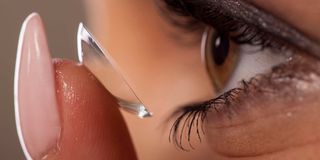
If you've ever thought about swapping your glasses for contact lenses, you're not alone. Dr Kajal Varsani has spent 26 years fitting eyes with them at Star Optics on Kaunda Street in Nairobi, and she's watched more women make the switch. Some want clearer sight without a frame on their face, some want a new eye colour for a wedding, others just want to play sport without worrying about their glasses breaking mid-game.
However, Dr Varsani observes that many people don't fully understand what these small plastic discs can do to their eyes when worn the wrong way.
“There are two broad types of contact lenses. Hard contact lenses are otherwise known as rigid gas permeable contact lenses,” Dr Varsani says.
These are made for people with irregular corneas, such as those with keratoconus, a condition where the cornea isn't shaped the way it should be.
Soft lenses remain the far more common choice, and women choose them for many reasons.
“The main reason is sport,” she says, since a stray ball or a fall can end badly with broken glass near the eye. Others want them purely for looks.
"I'm going for a party, I don't want to wear my glasses, I want to put my makeup on. Those come in different colours; brown, grey, hazel, honey, amethyst," she says.
Before fitting anyone, Dr Varsani studies the person carefully, including their age, occupation and habits. Hygiene matters enormously, since it decides how safely someone can wear lenses long term.
"You have to remember, contact lenses are something that goes into your eye which is very delicate," she says. Unlike glasses, a lens has to be handled with clean fingers before it touches the surface of the eye.
"You wear them only for one day, and you throw them away. They are very popular for sporty people because they don't have to touch them and they don't have to handle them much," she says, and the risk of infection drops because they're changed every day.
Monthly lenses need far more care, since they have to be cleaned in solution every day, and many people struggle to keep up. Annual lenses, worn for a full year, have fallen out of favour.
"People don't like them because you're wearing the same lens for over a year. Definitely less hygienic and less comfortable," she says.
Hard lenses are usually reserved for patients with keratoconus, which Dr Varsani describes simply.
"Your cornea thins out, and then it starts bulging out to form a cone, and that causes distorted vision," she says.
The condition can run in families, but it's also linked to the dusty environment some children grow up in and to eye rubbing from allergies.
"It is a progressive condition. If not caught early enough, it can cause loss of vision in that eye, and in severe cases the patient then needs a corneal transplant," she says.
A newer procedure called cross linking is now the preferred first step, since it stabilises the cornea and slows it down. Many patients still need a rigid gas permeable lens fitted afterwards for the clearest vision.
One thing Dr Varsani insists on, is that no one should ever buy contact lenses without a proper eye exam first.
"Really, we see it, and it's really not good; people being sold contact lenses over the counter. Only an optometrist can do that," she says.
Skipping the exam is dangerous because whoever is selling over the counter usually isn't explaining how to insert, remove or clean the lenses.
"People are sold contact lenses without a solution. People wash their contact lenses with water, which is so bad, because you can get an acanthamoeba infection, which can cause loss of sight," she says.
Asked whether poor lens use can lead to blindness, she says simply, "Yes, if you have a virus or any kind of infection that can be severe, you can lose your eyesight."
Redness, irritation and dryness are common complaints, and Dr Varsani traces most of them back to one habit.
"The biggest problem we have with contact lens wearers is noncompliance," she says.
Lenses should generally only be worn between eight and 10 hours a day, with a full day off at least once a week.
"This is to allow your cornea to breathe. When you don't allow that to happen, you cause damage to your cornea," she says.
"You're so tired, by the time you want to remove them, you're not going to clean them the way you're supposed to. It becomes a vicious cycle," she says and adds, “If your eye ever turns painful and visibly red, seek medical attention immediately, and do not wear your contact lenses."
Dr Varsani notes that ordinary daily and monthly lenses don't let in enough oxygen overnight to be worn safely through the night.
"We have contact lenses you can sleep in, called extended wear contact lenses. They're designed in a way that allows more oxygen into your eyes," she says.
Dr Varsani sees no extra danger in cosmetic coloured lenses, as long as the product is genuine.
"In terms of safety, yes, there's nothing wrong with them, as long as they're from a reputable company and you follow the rules," she says. The real risk comes back to how the lens is worn and cared for, not the colour.
"A contact lens cannot float inside. There's nowhere for it to go. If you can't find it, it's under your lid somewhere, or it's fallen off," she says.
The other myth is that lenses can fully replace glasses forever. "Your limited 10 hours , what are you going to do for the rest of the day?"
So, who can actually wear contact lenses?
“Anybody, actually. Most wearers are short-sighted patients who struggle to see without correction, though some healthy eyed patients simply want coloured lenses for looks.”
"I would need parental consent even for a 16-year-old. I prefer young patients not to be wearing contact lenses," she says.