“The bankruptcy case involved a media mogul who owed about Sh500,000, a small amount of money for a man of his stature, which he had refused to pay. The court found for the creditor and ordered the media mogul to pay the money.
The creditor was unsuccessful in attaching the property because the media mogul did not have any property registered in his name. All his known assets were registered in the name of his companies.
The creditor applied to have the media mogul declared bankrupt. When the bankruptcy case came before me, the media mogul said he was not willing to pay. I made an order declaring him bankrupt. The order sent shock waves through the court corridors and the echelons of power. The aftershock was swift. I was in the middle of dictating a judgment when I received a transfer letter. I had been moved from Nairobi to the High Court in Kitale, whose jurisdiction included remote parts of north‑western Kenya.”
These are words from Chief Justice Martha Koome’s autobiography, Courting Courage . “Courting” in this title invokes the formal world of the courts—law, justice, procedure and the long corridors in which Martha has spent most of her life. But it also carries the older sense of seeking, wooing and pursuing with intention.
“Courage,” in turn, is both the quality she has had to summon repeatedly, as in the bankruptcy case where she had to stare down the powerful and rule against them in defence of justice.
Martha’s story begins in a village called Kithiu in present-day Meru County. Life in the village was communal, and she grew up among members of her extended family. Growing up in a large polygamous family, Martha had nine siblings, apart from those from her father’s second household.
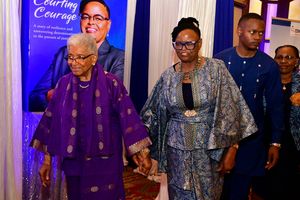
Caption: Chief Justice Martha Koome (centre) with Former Liberia President Ellen Johnson Sirleaf with Koome's family members pictured during the launch of her book "Courting Courage" on February 20, 2026 at the Safari Park Hotel.
She writes that her mother, Naomi Irangu—affectionately called Gaake (aunt) by everyone, including her own children—had the greatest impact on her life. Of her mother, she writes, “She taught me to be independent and responsible. She taught me how to do my laundry, fetch firewood and cook… and how to carry a jerrycan of water on my back.”
At school, Martha was always a star—from her days in primary school to Chuka Commercial Secondary School (O level) and then to Mugoiri Girls School (A level). At Mugoiri, she was among the top ten students nationally in her A level exams.
After her A levels and before joining university, she got married. She pauses to remember the youth that has vanished, and her love for Koome Kiragu, the smartly dressed gentleman she met years ago. Of that time, she writes that Koome “introduced me to them (his grandfather and grandmother) as his fiancée. That was the first time he had openly talked about marriage. I was pleasantly surprised… Outwardly, I put on a little drama and asked many questions. What sort of marriage proposal was that?”
At the University of Nairobi, as a young mother and wife, she writes, “I hardly had time to study. This took a toll on my academic performance and my final results were a Pass, the lowest grade for those who made it to the graduation list. I was downcast and did not know what to do.”
Martha’s memoir understandably dwells on her life in the corridors of justice. There are serious as well as humorous sections. Describing lawyers, her colleague G. B. M. Kariuki said that “while ordinary mortals have one mouth and two ears, litigation lawyers at times seem to have two mouths and no ears.”
Another humorous incident occurred during her tour of duty in Nakuru as the High Court Resident Judge: “The court compound was not fenced and the premises could be accessed from all directions, by all and sundry… I would be seated in my chambers, pondering an important legal issue, when a hawker selling mali-mali (petty goods) would emerge. While I was trying to process this outrageous sight, I would see another pedlar carrying a huge flask, selling tea and mandazi around the court premises.” She eventually put an end to this spectacle.
Chief Justice Martha Koome during the official opening of the Annual Judges Colloquium in Mombasa on August 18, 2025.
Photo credit: Kevin Odit | Nation
Martha is fierce, urgent and intense in her demands for justice. This urgency, this wildness, the seeming rebellion of a life that refused to stay within the lines drawn for it—echoed in the many abrupt twists and turns of a journey that took her from advocate and activist to celebrated jurist. Her career runs alongside something else, something melancholic and heavier: Is justice possible in this life? And more urgently—what is the law for, if not this?
In her experiences with the women she defended, the detainees she visited in cells (including the late ODM leader Raila Odinga), and in many other causes, the system itself appears as a recurring character, endlessly frustrating, and yet she kept returning to its doors, briefs in hand.
The memoir succeeds on many fronts: the storytelling is direct, with some characters that would rival Dickens’s fictional creations for their spectacle. It especially benefits young women and students for its message of resilience, ambition, and self-belief.
Courting Courage, the autobiography of Martha Koome, Kenya’s first female Chief Justice, pictured at the Nation Centre on February 18, 2026.
Photo credit: Bonface Bogita | Nation
Lawyers, judges and law students will glean insights into Kenya’s legal system, activism and judicial philosophy. Policymakers and gender advocates will draw lessons from its reflections on women’s rights, legal reform, and social justice.
General readers will enjoy its riveting storytelling, humour and emotional honesty. Courting Courage speaks to all. Understanding or being informed about the law or anything else you are dealing with is the first step to administering and receiving justice, for what you do not know might never favour you.
Beyond being an enjoyable read, the childhood and court scenes could easily be adapted into drama and film episodes. The book can also be used in education—in gender studies, law, leadership training and civic education—and in policy-making, as Martha’s reflections on justice, gender and institutional reforms offer rich material for discussions on legal and social policy.
The main hiccup in Courting Courage emerges not from a lack of material, but from the way the story is shaped and where it stops. The memoir carries the reader through Martha’s colourful life and career, but just as the narrative gathers momentum—just as the stakes rise and the arc of her public life reaches its natural peak—the book ends.
The moment she is appointed Chief Justice, the story closes, leaving the reader breathless, standing at the anticlimactic threshold of the most dramatic and historically significant chapter of her life. The memoir feels like the first volume of a larger story rather than a complete autobiography. We hope the next volume comes soon. The book is published by Moran (E.A.) Publishers and is available in bookshops countrywide.