I bought “Green for Life” by accident. I was standing in the international terminal, more interested in boarding my flight and coffee than in books when two tourists started pointing at a green-covered book on the shelf. From their conversation, I picked out that they had apparently also spotted the book in Madrid and Paris.
Curious, I picked it up. The author’s name sounded African, though the design looked European.
Within the first few pages, I realised this was no ordinary biography. It serves as a field manual for life, leadership and responsibility.
It’s a rare book that links the soil beneath our feet to the decisions we make in boardrooms and parliaments. Its tone is calm yet urgent, practical yet poetic. It spoke about faith and failure, business and purpose, mistakes and miracles, and somehow made them all fit in the same sentence.
The author, Dr Isaac Kalua Green, is a Kenyan environmentalist whose work spans three decades and multiple continents. I realised that the book’s international significance is no coincidence.
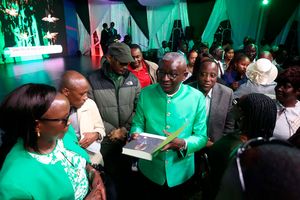
Environmentalist Isaac Kalua Green (centre) during the launch of his new book 'Green for Life: From Brokenness to Boldness' in Nairobi on September 14, 2025.
Photo credit: Evans Habil | Nation Media Group
It features a foreword by H.S.H. Prince Albert II of Monaco, a lifelong advocate for oceans and sustainability, and a prologue by American pastor and leadership expert Chip Ingram. These are not just celebrity touches; they signal that the book’s vision has bridged cultures and disciplines.
The book introduces what it calls the MPR Green Impact Lens™, a formula for transforming chaos into character, based on the principles of mistakes, problems, respect. What makes it so special is its practicality.
Every day, you'll make mistakes, often five or more. Each mistake creates at least five problems to solve. And each day, you meet at least five people to whom you can choose to show respect. That rhythm holds the secret to balance and growth.
MPR turns everyday life into leadership lessons. It’s the easiest framework to use and the hardest to run out of. In a world obsessed with perfection, it teaches that mistakes are teachers, problems are classrooms, and respect is the final exam. It's an African framework with universal relevance, and I can imagine it being taught in universities, boardrooms, and diplomatic training centres around the world.
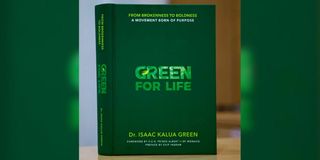
The cover page of Dr Isaac Kaluna Green's autobiography 'Green For Life.'
Photo credit: Wilfred Nyangaresi | Nation Media Group
Then comes the chapter that every reader heading to COP 30 — the United Nations climate change conference in Belém, Brazil — should pause for.
He argues that Africa’s future cannot be negotiated in sympathy but built in partnership, that we must balance green ideals with human dignity.
Reading it, I pictured delegates walking through the plenary halls in Brazil, with side conversations humming between sessions asking each other if they had read “Green for Life”.
I could almost see the green-tinted pages appearing in backpacks and on conference tables. It deserves to be the book that moves from hand to hand among decision-makers, not as a policy document but as a moral compass.
Green Africa Villages model
What surprised me even more was that this philosophy isn’t just on paper. Each chapter connects to real initiatives already happening in Africa. The Green Africa Villages model turns ideas into jobs by linking tree planting, clean energy, bee-keeping, and water-harvesting.
The Green Africa Foundation mentors communities and partners with governments. Every copy of the book sold directly funds these projects. It’s printed on sustainable paper, translated into French, and already available in airports and universities. For once, a book about change is actually funding change. There is also a spiritual undercurrent that adds unusual depth.
The author writes with gratitude, not bitterness, about the hardships that shaped him. He shares moments of failure and redemption with the tone of a man who has experienced both storms and sunlight and has learned to praise God in each. The humility is disarming and causes the reader to trust his voice.
In many ways, Green for Life asks leaders to become stewards, not masters. It challenges citizens to treat the environment as the primary economy. It argues that development disconnected from moral renewal is self-destruction. These are not slogans.
They are distilled truths from years of planting trees, negotiating policies, and mentoring communities.
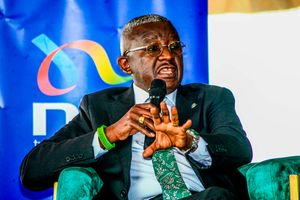
Nation Media Group Editor in Chief Joe Ageyo (left) interviews environmentalist Isaac Kalua Green during the book launch in Nairobi on September 14, 2025.
Photo credit: Evans Habil | Nation Media Group
As the world gathers for the climate change talks, marking the 30th anniversary of a conversation that started with hope and often drifted into bureaucracy, this book arrives like a long-overdue mirror.
It reminds us that sustainability is not just about survival but about restoration. It suggests that Africa’s story, told honestly and based on evidence, can provide the moral logic that global negotiations have been missing.
Even after I finished the last chapter, I reread the final paragraph. It spoke of respect for people, for time and for the Creator, who gave us the planet. I realised this was more than just a moment for a book review. It was a wake-up call.
I have since seen “Green for Life” on the desks of business executives just two months after its launch, in university lounges, and even in church foyers. Some also buy it as a wedding gift, while others use it as a mentorship guide. Each reader seems to find their own reflection in it. That may be its greatest strength: it meets you where you are but refuses to leave you there.
If I could give one piece of advice to every participant flying to COP 30 and anybody concerned about climate change, it would be this: get a copy of the book and read it, because the story of “Green for Life” is the story of what happens when one person decides that conferences end where real life begins. Certainly, some books inform. A few inspire. “Green for Life” reforms.
Dr Giovanna Grampa is a distinguished Conservationist and Wildlife Photographer, serving at Malindi Marine Park and Tsavo East National Park. She is also an acclaimed author and advocate for Marine and Terrestrial Biodiversity.