The man who, at one point, used to cultivate roses that former President Daniel arap Moi would wear on his lapel was a staunch Christian who became obsessed with the question of why there was no church inside the State House precincts.
And so, he decided to lobby for one.
His name was David Kalua, and the year was 1983. He was a State House employee, charged with landscaping at the House on the Hill — where Mr Moi himself would inspect the work done.
When Mr Kalua realised that his pleas for a State House chapel were not being treated with the urgency he desired, he took matters into his own hands and built a mud-walled structure. He didn’t think this would go wrong.
A new book by his firstborn son, Dr Isaac Kalua Green, describes the turn of events.
“My father was like a rhino. Once his mind was set on something, he kept charging forward in a straight line,” writes Dr Kalua Green in his book Green for Life: From Brokenness to Boldness — A Movement Born of Purpose .
“So, he wasn’t about to allow State House bureaucracy to stand in the way of God’s house. Because State bureaucracy wasn’t responsive to him, Nau (father) eventually used his landscaping and amateur architectural skills to design a beautiful chapel. He then proceeded to construct a mud-walled chapel whose unique design compensated for its mud walls,” writes Dr Green.
Kalua Senior then organised what Dr Kalua Green describes as “the first-ever State House church service” in that structure.
“It was well attended and subsequently became quite popular with the dozens of State House staff who lived on the premises. Nau [father] was aglow with gratitude that entire Sunday. He was so grateful to God for giving him the grace and courage to pursue this matter to its logical conclusion,” he writes.
Dr Kalua Green, then a teenager who could not quite believe that they were living a stone’s throw away from the country’s most powerful man, marvelled at the efforts his father made. Starting the church also saw his father ordained as an Anglican reverend. The church ran for a while before problems sprang up.
“The winds of bureaucracy and public image soon blew down on the building. State House luminaries questioned why a mud-wall structure was on the revered grounds. What kind of image was that for the President? They demanded, frothing at the mouth,” writes Dr Kalua Green.
“As a result, the temporary chapel was demolished. Just like that, in less than thirty minutes, a church that had become the centre of collective worship at State House was destroyed. Nau watched helplessly as the four walls tumbled to the ground. To make matters worse, he was transferred to the Ministry of Public Works. Consequently, we had to shift from the State House grounds to another government residence at Mihuti Court, within the State House vicinity. I felt like a mango dropping prematurely from its lofty position to the cold, hard ground. It hurt being unceremoniously ejected from State House,” he adds.
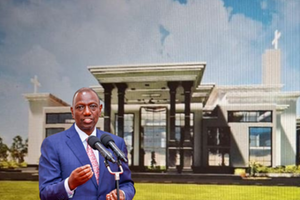
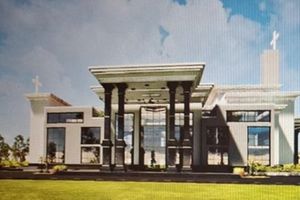
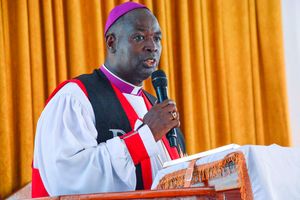
In July, as the story of a planned 8,000-capacity State House chapel was the talk of the town, the State House chaplain spoke to journalists about the history of the iron-sheet-walled church there. Bishop Bernard Murani, an Anglican cleric and a police chief inspector, said that gatherings inside the compound that gave rise to the church began during the tenure of Mr Moi’s successor, Mwai Kibaki.
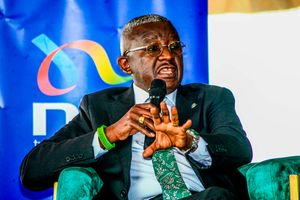
Nation Media Group Editor in Chief Joe Ageyo (left) interviews environmentalist Isaac Kalua Green during the book launch in Nairobi on September 14, 2025.
Photo credit: Evans Habil | Nation Media Group
“In 2003, I was deployed here to State House, when I was in the GSU [General Service Unit]. At that time, we were serving President Mwai Kibaki. When I came here, we started a small fellowship. At that time, these [storey houses housing the police] were not complete, and we had tents where we lived. Our families stayed at the GSU headquarters. When a few of us started the fellowship, these houses were completed and the population increased. We demanded a place to pray. On May 12, 2005, we started to pray there. It was just a shed, and we contributed iron sheets that we used for walling,” said Bishop Murani, the State House chief chaplain.
He added that the mabati structure stayed on for years until then First Lady Margaret Kenyatta noticed its poor state and ordered an improvement.
That gave rise to the current structure, made of metal that is tougher than iron sheets.
“The church you see here was dedicated on May 15, 2019. It was opened by the former Head of Public Service, Mr [Joseph] Kinyua, together with the State House comptroller,” said the bishop.
It is that church, Bishop Murani said, that President William Ruto wants to upgrade. While Dr Kalua Green doesn’t indicate whether the site of the church his father built is near the current one, his book opens a window into the religious aspirations of those who live within the highly restricted gates of State House.
“A permanent feature on [Mr Moi’s] coat lapel was a fresh red rose. Few Kenyans knew that a dedicated State House employee ensured the constant availability of these roses. That man was my father. He took great pride in preparing these suitably sized roses for Kenya’s most powerful man. As he watered, weeded, and tended to the roses, my father saw his work as a service not just to the President, but to all Kenyans,” he writes.
“At first, I found it strange that he saw the simple act of pruning and weeding roses as a patriotic service to his country. But with time, I came to understand how one’s inner fuel can infuse meaning and purpose into the simplest, mundane tasks,” he adds.
His father was initially a Kenya Prisons constable, dealing with plants in the various facilities he was posted to, but he quit due to numerous transfers.
He continued with his gardening passion. His work in agricultural shows caught Mr Moi’s eye. The President ordered his hiring, offering him a new lease of life as he was languishing in penury after quitting his job.
“Because the garden events had such prominence in the State House calendar, President Moi had a particular interest in the garden landscaping. As a result, he would sometimes stroll with my father in the gardens to inspect the landscaping and admire nature’s beauty, as carved out by my father,” Dr Green writes.
Elsewhere in the book, he says his father – who died at the level of a bishop – had a hand in introducing opposition politician Kalonzo Musyoka to President Moi. The Kaluas’ native home is in Kitui County, which is also Mr Musyoka’s backyard.
Dr Kalua Green, an entrepreneur whose first employer was a company owned by former Machakos Senator Johnstone Muthama, is an environmentalist who furthered his father’s love for nature. He is the chief steward of the Green Africa Group, a conglomerate he started in 1992 with interests in sustainable mobility and safety solutions; ecopreneurship and agribusiness; shipping and logistics; environmental protection initiatives; and hospitality and furnishings. He has also held various positions in pro-environment organisations.
His biography, packed with more than 600 pages, easily draws in the reader. Humour, situational irony and show-don’t-tell are served in generous doses because, for Dr Kalua Green, it appears that there is no such thing as “too much info.”
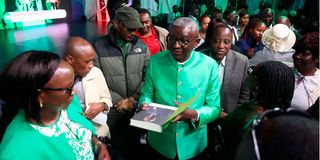
Guests attend environmentalist Isaac Kalua Green's book launch at Entim Sidai hotel in Nairobi on September 14, 2025.
Photo credit: Evans Habil | Nation Media Group
In a book that can make perfect company for anyone after a recollection told without the limitations of summarising and revisionism, Dr Kalua Green bares it all, even describing his early instances of juvenile delinquency. He describes his days as a drug abuser in secondary school who wore the facade of a student “reverend” and his amorous life in which he was cheating on various women, among them the one who eventually became his wife. His love for alcohol in his earlier years is also described in detail.
He also shares his highs and lows in entrepreneurship, not least how he lost an export deal in Japan for being eight minutes late for a meeting. He was to make $50,000 (Sh6.5 million at today’s rates) from that deal in 1992, but he got his transport mixed up and showed up late.
“Back home in Kenya, being eight minutes late would have probably been applauded,” he writes, describing how that experience made him start despising people who blame traffic jams for being late.
The book is also a literary masterpiece, given how Dr Kalua Green draws parallels between his growth and the growth of an East African yellow wood tree growing in the Mau Forest. It is packaged in 56 chapters to match the age he attained on September 14, when the book was launched.
In 2020, he secured his parents’ blessings to add “Green” to his official name. He remembers his father asking, “Would that make you happy, son?”
What’s more, he writes that he is living the advice he was given by a global public relations expert that he should wear something green every day.
“This is more than a book; it’s a movement,” says a promotional video on Dr Green’s X page. “This is a book that walked with a cow and now walks with you,” it adds, referring to an incident in Dr Kalua Green’s life where he had to run after a cow to take it to the market. It needed to be sold to generate school fees for him.