On a cold Johannesburg night on July 2, 2010, Asamoah Gyan, Ghana’s finest striker, was ten metres from immortality.
He was taking a penalty in the final minute of extra time, with the score level and history hanging in the balance. Inside the stadium, the magic was happening —hope was coming to life, blast after blast, pulsating, firming up as if arching into broad billows of flame.
The entire African continent seemed to hold its breath. On the lonely goalpost to defend was Fernando Muslera, the Uruguayan goalkeeper, who looked doomed. Gyan stepped forward, adjusted his run, and struck the ball — and missed! The ball hit the crossbar and bounced off, with it, the broken hearts of a continent.
Uruguayan goalkeeper Fernando Muslera.
Photo credit: File
I remembered this as World Cup football games are on currently in the United States, Canada, and Mexico, having started on June 11, 2026, to July 19, 2026. The games are like watching Shakespearean drama on stage or reading a good novel: the familiar, blood-bubbling thrill, like a burst of champagne, and the climax, the part where the world either splits or holds. In many ways, football is like literature.
As someone wrote, “Soccer derives its beauty from its simplicity. Twenty players and a ball on a rectangle of grass; put the ball in the other team’s goal; don’t use your hands.” Like literature, football manufactures riveting theatre daily, sometimes spinning out more drama and reversals in a single week than a set of literature classics.
There are several ways in which football is like literature. The first is that football is like a stage on which a tragedy (drama) is cast. Aristotle said that tragedy has three elements: one place, one action, and one continuous span of time. Football has all these qualities: Ninety minutes and a little stoppage time. One pitch. One action is pursued within the match duration. In Oedipus Rex by Sophocles, the entire catastrophe gathers and breaks in a single day before the palace gates. In football, the fate of nations is settled on a green field in a single afternoon.
The second similarity between football and literature is the chorus, representing the voice of the people of Thebes, the suffering city whose people watch a tragedy unfold before their eyes in Oedipus Rex. In football, this is the stadium with thousands of spectators. In Oedipus Rex, the chorus cannot intervene; it can only witness, lament, and warn. In football, the crowd cannot intervene either; it can only groan and chant and plead with a fate that is not always listening. In the stadium or on TV, the crowd only watches but is powerless to change anything.
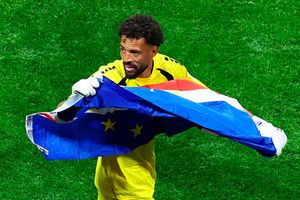
The third similarity is the sudden reversal of fortune, which the ancient Greeks called “peripeteia.” A good example of this was the recent World Cup game between Cape Verde and Uruguay on June 21, 2026, in Miami Stadium (USA)—a game of reversals, swings of fortune, and sudden shifts. Cape Verde, one of the smallest nations at the World Cup, scored first. Then, just before halftime, Uruguay flipped the story —an equaliser followed almost immediately by a second goal, the kind of double blow that would have discouraged the underdogs. But Cape Verde refused to give up. Midway through the second half, they scored. The match ended in a 2-2 draw.
Cape Verde's Vozinha with teammates during the pre-match walkaround at Miami Stadium - Miami Stadium, Miami Gardens, Florida, US on June 20, 2026
Photo credit: Paul Childs | Reuters
The fourth similarity between football and literature is in the duel. In the Iliad, when the writer Homer wished to bring the vast war down to one unbearable point, he set Hector to run from Achilles around the walls of Troy. In football, that is the penalty kick. Epic literature has always resolved itself in climactic duels — Homer’s Achilles against Hector, the Bible’s David against Goliath, Shakespeare’s Macbeth against Macduff—and football resolves itself the same way: striker against keeper, the penalty taker against 10 metres of fate.
The fifth similarity is dramatic irony (the blade the hero cannot see). Dramatic irony lets the audience see the danger that the hero cannot. In Shakespeare’s Julius Caesar, we know the knives are out; Caesar does not. And in football, we see the loose pass becoming a catastrophe before the midfielder does, and the offside trap collapsing before the back line understands.
The sixth is catharsis (cleansing). Aristotle said that tragedy exists to accomplish, through pity and fear, the purging of strong emotions. Football purges us by way of suffering that is entirely real and entirely harmless, a rehearsal of loss. Shakespeare’s Romeo and Juliet purges us by undoing a great love with nothing grander than bad timing. Football purges us by allowing us to lose and to lose safely — a “pleasure that hurts,” as one author once aptly described it.
That is what I felt in my sitting room in 2010, watching Gyan miss that haunting penalty shot, when my wife and I sat silent and stunned after the game. It reminds me of something I have read in the book, Soccer in Sun and Shadow, by Eduardo Galeano, who wrote of “the children who, once upon a time, years ago, crossed my path on Calella de la Costa. They had been playing soccer and were singing, ‘We lost, we won; either way we had fun.’”
After that 2010 game, the lights came up over the far field in South Africa, the chorus rose and faded out into the night, and almost 3,000 kilometres away in Nairobi, I sat a little longer in the dark, counting my loss, the faint smell of fried onions drifting from the kitchen like a reminder that life, indifferent and domestic, was carrying on. This is the footballing spirit: We lost, we won; either way, we had fun.