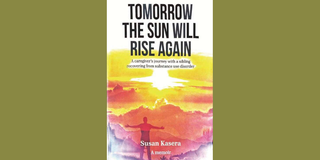
What to do when a relative is addicted is not a mere question. It is a statement of exasperation. It is a cry of the desperate family member caring for the addicted. It is a call to action. It is a reminder to ‘others’, those who think that they are unaffected to beware that the situation could be much closer home.
This is the question that Susan Kasera poses in her memoir, Tomorrow the Sun Will Rise Again (Aquarius Media Limited, 2026). Tomorrow the Sun Will Rise Again is not your standard memoir. It is not a predictable tale of one's life, whether in a linear form or in a jagged structure. It sketches the life Kasera has lived since her brother, the first son in her family, her second brother, got addicted to alcohol. It is a scary tale of how alcohol pares away not just one's physical health but one's humanity.
Addiction comes in many faces. It could be addiction to alcohol, tobacco, marijuana, sex, shopping, work, literally everything that human beings do everyday. Unfortunately, addiction comes with extras. Being wedded to alcohol drains one financially. It affects one's health. It strains family relationships. It breaks friendship. It leads to fractured families, job losses, poverty, even homelessness. Addiction generates a force of its own, which enables it to regenerate itself and (re)create side effects.
Consequently, the addiction becomes a self-perpetuating cycle with seemingly no end in sight. It is this apparent everlasting drama of pain that drove Kasera to write her memoir, which she subtitles, A Caregiver's Journey with a Sibling Recovering from Substance Use Disorder. Thus, this is not just Kasera's tale of a tragedy she has lived with for years but also a manual to other people or families who are either dealing with cases like hers or might be affected by one.
This memoir is a very personal narrative that reveals details that many other people would not have been willing to speak about in public. But Kasera shares with the reader her family’s history. She grew up in Nairobi, in a family that would drive to the cinema, went to the swimming pool over the weekend and took holidays at the Coast.
Raised by working parents, she and her siblings attended good schools and were naturally expected to be successful in life. By getting employed in a bank after school, her brother would be said to have been successful. Yet, it is this very brother who would bring her the pain that is a large part of the memoir.
The brother would progressively get addicted to alcohol, lose his job, migrate back to the village, where his parents had retired to, lose his wife and son to death, and eventually become dependent on the sister, Kasera. The tragedies that followed the addiction accumulated into a depression, which possibly worsened the alcohol addiction.
This is what is called ‘dual diagnosis’ if one seeks help from health professionals. On its own depression is quite challenging, needing constant care, medication as well as counselling. Alcohol addiction sometimes needs similar attention. This is why a caregiver is a crucial part of the healing process.
But who is the caregiver? An employee? Some nurse or individual who can deal with the emotional turbulence of the addicted? Probably yes, where there is money, but which is quite expensive.
As Kasera writes, rehabilitation alone —commonly known as rehab — which involves detoxification, medication and other forms of treatment, can cost from a few thousand shillings a day into hundreds of thousands a month. It is not surprising, therefore, that Kasera ended up as the caregiver to Owadwa — his brother. Why?
Maybe because of familial care? Maybe because of love for another human being? Or, is there a duty of care that binds human beings together? Should we or shouldn’t we feel morally obliged to support those who associate with us, or those we share blood roots with, or those we called friends or neighbors when growing up? Is it the fear of being judged as neglectful or unkind that has kept Kasera going as she struggles to host her brother, feed him, take care of his other needs, and pray for him to overcome the addiction? These are not questions that have easy answers.
Indeed, Kasera suggests that there are no ready answers in her situation. All that she offers are anecdotes of the changes that have happened in her life because of taking care of her brother.
For instance, she decries the weight of the responsibilities that she has to bear. She calls it all, “Bearing the heavy cross.” How heavy is this cross? She writes, “The weariness I feel is the result of years spent shouldering Owadwa’s responsibilities that were never meant to be mine. I have provided shelter, food, and stability for an adult who should have been able to provide these for himself. I have paid school fees for his children and taken up other parenting duties in my brother’s family. Carrying his burdens, on top of my own and my family’s, has left me tired and drained.” Yet, there is hope.
What is hope? Why even hope in a situation where the addict has been to rehab, come back to the family and sworn to be clean but has relapsed; gone back to the bad old habits of drinking alcohol and smoking as if it is the most natural thing to do? How can one even speak of hope in this case? For her, “…there is no horizon, no final instalment, only the endless cycle of relapse and responsibility,” which is like a loan that is “…invisible, yet the payments are real, and the currency is not the Kenya shilling, but my sanity, my peace and my years.”
Thus, Tomorrow the Sun Will Rise Again is a moving prayer, a search for accountability but at the same time an attempt to find meaning for the work of caring for a close relative whose disease has no immediate cure. Knowing that alcoholism can only be managed but not cured was one way for Kasera to accept that the solution for her brother’s problem would be a “…long, exhausting work of management.” One imagines that writing the memoir is Kasera’s way of sharing with other caregivers - current and in future - a truism that should be at the foundation of all interventions in addiction cases.
Kasera’s memoir is also a manual for the individual and others who work as caregivers, with caregivers, live with the addicted, the addicted and those who may be curious about addiction. For instance, alcoholism doesn’t just appear and overwhelm the addicted, the family, friends, and community. It is progressive. It takes time. It builds up. It is one drink too many, which becomes a habit before it takes over the addicted person’s life. Often the individual is dismissed as a mere drunkard when the so-called ‘drunkard’s’ family, colleagues or friends endure episodes of embarrassment, violence, lying, theft, debts etc. In the end the individual becomes dependent on others for their daily survival but also deeply affects those others in many costly ways.
In a world where socio-economic difficulties have deeply eroded concern for the welfare of others, even those related by blood, Kasera’s care for her brother is admirable; her own suffering without abandoning him is a lesson in resilience; but most important, it takes immense bravery and love to be able to bear and bare all that she writes about her brother’s struggles with alcoholism.