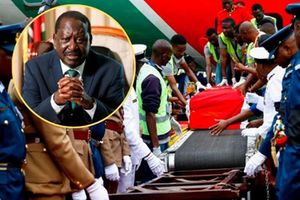
Soon Kenyans will be celebrating the first anniversary of the passing on of Raila Amolo Odinga. If children born when RAO quit the physical world stage for the land of ancestors were named after him, many more will be called Raila beginning this month. For, those who were conceived when he was interred, especially among the Luo, will be accompanying RAO back to the land of the living. Of course, the politicians will soon be invoking his name as they traverse the country in search of votes.
But RAO has already returned in many forms. But, did he really leave? Or is he just hovering around, somewhere in the air, at a beer drinking hall, in some political party meeting, wherever? Kenyans have started to memorialise RAO in earnest.
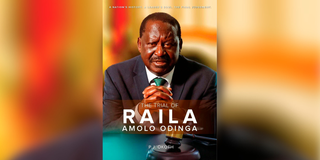
One of the most memorable attempts to remind Kenyans about RAO’s place in the country’s history and story of the seemingly failed Project Kenya is The Trial of Raila Amolo Odinga by P.K. Okoth (Hazel Publishers, 2026). This ‘trial’ of RAO is many things in one.
For reasons that only he knows, the author calls it ‘speculative fiction.’ But what is fiction if not speculation; if not dreams put down on paper?
What else remains to be said about the ‘enigma’ of Kenyan politics if not mere speculation? Isn’t speculation why so many people invoke his name in public, claiming how RAO was a national hero, a man of the people, a revolutionary, the president-that-Kenya-never-had, and such others, when those same individuals had little or no time for RAO when he was alive.
Well, if we take The Trial of Raila Amolo Odinga as speculative fiction, we have to remain in the land of speculation — a world beyond the physical spaces of the living. Okoth, the author — who is a character in this drama — summons RAO to a court, in a manner of speaking. A celestial court; the council of principalities, as he also calls it. RAO is charged with four offenses. First, that he “…cultivated politics of perpetual agitation, prioritising defiance over stability, and in so doing, undermined the peace and economic well-being of the nation…” Second, that he “engaged in Faustian Bargains, forming alliances with the very architects of the system you vowed to dismantle, thereby betraying the principles of your struggle and the trust of your followers.”
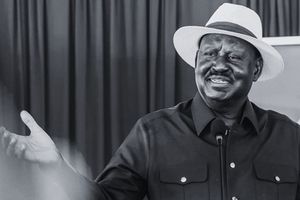
Former Prime Minister the late Raila Odinga.
Photo credit: File | Nation Media Group
Third, that RAO “failed to build enduring political institutions, fostering instead a personality cult that left a vacuum upon your passing, causing the movement you led to fracture and falter.” Fourth, that he “raised the hopes of millions for transformative change but ultimately failed to deliver them to the Promised Land, leaving a legacy of raised expectations and profound disappointment.”
It is most ironic that the prosecutor of RAO is Tom Mboya. Who is his defender? Nahashon Njenga. In the courtroom are several witnesses, including living and dead Kenyan politicians; academics; ‘the ghost of the post-election victim of 2007; ‘the spirit of the 2010 constitution; ‘the spirit of a Luo youth’; ‘the shade of Kalonzo Musyoka’; ‘the spirit of internal party democracy’; ‘the ghost of an ODM defector’; ‘the spirit of Dalmas Otieno Anyango’; ‘the specter of Charles Njonjo’; ‘the specter of Mirugi Kariuki’; ‘the spirit of Peter Habenga Okondo’; ‘the ancestral spirit of Jaramogi (RAO’s father)’; ‘the personification of the Second Liberation’; ‘the personification of ODM’; ‘the ghost of a rehabilitated political prisoner’; ‘the spirit of the handshake’; ‘the collective chorus of the marginalized’; ‘the ghost of Field Marshal Dedan Kimathi’; ‘the spirit of Ronald Ngala’; ‘the luminescence of Wangari Maathai’; ‘the spirit of Bishop Alexander Muge’; ‘the spirit of Professor Ali Mazrui’; ‘the spirit of political metamorphosis’; ‘the spirit of Professor William Ochieng’.
Former ODM leader Raila Odinga (centre) is mobbed by coast women leaders during an ODM meeting in Mombasa on October 13, 2024.
Photo credit: Kevin Odit | Nation Media Group
This is a fairly representative cast of the different individuals, ideas/ideologies, generations, political philosophies and thinking, professionals etc that reflect(ed) the ideal of Project Kenya. These names matter because Kenyans have a tendency to easily ‘forget’ the women and men who have determined the course and cause of this country.
Both Mboya and Njenga, one a dreamer of the spirit of the nation-state called Kenya and the other the assassinator of the dreamer, are revived in this polemical drama because they are men who Kenyans seem to have forgotten. There is no doubt that many of the tens of Kenyans who sit at the square next to the Tom Mboya statue in downtown Nairobi will struggle to explain who the man is or was. It is because his ghost haunts Kenya since he was shot by Njenga. The death of Mboya is often said to be the root cause of the supposed ethnic tension and rivalry between the Luo and the Kikuyu. How ironic that a man who was one of the most cosmopolitan Kenyans of his time, a man who easily spoke Kikuyu, Kikamba, Dholuo, Kiswahili and English, quite smoothly; a man who dreamt of and actively sought the establishment of the republic as opposed to federalism was killed by conspirators who imagined that he was too ambitious. As the writer notes, Mboya’s death left Kenyans with an unanswerable question: what if?
Former Prime Minister the late Raila Odinga.
Photo credit: Sila Kiplagat | Nation Media Group
When Okoth, therefore, makes Mboya, Raila’s accuser, and has Njenga in defence of RAO, he is exhorting Kenyans to question their history; to revisit the foundational myths of this country and ask themselves about who they have served; to (re)check what history has noted and what it has elided in this ever confounding story of Kenya. For Mboya, a man who sought the middle ground, a peacemaker (and deal-maker), moderation over resistance, Raila (like his father, Jaramogi, later Mboya’s nemesis) is a breaker of the dream that Mboya and his type had for Kenya. For them, Raila did not seek to build a lasting national spirit. Yet, Mboya seems unaware that his efforts to build that inclusive Kenya ended in his own death. Njenga’s spirit is a reminder that it takes just one shot, literally, to extinguish a dream. In the case of Raila, his death too leaves the Mboya question: what if RAO had become the president of Kenya?
The accusations and counter charges against RAO are really charges against Kenyans. Why? Because RAO’s dream wasn’t an individual’s dream. It was a collective desire to liberate Kenyans from the yoke of political oppression, economic exploitation, cultural domination and spiritual incontinence. The men and women who appear in court against and for him, all witnessed by several members of the Kenyan judiciary as well as presidents since independence, represent different shades and spirits of the struggle for and against the liberation of a majority of Kenyans since the colonial era.
RAO is the proverbial sacrificial lamb. It is in him that Kenyans revisit their history with its deficits and silences, as Yvonne Adhiambo Owuor would say. In RAO and his trial, Kenyans stand accused of all the charges that he faces. For, how could millions of individuals bank on one individual to rescue them from misery that was/is inflicted upon them daily by their relatives, friends, village-mates, church-mates, workmates, leaders etc? What kind of madness would make women and men vote for leaders today who they would turn around and accuse of oppression, only to hope that RAO, who they didn’t vote for — and accused of all manner of ills — would liberate them?
Well, as the celestial judges rule, “…the soul of RAO is weighed and found burdened by the compromises of earthly power, but not wanting in courage, principle, or impact.” RAO is also adjudged to have been responding to conditions of “…structural violence, economic exclusion, political assassination, and the perpetuation of a system that rewarded loyalty over justice, tribe over talent, and power over principle.”
In the end, it is the Kenyan state that was/is in the docket; and not RAO. This is not to say that RAO can’t or shouldn’t be tried. All Kenyan politicians and leaders need to be tried. RAO was human. He made mistakes like all humans. He probably chose paths when alternatives would have produced the liberation he sought. But he was human, all too human, as Nietzsche would say. Revisionists and those who lost a hate figure as well as dependants will give different versions of the man they loved or hated but it is Kenyans who are on trial in this ‘return of RAO.’