“In one of his last major public appearances, at the funeral of Nelson Mandela in December 2013, former Zambian President Kenneth Kaunda recalled his own history in the fight to end apartheid, launching into a version of a song that had once been his rallying cry, Tiyende Pamodzi (‘let’s go together’). But this time, when he reached the chorus, his listeners did not dutifully sing along, as they had in the past. “Ah, you have forgotten,” he said wistfully, once wrote Michael T. Kaufman.
“Ah, you have forgotten” sums up a memoirist’s greatest fear: people forgetting how a great man impacted his generation. This is probably what President William Ruto had in mind on July 8, 2026, during the assent of the Sovereign Wealth Fund Bill, when he praised Cabinet Secretary John Mbadi’s leadership at the National Treasury and said, “When I write my book, you will have ample space for what we have done together.”
Treasury Cabinet Secretary John Mbadi (left) and President William Ruto at State House, Nairobi, on August 12, 2024.
Photo credit: PCS
Kenya has had five presidents: Mzee Jomo Kenyatta, Daniel arap Moi, Mwai Kibaki, Uhuru Kenyatta, and now President William Ruto. These are five consequential but also deeply complicated men — spiralling, haunted, and reclusive. Surprisingly, none of these men ever wrote their memoirs, so it’s encouraging that President William Ruto is thinking of writing one.
Such a book would bring him to the edge of susceptibility and human vulnerability. And in the poignant voice of autobiography, he will communicate his aloneness, his “unknownness.”
Though he is our president, like all others, the man behind the public image is largely unknown to his people. But the sense of his opaqueness, of his hidden life, is precisely what gives him the mystery. An inscrutable subjectivity haunts every president.
The newspaper articles’ portraits of these figures are incomplete, and they remain enigmatic, holding many secrets. Sometimes, journalists add lights and shadows to the portrayal of the president but, in a sense, only deepen the mystery that resists our full understanding.
Memoirs would solve this problem, painting a clearer picture and thus helping us come to terms with greatness in a purer and less guarded way — penetrating the thick walls of secrecy and decorum to give us an insider’s perspective of the intimate, revealing, and poignant account of the intimacies and rivalries like those of the ancient Greek gods.
In the lens of literature, our five presidents would fall into two kinds of novelists: “the swallow” (quick, sweeping, panoramic) and “the snail” (slow, inward, reflective, intricate).
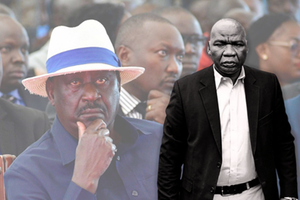
After co-opting the Moi, Kenyatta, and Odinga families into a "broad-based government" to survive the turbulent 2024 Gen Z-led protests, President Ruto has abruptly abandoned the truce to resurrect his aggressive "Hustler vs Dynasty" rhetoric ahead of his 2027 re-election bid.
Photo credit: File | Nation
In the swallows, we have Daniel arap Moi (he governed with breadth and stamina and had a long, sprawling narrative; his Nyayo philosophy resembled a Victorian novel: paternal, orderly, moralising, and all-encompassing); Uhuru Kenyatta (king of public relations, especially with his famed warmth, humour, and easy-going charm; a man of the people, seemingly always amused, bemused, and amazed and laughing through turbulence, turning politics into social comedy with a feel-good aura); and William Ruto (Tolstoyan sweep: energetic, audacious, a relentless swaggering campaigner covering political terrain at breakneck (almost inhuman) speed, everything so fast that there is a sense of vertigo.
These leaders move swiftly, cover vast terrain, and act with great appetite. Their style resembles writers like Honoré de Balzac, Charles Dickens, Henry Fielding, and Leo Tolstoy — expansive, outward-looking, and confident.
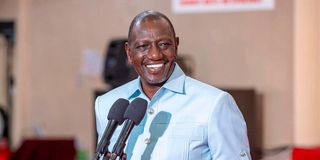
President William Ruto fields questions from the media at Sagana State Lodge, Nyeri County on March 31, 2025.
Photo credit: PCS
On the other hand, presidents who were “snails” are Mzee Jomo Kenyatta (deliberate, symbolic, and inwardly philosophical and concerned with conserving culture, and his book Facing Mount Kenya itself is a snail’s book—deeply reflective, ethnographic, and intricate) and Mwai Kibaki (governed like a behind-the-scenes intellectual; inward, analytical, restrained and he hated spectacle).
When President Ruto writes his memoirs, there are several things that would be of great interest. Firstly, the humble roots. Great memoirs begin before power, and Ruto’s beginning is already national folklore: the barefoot boy selling chickens by the Eldoret–Malaba road, bringing back memories of the dust, the paraffin lamp, the heartbreaking tale of missed sales.
Secondly, the wounds. Presidential memoirs are judged by what they dare to expose. The Hague years and the crucible of 2007–2008; the slow rupture with President Uhuru Kenyatta, from brotherhood to open political war and other significant events of his political career.
Thirdly, the dark June 2024 Gen Z protests. This will be hard to write, but it will be enlightening to hear it from the perspective of the man at the helm. The man who took that lonely walk on that evening had heavy steps as he left the cameras after addressing a shocked nation.
Fourthly, the rooms where things happened. President Ruto has already shown he can tell a good story: only recently he recounted how he appointed John Mbadi over strong objections from some quarters. The memoirs need a hundred such rooms: the various presidential appointments, the midnight calls of the broad-based government, and the long argument that became the Sovereign Wealth Fund.
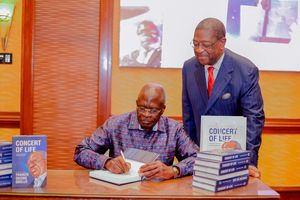
President William Ruto speaks at Serena Hotel in Nairobi on May 11, 2023, during the launch of Defence Cabinet Secretary Aden Duale’s book titled ‘For The Record’.
Photo credit: Evans Habil | Nation Media Group
The book will matter to literature because it fills an empty archive. Kenya’s presidencies have been narrated by everyone except the presidents themselves.
A first-person account from State House becomes a primary source of information. It will also matter because it will give African letters an epic story of ascent. World literature keeps a special shelf for memoirs of ascent.
An account of the journey from a roadside chicken stall to State House would be an interesting addition to the bookshelf. The book will also probably provoke a literature of reply (book rebuttals).
Lastly, the book will benefit publishers, editors, ghostwriters, bookshops and others in the book industry.
We look forward to the president’s memoirs that will allow the boy from Kamagut to tell of his journey to State House. He will not say, “Ah, you have forgotten.” His memoirs will remind us of his presidency.