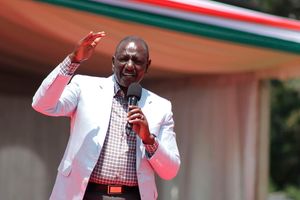
President William Ruto on Thursday laid out his grand dream of what he says will get Kenya to First World status, but for which he says the country should invest Sh5 trillion to fund and actualise it.
In his third State of the Nation Address (SoTNA) to a joint sitting of the National Assembly and the Senate, President Ruto was bullish as he outlined his agenda, casting an image of a person determined amid mounting criticism from the united opposition.
The speech was delivered in colourful words, but how it will be transformed into actual projects on the ground remains the biggest task.
President Ruto's third state of the nation address
At the same time, rampant corruption within the public service, the rising public debt burden, unfavourable economic policies and an unpopular taxation regime that has resulted in numerous job losses remain a big challenge to the realisation of the President’s dream.
The numerous industrial actions that have seen teachers, university lecturers and healthcare workers’ strikes also raise questions about whether a nation that cannot address such issues is ready for First World take-off.
But for President Ruto, the path is clear and achievable.
His vision, he said, is anchored on four things.
These are increased access to education; turning around the economy from a net importer to a net exporter, with food imports currently costing about Sh500 billion annually; the generation of an additional 10,000 megawatts in the next seven years; and the dualling of at least 28,000 kilometres of roads in the next 10 years in a plan that also maps out a total of 2,500 highways across Kenya.
“Estimates indicate that achieving these four priorities will require at least Sh5 trillion,” said the President as he outlined his achievements over the last three years in office, adding: “This is undeniably a large sum.”
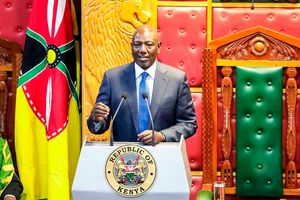
President William Ruto delivers the State of the Nation address at Parliament Buildings, Nairobi, on November 20, 2025.
Photo credit: Lucy Wanjiru | Nation Media Group
“It is a vision to rise from developing to developed status. To rise from potential to reality. To rise from promise to prosperity. To rise from the Third to the First World. To rise, finally, into the Kenya we have long imagined, the Kenya we deserve,” the President said.
“Some may see it as unrealistic, even audacious, for a country like ours,” the President stressed as he recalled former US President John F Kennedy’s words in 1962 as he rallied America to reach the Moon.
The President revealed that under his leadership, “we are raising the bar of national ambition.”
“We choose to go to the Moon in this decade and do the other things, not because they are easy, but because they are hard… because that challenge is one we are willing to accept, one we are unwilling to postpone.”
The President dismissed those who have questioned his development agenda for the country over the last three years, saying that “it is a story you can see in the numbers, feel in the homes, and trace in the lives transformed across our Republic.”
“It is a story whose facts are available for all to examine, except perhaps for the cynical, who have no facts,” he said.
“For too long, our ambition was held hostage by small thinking and ordinary expectations. But that era must now be consigned to the past,” the President added.
According to the President, transforming Kenya to a First World nation is a vision not just to grow, but to transform, and a roadmap not merely to move forward, but to rise.
“To do this, we must cast off the prevailing mindset of being content with the average. We must step beyond the comfort of the familiar and the ordinary and reach, with courage, clarity and conviction, for nothing less than excellence and greatness,” said the President.
The President identified the Hustler Fund, containing inflation and fuel shortages, debt servicing that he said has restored confidence both locally and internationally, and the successful Eurobond redemption as some of his greatest achievements in his three years in office.
President William Ruto (center) flanked by Speaker of the National Assembly Moses Wetangula (left) and Speaker of the Senate Amason Kingi, delivers the State of the Nation address at Parliament Buildings in Nairobi on November 20, 2025.
Photo credit: Lucy Wanjiru | Nation Media Group
“Today, the evidence is clear—evidence of promises made and promises kept. In just three years, we have built not monuments of words, but foundations of progress,” President Ruto said.
He noted that the results of the past three years have laid “a firm foundation for equality of opportunity and a nation where no one is left behind.”
He said that Kenyans often speak of the Asian Tigers—South Korea, Singapore, Hong Kong and Malaysia—with reverence, making their rise “seem like a miracle from a distant world,” noting that “we marvel at how they journeyed from poverty to industrial powerhouses, from aid recipients to exporters of world-class goods.”
“History answers us plainly. Their rise was not magic. It was intentional and crafted through leadership, discipline, strategic investment and an uncompromising rejection of mediocrity. Today, they stand as First World economies. If they could rise, so can Kenya. It can be done.”
Actualise First World agenda
According to President Ruto, their stories begin in ruins—the example of post-war Japan with barely 2,000 kilometres of paved roads, and South Korea, whose GDP per capita was nearly identical to Kenya’s at independence.
Literacy rates in Singapore, Taiwan and Malaysia in 1965 were 75, 78 and 76 per cent respectively, while Kenya’s was below 40 per cent. Life expectancy for the same countries was between 61–67 years, while Kenya’s was less than 50 years.
At the same time, the GDPs of Singapore (3,500), Taiwan (2,200) and Malaysia (1,800) in 1965 were still higher than Kenya’s at 1,100 USD.
Currently, Japan commands over 1.1 million kilometres of paved roads, while Kenya has just 22,000—62 years after independence. South Korea’s GDP per capita now exceeds $36,000 compared to Kenya’s $2,200.
“These comparisons are not meant to indict us, but to demonstrate what becomes possible when a nation chooses ambition over resignation. The task before us, therefore, is unmistakably clear. If Kenya is to grow at scale, we must raise our ambition.”
To actualise his First World agenda for the country, the President submitted that investment in the education of young people, their skills development, scientific training and innovation capacity will be critical.
He said the country has already set the foundation through major reforms in the education sector as he identified the increased education budget from Sh490 billion in 2021 to over Sh700 billion, which has facilitated better infrastructure in the education system as a pointer.
The President revealed that he reorganised the government departments to establish a dedicated State Department for Science, Research and Innovation to support the urgent need to scale up STEM courses in the education system.
This is meant to strengthen innovation, promote research and create a pool of high-level professionals in engineering and science as it helps to realise the 2 per cent research funding needed to make the ambition a reality.
The Head of State also noted the need to turn around the economy from a net importer to a net exporter of products, goods and services—the most urgent being imports of agricultural food products that cost “us Sh500 billion every year.”
He pointed to the interventions already made to reduce imports of maize, sugar, edible oil, rice and wheat, which he said have been undermined “by the natural limits of rain-fed agriculture.”
“We can no longer allow the clouds to determine whether our people eat or not. If we are to produce enough for domestic consumption and exports, expanded modern irrigation is now necessary and the only path forward,” he said.
Although Kenya is endowed with fertile arable land, only 15 per cent of its landmass can support rain-fed agriculture—a limited area relied on to feed the entire nation.
About 85 per cent of the country does not receive sufficient rainfall, meaning that if water was harvested and stored, the vast arable lands in arid and semi-arid (ASAL) areas can be put to productive use through irrigation.
“This is why we must build at least 50 mega dams nationwide, alongside 200 additional medium and small dams and thousands of micro dams, to collect and store water, not only to secure our supply, but to bring at least 2.5 million acres under irrigation within the next five to seven years.”
The President noted that the commitment to harvest and store water is not simply about food and water security but a strategic, nation-shaping investment that underpins the aspiration to be a net exporter of agricultural products.
The energy sector, the third priority, was not left behind in the bid to transform the country.
The President reminded the country that because energy is the lifeblood of any modern economy, no nation has developed without “abundant, reliable, affordable power.”
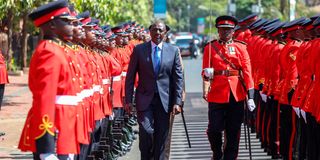
President William Ruto greets scouts outside Parliament Buildings in Nairobi shortly after delivering the State of the Nation address on November 20, 2025.
Photo credit: Dennis Onsongo | Nation Media Group
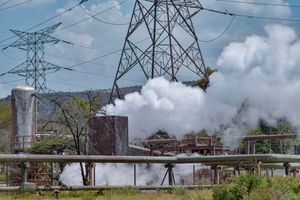
The country has an installed capacity of 3,300 MW, but with the intermittence of solar and wind power, it means that the firm capacity is only 2,300 MW, which is far below “what the Kenya of tomorrow will require.”
As the region’s economic and diplomatic hub, home to the UN’s largest office in the Global South and the sixth-largest economy in Africa, Kenya has a challenge to maintain world-class seaports, airports, highways and digital corridors.
According to the President, efficient transport and logistics remain the backbone of “our competitiveness” as they accelerate national development, connect products to markets, move goods and services, lower the cost of doing business, and reinforce Kenya as the aviation and commercial capital of East and Central Africa.