In African literature, there are loud, colourful characters who dominate the page. There are others who are forgettable, colourless and almost inconspicuous, lurking in the periphery like shadows on the edges of the page.
And few characters capture the tension between power and near invisibility as Baroka, the aging chief of Ilujinle in Wole Soyinka’s The Lion and the Jewel. In Kenyan politics, few careers have been shaped so profoundly by being underestimated as that of former Vice President Kalonzo Musyoka.
Kenyan politics is rough, but Kalonzo Musyoka has refused to be jagged. Kenyan politics often feels like a matatu stage — crowded, noisy, full of sudden manoeuvres, and governed by chaotic unwritten rules.
Like in matatus where drivers, touts, and passengers negotiate space with a mixture of bravado, charm, and threats, our political leaders must learn how to position themselves, how to negotiate in coalitions, and how to survive betrayal.
In politics, like in a matatu, alliances form the way passengers squeeze into a seat: quickly, opportunistically, and with an eye on who might shift next.
And just as a matatu can change course without warning — overlapping, driving on the wrong side, and scraping along pavements— our political actors pivot with dazzling dexterity, swerving around obstacles, inventing new rules and breaking others, and leaving us like bewildered onlookers trying to piece together what’s really going on.
Wiper Party leader Kalonzo Musyoka speaks during an political rally at Shianda in Mumias East Constituency, Kakamega County, on June 13, 2026.
Photo credit: Alex Odhiambo | Nation Media Group
Kenya is like an opera cast in which the volcanic Rigathi Gachagua, the charming Uhuru Kenyatta, and the energetic President William Ruto thrive. In this environment, Kalonzo seems to be the odd one out. He is the master of the art of remaining in the periphery. Kalonzo always appears in the third act as the polite, humble understudy, not remarkable, almost inconspicuous. He has never been the first choice. He is not a spellbinding orator. He doesn’t belong to a dynasty. His virtue consists in being the man who never provoked a scandal and never lost his cool — with an implied soft blandness.
Kalonzo is like a phantom ship waiting in the fog, drifting out of the mist towards the place where the sky and ocean meet, disappearing over the curvature of the earth. The moment is so evanescent, so intangible, that many Kenyans are left wondering — with only a wisp of him still in sight — if he was ever there at all. He performs the greatest disappearing acts, slipping into the margins and letting himself be almost forgotten.
For years, this unremarkableness has been Kalonzo’s curse. He has had the misfortune of showing up in a period of convulsing, technicolour drama, during which the country’s attention was always drawn to more charismatic, louder, and wilder men. But the gift of being underestimated, as any student of African literature understands, is not a small one.
And in that aspect, there are several ways in which Kalonzo’s laid-back nature is like Baroka in Soyinka’s The Lion and the Jewel. Firstly, Baroka enters the play as a man seemingly past his prime.
He is 62 years old, unhurried and content to let the loud young schoolteacher Lakunle dominate. Lakunle is certain history has already overtaken the old Baroka. He has all the rhetoric, all the confidence, all the missionary zeal of the civilised modernist.
In the same way, Kalonzo is a man seemingly almost past his prime. He is now 72 years old, unhurried and content to let younger politicians shout themselves hoarse. He keeps a low profile, and most of the time he is the subject of jokes that “he is working from home” as others campaign hard in political rallies around the country.
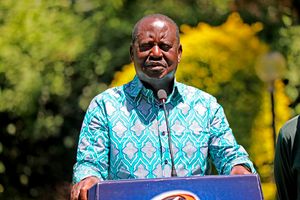
Wiper Patriotic Front (WPF) party leader Mr Kalonzo Musyoka.
Photo credit: Boniface Mwangi | Nation Media Group
Secondly, Baroka performs one of the most audacious acts in African drama: he allows himself to be underestimated and dismissed. In The Lion and the Jewel, both the aging Baroka and the youthful Lakunle are competing for the love of Sidi (the “jewel”) — the village beauty whose photographs have made her famous.
Baroka knows he is aging. He knows the village sees him as a fading force. Instead of fighting that perception, he weaponises it. He spreads a rumour — deliberately — that he is impotent. This is the masterstroke. It makes him appear harmless, finished, no longer a threat to anyone, least of all to Sidi. This rumour achieves three things: Sidi stops fearing him, his opponent Lakunle becomes overconfident, and the entire village relaxes, believing the old lion has “lost his teeth”. Baroka’s silence is strategic as he waits, watches, and lets others underestimate him.
Kalonzo, like Baroka, often appears peripheral, quiet, or politically spent — yet he remains capable of decisive, unexpected moves that can topple the entire political chessboard. Kalonzo appears harmless, finished, and a threat to no one. Unlike the fiery Rigathi Gachagua, who is deeply polarising just like the late Raila Odinga, Kalonzo Musyoka is not polarising. Whether that’s an advantage or disadvantage is yet to be seen, but in literature, he is exactly like Soyinka’s Baroka. By the final scene, the old lion (Baroka) has taken Sidi (the jewel). In the same way, Kalonzo rode to the vice presidency under President Kibaki by passing between Kibaki and Raila (Kalonzo famously said he passed between them—“alipita Katikati yao”). As Kibaki and Raila went for each other in an all-out political war, Kalonzo quietly slipped into second position as vice president.
For years, political commentators have written off Kalonzo as a spent force — “irrelevant,” “flip-flopper,” “the most boring man in Kenyan politics” — but could they be, in effect, repeating Lakunle’s mistake? The watermelon, they believe, has no taste. He lacks charisma, lacks ambition, and lacks the necessary political “killer instinct.” But what if they are wrong about the man from Tseikuru? Could he become the lion who runs away with the jewel?