The word 'development' can literally be found in every government policy document or plan in this country. NGOs use it as received wisdom. Even scholars retail it without thinking twice about it. It is the currency that politicians use to buy public office. Yet, very few people will find time to ask what it really means.
Does it mean paved and tarmacked roads? Dispensaries and schools? Potable water and bridges? Affordable houses? Or is it about availability and access to the basics of life? Well, if development has been on the agenda of the colonial and postcolonial rulers for so long, why does it remain a futuristic expectation? Why is it spoken of in hope, for tomorrow, instead of what can be attained today; what can be available to the living and not to the yet-to-be-born?
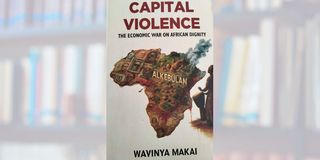
Reading Wavinya Makai's Capital Violence: The Economic War On African Dignity (2025) leaves one in no doubt that development ain't coming any time soon; although it could or should. For, she argues, the dream of socioeconomic progress in Africa is meant to remain just that: a dream. Fulfilling the dream would not fit into the evil agenda to keep Africans at the base of the global economic ladder! Retaining Africa in the poverty box is what Wavinya refers to as “capital violence” or “economic war on African dignity.”
Wavinya argues that capital violence is historical and contemporary, it is driven by external and internal forces, it is subtle but also in-your-face, it is deliberate, planned, vicious, long-term and violent. She reminds the reader that colonialism did such a good job that when it supposedly left, it had firmly established corrosive and exploitative roots on the continent.
Remember the 'flag' independence, where, for instance, the Union Jack was lowered and the Kenya flag (what's its name?) was raised? Remember that the colonial administration structure was simply adopted and adapted when Africans got uhuru? Remember that the school system never changed? The shilling replaced the pound but as a junior cousin, right? In (French?) West Africa, the currencies of several 'independent' African countries is dependent on the French franc (the French use the Euro) and the French Central Bank.
The colonialists departed in person but left their language, culture, political ideology, religion, education and economic systems etc as the standards of reference for seemingly independent Africans. It is not surprising, therefore, that whatever Africans call development is really an imitation of what is seen as societal progress by Europeans, Americans or Asians, pretty much in that order.
Thus, African economists tend to simply transpose Euro-American economic models onto African economic policies. Wavinya argues that in most cases, African bureaucrats are given ready-made policies and instructed to implement them, which says a lot about where resources and power are located in the relationship between Africa and the West
The politicians, Wavinya notes, will declare nationalistic intent in their public pronouncements but hardly blink when signing off national wealth to foreigners. How can a people develop when their minerals, crop produce and other raw resources are exported to foreign lands cheaply only to come back as expensive finished goods, sold in expansive shopping malls to the local elite?
Cover of the book ‘Capital Violence’ by Wavinya Makai.
Photo credit: Pool
The African elite, Wavinya suggests, are trapped in what she calls a 'gated mindset.' Think of the gated community. What happens there? Do its members care about their immediate neighbors? Do they really worry about the rest of the country once they pass through the security check into their safe neighborhoods? The elite is 'gated' because it is captured by external economic and political interests. The political and bureaucratic elite today thinks more about travel allowances, invitations to conferences, staying in good hotels locally and abroad, living in exclusive neighborhoods, taking their kids to international schools and universities abroad etc than they care about the responsibilities of their offices - to serve the citizens.
These benefits are guaranteed by the dollar or Euro or yuan, and available at conferences, workshops, seminars, or colloquia where the magical ‘lanyard’ determines access and speaking opportunities. Wavinya warns that such persons have little time to think about or act on local needs and problems, for they are simply involved in a side hustle.
This elite includes the intellectual class. The women and men trained, employed and paid by the public to think and suggest solutions to local problems. Following other earlier scholars, Wavinya indicts this group for neglecting its primary responsibility. For instance, she wonders, why would African scholars break their backs researching, writing, reading conference papers and publishing them somewhere in the West? Who do expensive publications hidden behind firewalls help? Who buys the books printed in Europe or America that cost hundreds of Euros or dollars? Why would someone be proud to be fully studying Africa from a foreign base? Isn't this situation really similar to exporting raw cocoa or diamonds and importing them back as finished products?
But, maybe the foreign-based scholar is just earning a living. What about those back at home? Well, Wavinya suggests that a good number of local academics merely parrot foreign theories based on books authored elsewhere with little relevance to local realities, as Ngugi wa Thiong'o noted before. Or, they are consultants to local NGOs, governments or foreign organizations. How can knowledge that is based on local lived realities be produced, disseminated and applied in such circumstances? As Mahmood Mamdani, Issa Shivji, Thandika Mkandawire and other African scholars have pointed out before, consultancy research is generally predetermined. It cannot pretend to change local circumstances because if it resolves the problem, it will erase the reason for its existence.
The consultant scholar is just a purveyor of received wisdom. They produce and reproduce policy propositions that are more or less cliches. Ever heard of phrases like public-private partnership, youth and women empowerment, sustainable poverty eradication etc? Often they are just empty phrases meant to hide a lack of critical thinking in policy formulation. Why would a responsible government hand over a road built by public funds to a private business to maintain and tax citizens for using it? Who disempowered women and the youth in the first place? Aren't the two groups an absolute majority population in many countries? How does one sustain eradication of poverty? Just eradicate it.
Capital Violence is premised on the proposition that if there were to be something tangible called development, it would be about restoring human dignity to all Africans. As she suggests the damage that capitalism has done to Africans must be named first before Africans can resist it. Let African governments free their citizens from dependency on foreign politics, culture, economics, religions etc. Leaders should enable people to live a predictable, satisfying and respectful life by providing access to the basics of life and opportunities for self improvement.
Intellectuals and activists need to think about, research, write and contest the violence of capital because “… it is survival, it is resistance, it is the beginning of repair.” For Wavinya, Africans today must begin thinking, researching, writing and working on undoing the violence of capital by going back to what African thinkers, philosophers and activists of the past have done. It is the foundation that must be acknowledged and cited. Why? Because “To cite Africa is to believe in Africa. To write Africa is to defend Africa.”
Capital Violence is a call to contest, undo and rewrite the language, culture, politics, economics, religion, the ways that have sustained the original intentions of European empire-makers by Africans because there is enough resources on this continent, both human and natural for it to thrive. Wavinya walks tall in the footsteps of Walter Rodney, Julius Nyerere, Kwame Nkrumah, Thandika Mkandawire, Micere Mugo, Yash Tandon, Thomas Sankara, Sylvia Tamale, Nelson Mandela etc; men and women whose thoughts and actions have proclaimed Africa’s capacity for self-renewal and progress.