Reading is not really different from listening to a story. It is just that the teller of the story is not physically present. This absence explains why readers sometimes drop a book that they have read halfway and forget about it.
However, reading enables one to travel in time and space with the writer they choose. You can take a book wherever, whenever, for whatever reason; you can read it or not; you can share it with another reader and get it back; and it won’t be pressed for time or complain about how it is being treated.
Kenyans seem to be reading a lot of books these days going by the number of book launches that are happening in Nairobi and other towns in Kenya.
As 2025 comes to the end and the new year beckons, a book might just be the companion one needs to end the year and welcome 2026. There is a huge selection of books in bookstores in Nairobi and other parts of the country. These days booksellers will easily deliver a book to any part of Kenya within a day.
I would choose the memoir for the end of the year reading. It is not that the auto/biography is superior to the other genres; it is just that there seems to have been a deluge of them this year, and I prefer them because they are many things in one pack.
They are personal stories; they speak to us about the families and communities from which the authors come; they retell histories of places, peoples, communities and this country; they remind the reader of the shared humanity; and, they sometimes take the reader back to that most basic of human skills: storytelling.
The few auto/biographies (and other non-biographical texts) that I refer to here come from a longer list that is available in the market. If you are a born Nairobi, as they would say those who swear that their shags is Nai, then Frank Njenga’s City Boy is one that will remind you of what the ‘green city in the sun’ used to be.
City Boy is a compelling story of being born, raised, schooling, growing up, studying and settling into family and professional life by a man who is probably Kenya’s best known psychiatrist. The confidence with which Njenga tells his story is probably only surpassed by AAA Ekirapa in Wings of Ambition
Former Nation Media Group chairman and chief executive Albert Ekirapa (second right) with (from left) former Attorney General Amos Wako, Dr Rachael Masake and Margret Ekirapa during the launch of Ekirapa's memoir at Karen Country Club in Nairobi on July 25, 2025.
Photo credit: Evans Habil | Nation Media Group
Ekirapa speaks to the reader from the heart, revealing his early life, his education, work in the civil service, family life, and a long career in the media. He is not shy to debunk some myths in Kenya about how some individuals became rich through shady deals. Giving his family a chance to reflect on their lives with him makes Ekirapa’s book quite convincing.
Marsden Madoka’s At the Ready is also a story of the transition from rural to urban Kenya in the colonial times. Madoka tells a good story of being raised by Christian parents — with the father serving in the military, which Madoka joins after school.
This is what can be called the story of the formation of the Kenyan elite. Madoka becomes an Aide-de-Camp to Jomo Kenyatta, goes back to the military and retires to serve on several corporate boards. However, the story seems to end abruptly, like a knockout.
Speaking of boardrooms, several of the memoirs take the reader directly into the centres of corporate Kenya. Mary Wangari writes the story of her life and times in the corporate space in From the Village to the Boardroom , which is a tale of one of the few women in Kenya who have broken through the glass ceiling. She has several lessons to offer about her time at Equity Bank, the small local financial institution that has become a major regional bank.
Still in the boardroom is the story of Philip Kinisu, The Interrupted Accountant . Here is an ordinary boy from Bungoma who breaks academic records at the University of Nairobi and ends up working for and managing a major global accounting and auditing company.
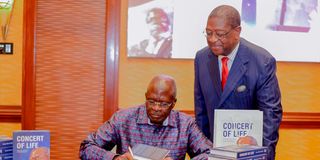
Francis Okomo Okello signs his book for Justice Philip Waki and his daughter during the launch of the book titled ‘Concert of Life’ at Serena Hotel, Nairobi, on September 19, 2025.
Photo credit: Pool
Francis Okomo Okello keeps the reader in the boardroom in Concert of Life , taking one from his village on the shores of Nam Lolwe to Dar es Salaam for higher education and back to Nairobi, where climbs the corporate ladder to the topmost chair.
From the stories of business one can easily move into politics. Justin Muturi’s The Fight for Order is the typical Kenyan story of politics. Even though it is also a story of from the countryside to the capital city, it is a broad brush that paints the story of Kenya’s tumultuous politics, moving from Mbeere to Nairobi, first as an MP, later as the Speaker of the National Assembly then the Attorney General. It is also the story of the intrigues of negotiating for power and dispensing it in Kenya.
Justin Muturi's book 'The Fight for Order’.
Photo credit: Francis Nderitu | Nation Media Group
On the other hand, Oduor Ong’wen writes about politics, economics, history and social reality in Kenya in a collection of essays entitled Untaming the Pen , which also broadly looks at how local, regional and global debates, processes and connections affect the everyday life of Kenyans.
How to survive the turbulence of the everyday struggles is what Dan Okwiri regales the reader with in I Cleansed the Tears
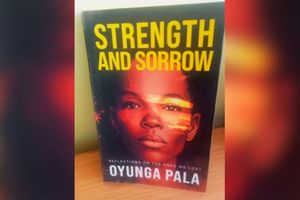
The cover of Oyunga Pala’s new book titled Strength and Sorrow.
Photo credit: Tony Mochama | Nation Media Group
Sadness, in a way, is what Oyunga Pala offers in Strength and Sorrow
Sadness and happiness are the ingredients of In Quest of Knowledge , which is a memoir written by Dineshkumar Shah, dedicated to his late wife Vibha, a stellar student, scholar, professional; a woman who easily maneuvered through the difficulties studying, working and taking care of a family at a time when many women in her community would have graciously just stayed at home. Vibha took and defined freedom in her own way, according to the story by her husband.
Cover of the book ‘I Cleansed the Tears’ by Dan Okwiri.
Photo credit: Pool
Freedom is the subject of Out of a Storm by Jason Njenga. This is that old Kenyan story of growing up under colonialism and its hardships, weathering the storms of life, seeing independence, working in the business sector and retiring in a country that still struggles to define its identity many years after the end of colonialism.
Identity is an important question in A Tapestry of Menopause by Wanjiru Kamau. Wanjiru writes about discovering how one’s body functions in a foreign land and coming back home to find out how her people, Agikuyu women, dealt with the life changing moment: menopause.
Identity is still the lead question in Capital Violence by Wavinya Makai who reminds the reader that Africans must continue to struggle to regain their dignity from the consequences of colonialism and its key tool of control: capitalism. Capitalism is the root cause of what Mordecai Ogada calls Green and Evil , the complex and exploitative story of environmental and wildlife conservation, which is really in the end land grab and neocolonialism.
There are books and books out there for one’s habits and liking. May you have a merry reading time during Christmas and the New Year holidays.
The writer teaches literature, performing arts and media at the University of Nairobi. [email protected]