Many Kenyans only know the Central Bank of Kenya from the signature of the governor on the currency notes. A few who live in urban centres where the Central Bank has offices may have seen the buildings that house the bank but probably have no idea what goes on there.
Some assume, wrongly, that the money in the country is printed or made in the premises where the Central Bank is located. The Central Bank is largely a mysterious institution. Its governor does not necessarily appear in news or at events to speak on the economy as often as one would have expected for a person whose word can trigger seismic waves in the economy and change the fate of a country.
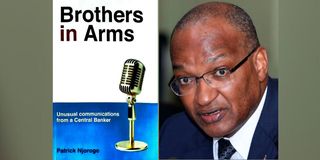
Thus, it is quite surprising to read the sketches, speeches, communication etc that are contained in Brothers in Arms: Unusual Communications from a Central Banker (Jahazi Press, 2025) by Patrick Njoroge.
Njoroge was the governor of CBK between 2015 and 2023. He served at a time when the global economy was experiencing massive changes, especially due to technological innovation, the war in Ukraine and the Covid-19 pandemic. Kenya is a tiny bit of the global economy. But it is a major player in Eastern Africa and has some political and economic influence on the continent. How did Njoroge go about his work?
What he offers in Brothers in Arms is a little opening in the window for the reader to espy what goes on in the world of banking, especially from a bank that makes fundamental decisions on the whole economy of a country. What does a cut or a rise in interest rates mean for private banks, borrowers, bank account holders, businesses, the government etc? What is the role of the Central Bank in determining or influencing interest rates, economic productivity, government income generated from taxes, creation of employment etc? When should the Central Bank intervene in the economy and when should it not; or how far should it intervene when it decides to do so? Can the Central Bank be involved in any other activity in the society beyond being concerned about the economy; or should we say, money?
Patrick Njoroge, the former governor of the Central Bank of Kenya, is the author of the book title Brothers in Arms: Unusual Communications from a Central Banker.
Photo credit: Pool
What Brothers in Arms reveals is the extent to which the Central Bank is involved in the everyday lives of bankers, people who deal with issues that have a direct policy effect on the economy, politicians, government officers and the ordinary citizens.
The presence of money — the coin or banknote — as legal tender, is enough evidence of how the CBK is present at the kiosk, M-Pesa dealer, marketplace, bar, in a matatu; wherever there is an exchange of money between Kenyans. The CBK guarantees that the promise or offer one Kenyan makes to another in the exchange of goods and services is backed up by the government’s ability to enforce or oil that exchange.
Philosophical book on banking
When a Kenyan crosses the border into Uganda or Tanzania and swaps Kenyan shillings for the foreign currency, the CBK is a silent observer for this transaction because it has a direct influence on the exchange rates.
The CBK, as the various chapters in Brothers in Arms demonstrate, is interested in how banks treat Kenyans who seek services at their branches, how disruptive technologies impact financial inclusion, gender imbalance in the banking sector, digital transformation in the banking sector, economic sustainability, the green economy etc.
Central Bank of Kenya Governor Patrick Njoroge displays new notes at his office in Nairobi on June 3, 2019.
Photo credit: File | Nation Media Group
Njoroge addresses these issues, among many others, in a language that avoids jargon, relates financial technicalities to lived realities, and seeks to include as many Kenyans as possible in discussions about the role of the banking sector in the economy and society in general. Whether it is in an article that wasn’t published in the press or one that was printed; in a speech at a graduation ceremony; in an address to fellow bankers or at an anniversary celebrations etc, Njoroge sought to have his message go beyond the interest group that he was specifically addressing.
The pieces in Brothers in Arms are a call to some kind of solidarity, one that is echoed in the poem ‘Brothers in Arms’, from which the title or the collection is derived. Ultimately the public is the most affected by decisions made by bankers, especially the Central Bank of Kenya.
Therefore, the public should know why, how, when, and what decisions the CBK makes; and the consequences of those decisions on their lives. Consider when the government/CBK decided to do away with the old Sh1000 notes in 2019. Why? Because the CBK thought that the old “notes were being used for illicit transactions and financial flows into the country and region.”
Njoroge notes that there were cases of counterfeit notes. Consequently, these issues “…posed a threat to the credibility of Kenyan currency.” In the end, new Sh1000 notes were issued at the end of September 2019. Yet, many Kenyans probably don’t know that more than Sh7 billion in the old notes were not exchanged, and so became worthless!
But Brothers in Arms is not just about money or banking. Njoroge includes in this anthology pieces memorializing his friends, fellow bankers; celebrating the relationships he had with workmates, family and friends.
Njoroge, the Emeritus Central Bank of Kenya Governor definitely has a collection of poems, a philosophical book on banking and money or volume on banking in Kenya in the past so many years coming out soon, going by what little he offers in this anthology.