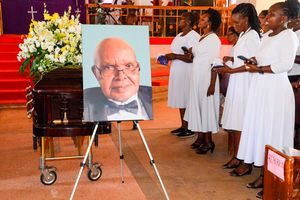
It is more than a year since Allan Bethwell Ogot passed on . Yet his name remains on the lips of many Africanist scholars. Ogot is discussed in words and phrases that elevate him into academic pre-eminence. He is described as the father or grandfather of Kenyan History; as the leading scholar on the Luo people of East Africa; as an eminent builder of academic institutions and intellectual practice in Kenya.
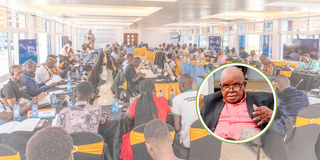
It is because of Ogot’s investment in scholarship that the Council for the Development of Social Science Research in Africa (CODESRIA) and the Department of History, Archeology and Political Studies at Kenyatta University, honoured Ogot with a conference - “The Indelible Footprints of Prof. Bethwell Allan Ogot on the Sands of Time: History, Method and Knowledge Production in Africa.”
The conference sought to “reflect on Prof Ogot’s remarkable intellectual contributions and work towards an appreciation of the relevance to contemporary debates on African history, knowledge production and the possibility of using his examples as a pathway to influencing school curriculum for the teaching of history.”
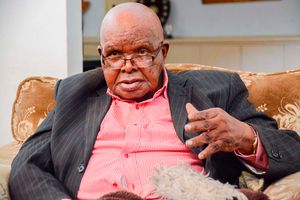
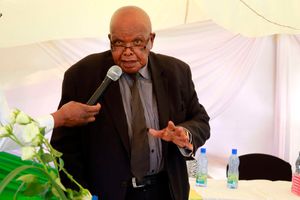
Prof Bethwell Allan Ogot speaks to the Nation at his home in Gem, Siaya County on December 24, 2024.
Photo credit: Alex Odhiambo | Nation Media Group
This conference was held in Kisumu, interestingly at the Tom Mboya Labour College, between September 21 and 23. Tom Mboya Labour College is significant in this case at least for two reasons. First, Mboya was a very close friend of Ogot. They shared the dream of ‘project Kenya’ - an inclusive and progressive country; and were some kind of intellectual buddies.
The institution is also just a few meters away from Ogot’s house in Milimani Estate. Why is this important, one may ask? Because, as Peter Anyang’ Nyong’o, the governor of Kisumu, posed when opening the conference, ‘Ogot ere’ (Where is Ogot)? One can only imagine that indeed Ogot was present in the hall where the conference was held, spiritually, for among his people, Ogot is a living ancestor.
As an ancestor, it behoves Ogot’s academic children, grandchildren and relatives to remember and honour him. It was, therefore, quite revealing that the presentations in honour of Ogot were as widespread as from historians, sociologists, journalists, political scientists; from Senegal, Tanzania, Uganda, the USA, Niger etc.
Each speaker had something to say about Ogot the scholar, researcher, teacher, mentor, supervisor, leader etc. Ogot was praised for having been a committed institution builder, archivist, and pioneer in many ways. Each of the speakers ‘remembered’ Bethwell Allan Ogot in their own way, from those who knew him closely, having studied or worked with him, such as David Cohen, Tiyambe Zeleza and Eric Aseka, to those he taught and mentored to those who studied and continue to study his works.
David Allan Cohen, more known as a collaborator with the late Atieno-Odhiambo, remembered Ogot’s ‘predicament’ as a post-graduate student. Ogot and Cohen both employed research methods that were not then fashionable with the leading scholars at the time they were doing research for their doctorates.
For instance, Ogot wrote his thesis entirely from oral sources and traditions of his people, the Luo, an undertaking that had not been attempted before. By going against the established tradition of ‘sourcing’ from the written archive, Ogot was creating something new. He was innovating. This approach would lead to a dispute about whether a doctoral thesis could be written without reference to any published sources. Ogot weathered that storm and set the pace for those who followed his methods for having pioneered a methodological approach.
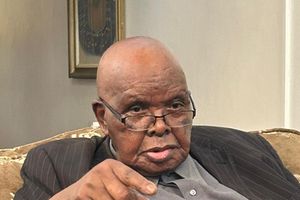
Professor Bethwel Ogot at his home in Gem Yala, Siaya County on March 17, 2016.
Photo credit: File | Nation Media Group
But Ogot was also celebrated for being a prolific writer who also promoted the publishing of local research within Kenya and the region. Ogot wrote extensively about the history of the Luo people in Kenya and East Africa, for which he has been accused of being too concerned with local rather than national issues.
But what is the national made of if not several local/regional/ethnic issues? Why wouldn’t Ogot have studied the Luo, the people among whom he was born and raised before going to the European-established schools? Who was best placed to study the Luo? And, why shouldn’t Ogot have studied the Luo for the rest of his life?
These are not merely rhetorical questions. These are issues that were raised at the conference and which need to continue being raised about scholarship in Kenya, East Africa and Africa. Why? Because, as Toyin Falola noted at the conference, Africans must ‘frame’ the terms of research and debates about their societies. Africans must originate the discourse on their condition(s). If Africans can define their problems, it will be easier to begin imagining and identifying the solutions. It is for this reason that Africans must focus on their history, a theme that animated the conference for three days.
A number of speakers at the conference noted that History was progressively being pushed to the margins of the school curriculum and public debates. History is hardly taught in schools and colleges in many countries in Africa. Politicians and government officials use terms such as ‘not useful’ or ‘mere stories of the past’ when referring to History.
Underfunding of universities in many countries in Africa means that there is little or no serious and sustained research on history. Consequently, very few African scholars are writing history. As Toyin Falola noted in his Keynote Address, “After Ogot: Who is Writing African History, and for Whom,” African historians have to rethink their methods of doing History, deliver the product of their research in more creative ways and provoke different kinds of audiences to engage with History. Why? Because History definitely shapes the present and the future.
For instance, colonial occupation of Africa happened more than 60 years ago for most countries. Yet, Africans are still grappling with the socio-economic, political, cultural, and religious impositions of colonial occupiers. Africans today still have to research and understand the workings of the structures and infrastructures that the colonial state bequeathed the ‘independent’ in order to figure out how to undo them, if they seek ‘true independence’ rather than the flag independence of today.
Yet, History, which offers us the archive, with documentation and knowledge about that colonial past is de-emphasized in the school curriculum. Indeed, several speakers at the conference decried the near death of History in African scholarship. In the case of Kenya, the inactive state of the Historical Association of Kenya, which was associated with Ogot for a long time, was a point of serious concern.