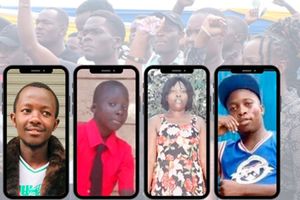
Davis Lichuma marched alongside others on June 25, holding a copy of the Kenyan Constitution as he has always done.
The pocket-size book contained the rights he is guaranteed as a Kenyan citizen. But as the day came to an end, some of those rights had been violated.
Davis has become one of the statistics contributing to a reported shrinking of Kenya’s civic space, with a risk of sliding into a group of countries classified as repressed States by the civil society alliance CIVICUS Monitor.
The latest People Power Under Attack report by CIVICUS Monitor indicates that Kenya’s civic space score has fallen 19 points over two years from 50 in 2023 to 37 in 2024, and further to 31 in 2025.
That decline has seen Kenya drop from the group of countries listed as having an obstructed space to those with a repressed space.
The five-point scale, which rates countries between 0 and 100, classifies civic space as closed (1–20), repressed (21–40), obstructed (41–60), narrowed (61–80) or open (81–100), with higher scores indicating a more open environment.
Kenya's downgrade to ‘repressed’ puts it in a tier with more than 80 of the world's most closed civic environments.
Another rights tracking organisation, Human Rights Measurement Initiative (HRMI), recently released data showing that Kenya has a Safety from the State score of 2.6 out of 10, which means that more people in the country are not safe from one or more of the following: arbitrary arrest, torture and ill-treatment, forced disappearance or extrajudicial killing.
The tracker, which checks how well the government is respecting its citizens' rights, showed that torture and ill-treatment ranked the worst at 1.7 out of 10, followed by extrajudicial killing at 2.1, arbitrary arrest at 2.6 and forced disappearance at 3.0 out of 10.
For Davis and a dozen others forcibly apprehended on June 25, the narrative after they were released was the same.
Activist Davis Lichuma still traumatised, cannot speak yet
While speaking to journalists after their release, protesters said they were arrested and bundled in unmarked cars, driven to unknown locations and tortured. Many of them suffered physical injuries from the beatings they received, while for some like Davis, the emotional torture took a toll on him and after his release on June 28, he was unable to speak, and only tears rolling down his face could explain the pain he had endured.
His elder brother, Benson Shikala, told journalists about how his brother has spent years defending constitutional rights and participating in peaceful demonstrations.
Benson Shikala, brother of activist Davis Lichuma: We looked everywhere for him
According to the Kenya National Commission on Human Rights (KNCHR), six protesters: Boniface Mulinge Muteti, Elisha Ochieng Alam, Collins Otieno, Fredrick Ojiro, Christine Alubengo and Michael Ngige, were arrested outside Parliament while they joined families of those who had come to mark the second anniversary of the death of their kin who lost their lives during the June 2024 protests.
They were not presented to any police station, and no charges were brought against them.
They were released on June 27, and according to KNCHR, they were heavily traumatised and recounted how they had been severely tortured and held under inhumane and degrading conditions in an unknown location.
The Commission also documented that three other persons, Macmillan Kiarie, Michael Oloo and Abdilaziz Duba, had been allegedly picked by security agencies and are still missing.
From left: Michael Oloo, Abdulaziz Duba, Davies Lichuma and Macmillan Kiarie.
Photo credit: Nation Media Group
Since the June 2024 protests that called for the rejection of the Finance Bill, there have been many more protests, and in almost all of them, protesters have had their rights violated.
According to HRMI data, the right to assembly and association ranks at 3.9 out of 10, while the right to opinion and expression stands at 4.1 out of 10, which are both considered “bad” according to the measurement scale used.
HRMI rates countries on a scale of 0 to 10, classifying performance as very bad (0–3.5), bad (3.5–6), fair (6–8) or good (8–10), with higher scores indicating greater government respect for citizens' rights.
Some of the rights that have been violated by security agencies, according to KNCHR, are the right not to be subjected to torture in any manner, whether physical or psychological, the right to freedom from arbitrary arrest and detention, the right to freedom of association and freedom of expression.
The right to movement has also been violated, as many people are unable to move from one place to another at any time there are protests due to police barricades or fear of being arrested.
This, according to KNCHR, has left many without access to essential services and economic opportunities, as many people could not access their places of work.
With KNCHR data showing that more than one hundred people lost their lives in protest-related incidents in 2024 and 2025, with many of them having been shot by security officers, there is growing concern over the conduct of those tasked with protecting citizens.
Apart from the deaths, hundreds more have been left injured, with some of them left with life-changing injuries.
Enforced disappearances still continue to happen, with data from the Commission showing that there were 82 cases in 2024 and 15 in 2025. Some have since been released, while the whereabouts of some remain unknown.
The CIVICUS Monitor report highlights that abductions did not only happen to those who participated in street protests, but also to those who posted online.
“Police arrested blogger and teacher Albert Ojwang in June 2025 for a social media post allegedly spreading false information about a senior police official. He died in police custody the following day under suspicious circumstances, with an autopsy later revealing injuries consistent with blunt force trauma, sparking widespread protests,” the report reads.
A photo of teacher and blogger Albert Ojwang, who died while in police custody.
Photo credit: Pool
The report also noted that Kenya is not only failing its own citizens but also becoming an instrument in regional crackdowns.
“A coordinated operation between Kenyan and Ugandan authorities led to the abduction of prominent Ugandan opposition leader Kizza Besigye from Nairobi. He was illegally rendered to Uganda to face charges in a military court, a move that circumvents civilian legal protections and demonstrates the misuse of state security apparatus to neutralise political opponents”
Civic space conditions in Sub-Saharan Africa remain highly restrictive, with 44 out of 50 countries and territories rated as obstructed, repressed or closed, and over 80 per cent of people living in countries where civic space is repressed or closed.
The shrinking of civic space has not been limited to the streets. Parliament has, in the same period, moved to construct what critics describe as a legal architecture for controlling dissent.
The Judiciary has repeatedly pushed back. In what has emerged as a defining tension in Kenya's governance, the courts have, in the same period, consistently ruled against the state on civic space matters.
It also ordered that police officers should wear uniforms and have their service numbers displayed at all times during protests as accountability concerns grew over police misconduct during demonstrations.
Activist Davis Lichuma surrounded by friends at Nairobi Women's Hospital, where he is nursing injuries following his abduction on June 25 during the second commemoration of the anti-Finance Bill 2024 protests.
Photo credit: Evans Habil | Nation Media Group
For Davis Lichuma, the pocket-sized Constitution he carried into the streets on June 25 remains his, but the rights printed inside it feel increasingly uncertain.
When independent measurement systems such as CIVICUS Monitor and HRMI converge on the same conclusion, when courts rule in favour of citizens only to be defied by the same government those courts are checking, and when the death toll from protest-related incidents crosses one hundred in two years, the question is no longer whether Kenya's civic space is shrinking.
The question is what, if anything, will arrest the decline?