Sugar, ethanol, alcohol and cigarettes accounted for the lion’s share of contraband and counterfeit goods seized by security agencies in the year to August 2025.
A new report shows that the widely traded contraband goods included sugar, electronics, cigarettes, alcoholic beverages, pharmaceuticals and cosmetics.
The Annual Report on the State of National Security, covering the period from September 1, 2024 to August 2025, indicates that there was also widespread use of pirated Information and Communication Technology (ICT) hardware and software.
The report, tabled in Parliament by President William Ruto, shows that security agencies intercepted 52,075kg of sugar, 58,193 litres of ethanol, 24,570 litres of alcohol, 9,707 packets of cigarettes, and 24,570 cartons of alcoholic drinks, among other items.
Other items seized by police included 338 litres of cooking oil, down from 879 litres intercepted during the same period the previous year.
Contraband fertiliser bags intercepted rose to 685 compared with 521 seized in the previous period, while contraband milk increased from 2,390 litres to 3,437 litres.
Notably, no contraband or counterfeit rice was seized during the period under review, compared with 19,900 units intercepted in the year to August 2024.
Seizures of contraband spaghetti dropped sharply from 2,345 last year to just nine, a reduction of 2,336 or 99 per cent.
Overall, the total volume of contraband and counterfeit goods seized during the review period fell significantly to 149,565 from 321,786 in a similar period the previous year, representing a decline of 172,221 or 53.5 per cent.
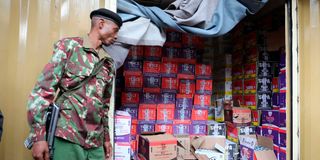
A police officer stand guard outside a liquor store in Kitengela, Kajiado County where Sh5.28million worth of counterfeit liquor was seized on October 28 2025.
Photo credit: Stanley Ngotho | Nation Media Group
“The trade in contraband and counterfeit goods remained high in the country during the period under review, with negative implications for revenue collection, the government’s industrialisation agenda, domestic enterprise, and public health and safety,” President Ruto said in the report.
To address the proliferation of contraband and counterfeit goods, the report says the government has implemented a series of coordinated interventions to disrupt illicit trade and safeguard national interests.
These measures include sustained crackdowns on contraband goods to disrupt distribution networks, arrest perpetrators and enforce compliance with trade regulations.
“Key measures include strengthening multi-agency border surveillance efforts and enhancing coordination between security, customs and regulatory authorities,” President Ruto said.
Other interventions include public sensitisation campaigns to raise awareness of the dangers of contraband goods and encourage reporting of illicit trade, as well as the deployment of advanced scanning and tracking technologies at strategic entry and exit points to detect and intercept illegal consignments.
Despite these efforts, the report notes that several challenges continue to hinder the effective prevention and disruption of contraband trade.
These include limited availability of modern detection equipment at some border posts, reducing the effectiveness of screening and interception, as well as corruption and collusion between smugglers and unscrupulous public officials.
The report also identifies high demand for cheaper goods as a driver of black-market activity, discouraging formal trade.
The government further cited inadequate storage and handling facilities for seized goods, which complicate evidence management and legal processes.
Another challenge highlighted is the increased use of digital platforms and online marketplaces to distribute contraband goods, particularly cosmetics and pharmaceuticals, beyond the reach of traditional enforcement tools.
“To strengthen the fight against contraband trade and secure economic and public health interests, the government is committed to acquiring and upgrading inspection technologies, including mobile scanners, surveillance cameras and digital tracking systems,” President Ruto said.
The government will also increase staffing levels and patrol coverage in high-risk smuggling corridors to enhance deterrence.
In addition, the State is strengthening anti-corruption mechanisms within border enforcement and regulatory agencies, fast-tracking prosecution and disposal of contraband-related cases, and promoting inter-agency intelligence coordination and data sharing to dismantle illicit networks.
“The government is enhancing public-private partnerships, particularly with the retail, transport and ICT sectors, to improve reporting and disrupt illicit supply chains,” the report states.
It further indicates that the government plans to introduce integrated product marking and identification for all goods.